

1879
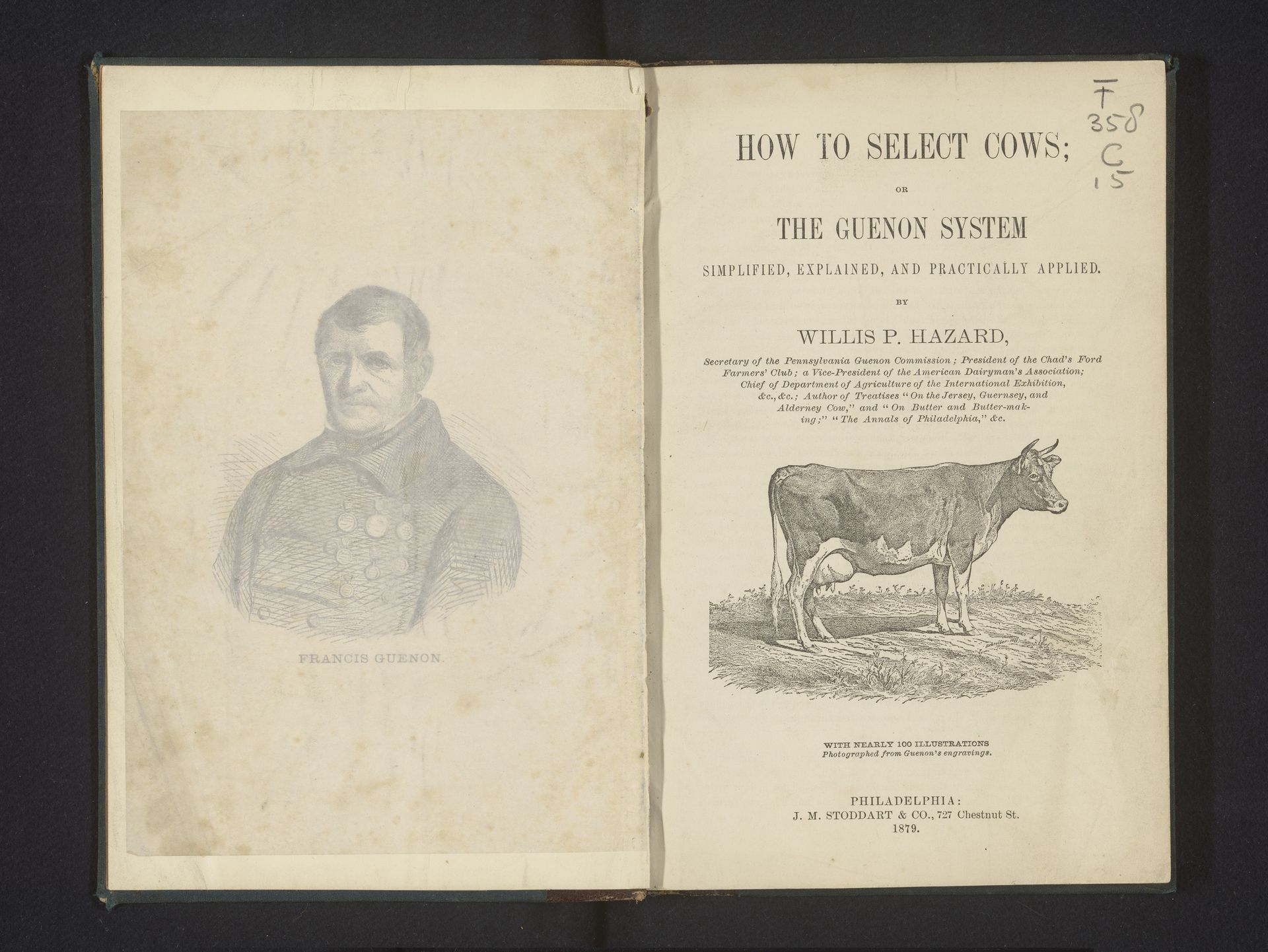
How to select cows; or the Guenon system simplified, explained, and practically applied / by Willis P. Hazard

Listen to curator's interpretation
Curatorial notes
Curator: Let's turn our attention to this rather peculiar piece: "How to Select Cows; or the Guenon System Simplified, Explained, and Practically Applied" from 1879. An engraving, apparently the frontispiece to a practical guide. Editor: My first impression is a strange formality; almost reverential. On one page, the stern, engraved portrait; on the other, a rather dignified-looking cow. A sacred animal, maybe? Or some other deep connection between the man and beast. Curator: In 1879, a book like this, detailing the specifics of animal husbandry, would have been a valuable commodity. Consider the materiality, the labor that went into the illustrations, the printing itself, the distribution network necessary to reach farmers. This object represents a nexus of agricultural practice and commercial enterprise. It speaks of land and value, not to some ethereal god, but for wealth to be created. Editor: But isn’t there also something deeply symbolic about it? A link between knowledge, power, and nature. Francis Guenon’s face staring opposite a grazing cow seems to promise the reader not only knowledge of agricultural techniques, but power through it! What exactly is it about how their skin appears to tell you all you need to know about production output of quality and quantity, the essence of wealth itself in milk. Curator: I'm not so certain the symbology is as strong as its material functions; these illustrations of Guenon and the cow, along with the printed text, function practically as educational tools in industrialized agricultural processes. These portraits could, if interpreted too abstractly, begin to overshadow what were practical aims to achieve very basic output. Editor: Even a diagram can accrue layers of cultural weight, though. The cow, standing regally with those perfect spots and shapes, became an archetype that echoes across time. The question then arises, what were those beliefs and ideals, and has something about these notions been subtly embedded with significance in later reproductions, such as that in fast food ads? What feelings do you, even, get when viewing it? It looks quite different to say, a pig on its way to slaughter. Curator: What is more revealing, though, is this 'Guenon System,' whatever that really means, or the publisher. They both sought markets hungry for data in a time period as urbanization pushed agriculture further into the hands of larger entities focused mainly on revenue-centered objectives Editor: I'll keep dreaming about pastoral ideals, while you're talking about economic pressures that underpin agriculture! All these subtle iconographies whisper of a past intertwined with our current understanding. Curator: Indeed. I appreciate this old book reveals to us complex relationships interwoven during a quickly expanding industrial America focused on what the machine produces over other concerns. Editor: And I suppose that I, with my own cultural biases in place, bring those biases into the discussion of this 1879 book, creating just another interpretation with its own cultural context.