1881
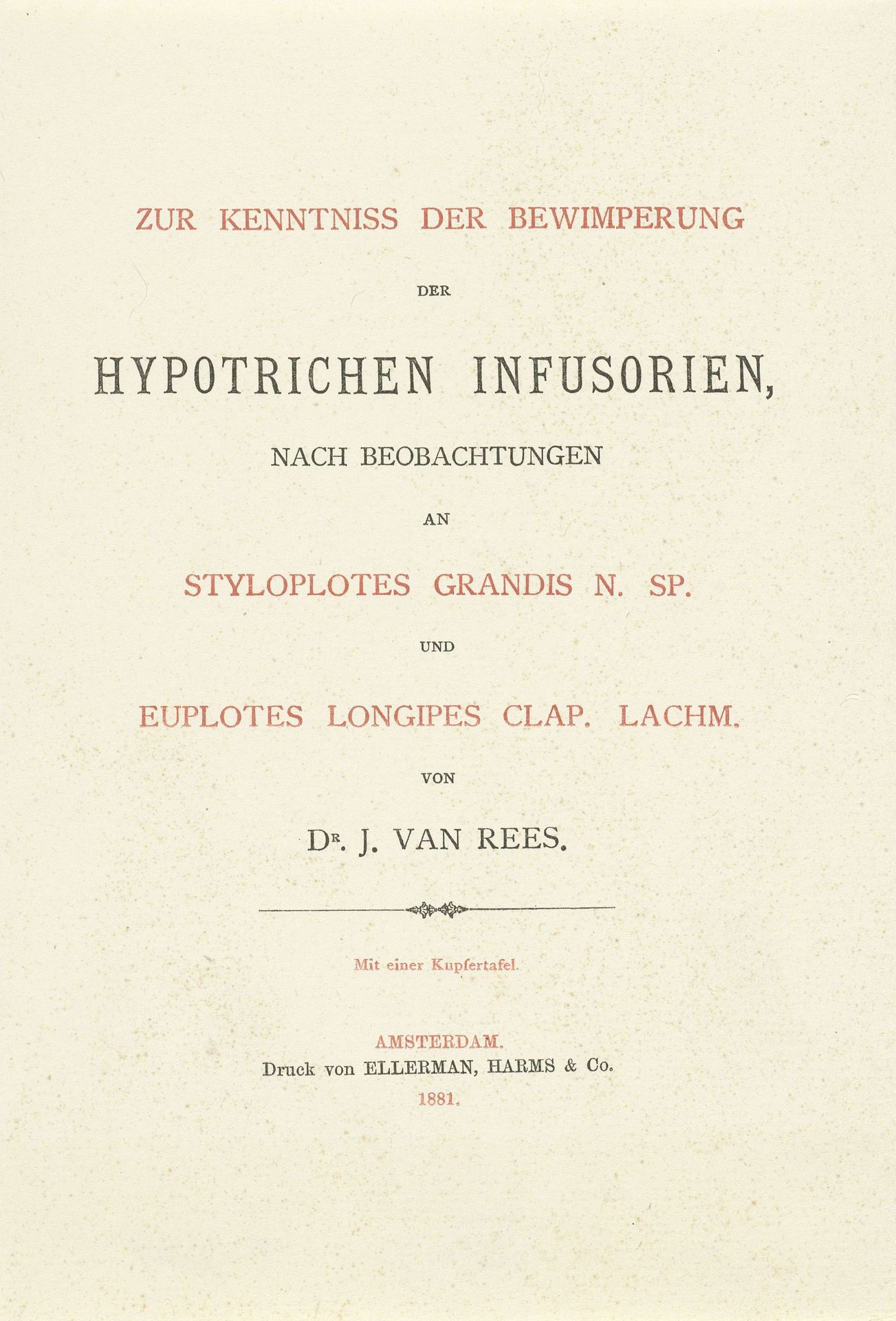
Titelpagina van het boek 'Zur Kenntniss der Bewimperung der Hypotrichen Infusorien'

Listen to curator's interpretation
Curatorial notes
Curator: This is the title page from Jacob van Rees's "Zur Kenntniss der Bewimperung der Hypotrichen Infusorien," published in 1881. Editor: It’s deceptively simple. Just typography, really, yet the weight of those scientific titles somehow feels monumental. It’s like a gateway to another, tiny world. Curator: Absolutely. Consider the typography; it reflects a period obsessed with taxonomy and categorizing the natural world. Each typeface carefully chosen adds to that weightiness you mentioned, projecting the authority of scientific knowledge. The red script on top, then black. Quite calculated. Editor: I'm struck by the deliberate arrangement; how it emphasizes the structure inherent in these scientific investigations. But the substrate, that warm, fibrous paper; I wonder about its sourcing, its materiality...it subtly softens what could be sterile. And the copperplate mentioned at the bottom hints at reproductive technology... Curator: Yes, there's a strong tradition linking the act of seeing and the creation of an archive through text and image; this stems back centuries in science! Note the formal naming conventions—Latin descriptions of the micro-organisms create almost a sacred, textual space...linking these new ideas to traditions that reinforce their importance. The page layout and typeface becomes part of the cultural ritual of creating knowledge. Editor: This kind of document always makes me ponder the lives of those making it. Think of the work setting the type, mixing the inks, running the press... how much collaboration was truly involved in making this declaration of new science? That paper had to be handmade, processed... Curator: The text hints at the layers involved in this scientific knowledge gathering as well – “based on observation” and “with an illustration." What sort of cultural assumptions were embedded in the 'observations' used as a basis? These microscopic creatures probably felt rather alien, viewed with specific scientific ideas… Editor: And those Amsterdam printers—Ellerman, Harms & Co., part of this story. Printing then wasn’t this detached, digital process—labor was directly involved! To contemplate these hands touching and forming the words gives it even deeper impact… Curator: Seeing through that material and symbolic lens enriches our understanding of the science; it reveals the human dimension within supposed objectivity. Editor: Precisely! Next time, I'm definitely buying a microscope.