drawing, pencil
#
portrait
#
drawing
#
imaginative character sketch
#
light pencil work
#
quirky sketch
#
landscape
#
personal sketchbook
#
idea generation sketch
#
sketchwork
#
ink drawing experimentation
#
pencil
#
sketchbook drawing
#
sketchbook art
#
initial sketch
Dimensions: height 134 mm, width 208 mm
Copyright: Rijks Museum: Open Domain
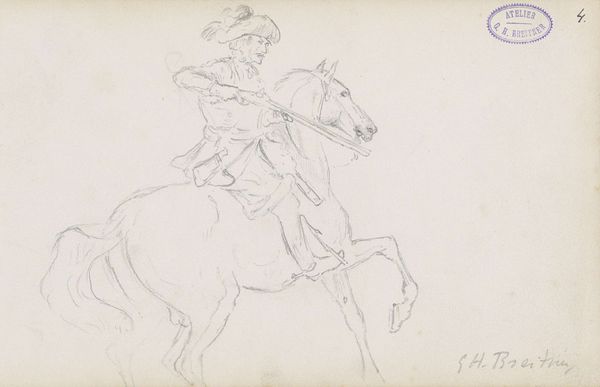
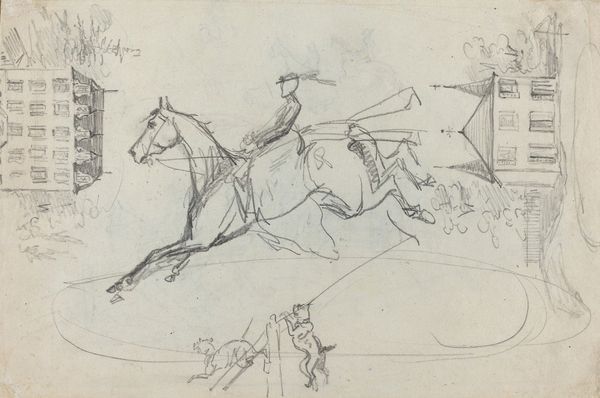
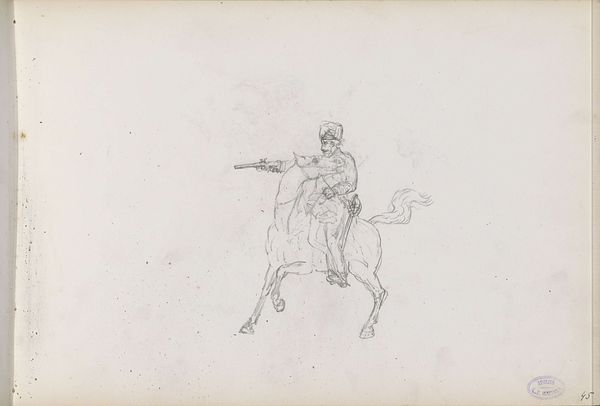
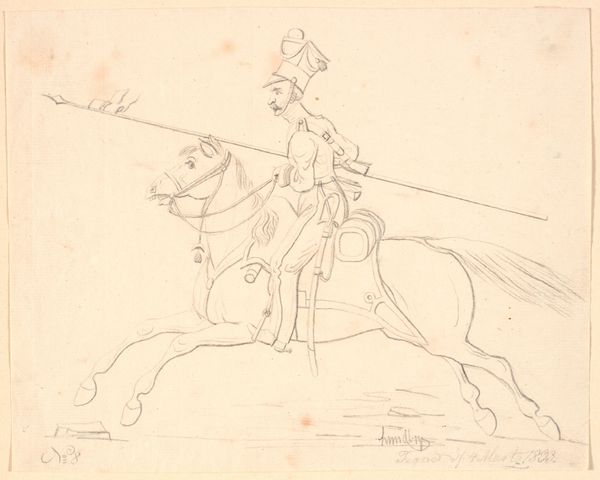
Curator: George Hendrik Breitner created this pencil drawing, “Ruiter met musket,” or "Horseman with Musket" around 1871 to 1876. It resides here at the Rijksmuseum. Editor: Immediately, I see a story unfolding—or maybe just a fragment of one, like a half-remembered dream. There's a softness, a vulnerability, in the lightness of the pencil strokes. The whole thing feels ephemeral. Curator: I find it interesting to consider the historical context when looking at Breitner’s sketches, and what they tell us about military representation at this time. You have to imagine this within a societal framework steeped in military tradition and colonial power. Editor: Well, the loose style avoids glorification. The horse and rider appear caught mid-motion, and I sense this raw energy but also a bit of playful defiance, almost as if the artist is gently mocking the conventional equestrian portrait. Like, “Here's my horse, here’s my gun – but it's just a sketch." Curator: That playfulness might stem from the drawing's purpose—likely not intended as a finished work but perhaps part of Breitner’s sketchbook explorations. Artists used sketchbooks to record fleeting impressions or to experiment with ideas for larger paintings, offering insight into their creative process. It reveals the foundation on which he builds his finished pieces. Editor: Right, it's the anti-monument, the fleeting idea given form. Look how the horse's legs dissolve into almost nothing! The energy of the stance is all suggestion, the rider has this "poof" of a turban, the rifle juts out so comically long and the piece, as a whole, feels so delicate that the least thing would blow it all away. It becomes less about martial prowess, and more about transience. Curator: The medium certainly contributes. Pencil lends itself to immediacy and revision, thus, it might also represent the artist’s commentary on the rigid structures of military iconography at the time. Editor: In the end, Breitner's brief sketch offers a meditation on authority itself – permanent and imposing, yet utterly, beautifully fragile. Curator: A poignant interpretation. For me, this sketch serves as a crucial reminder that artistic choices, even seemingly casual ones, reflect complex dialogues between the artist and society.
Comments
No comments
Be the first to comment and join the conversation on the ultimate creative platform.
 Collect
 React
React Comment
More like this