Copyright: Octav Angheluta,Fair Use
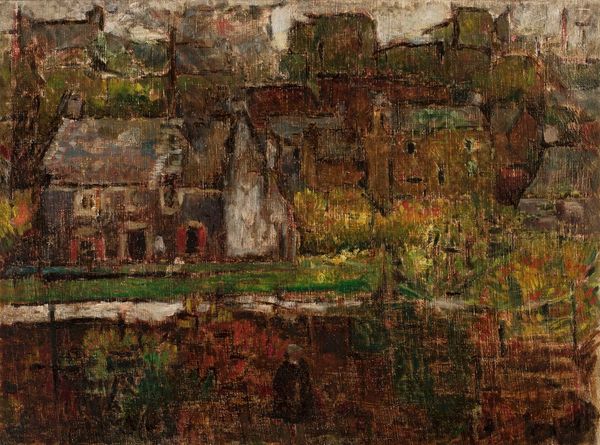
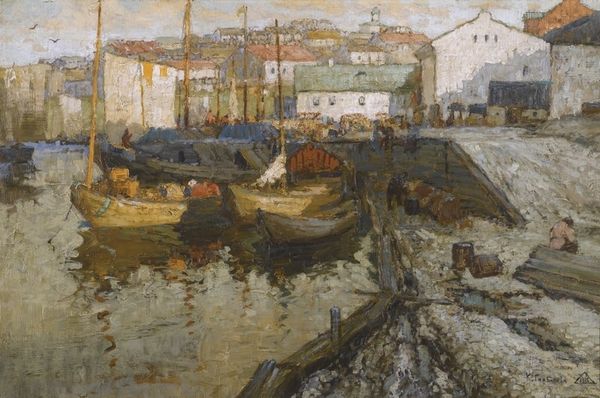
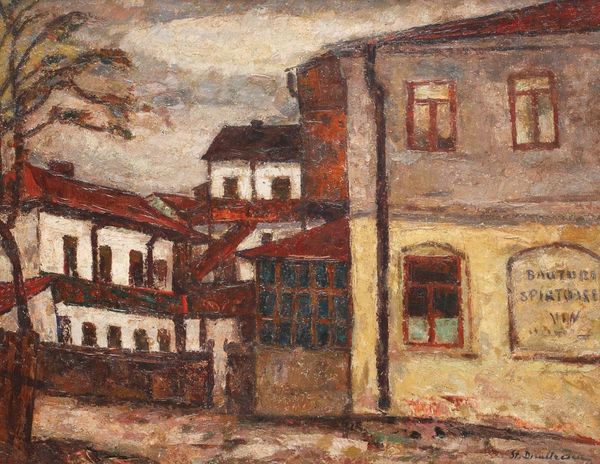
Editor: So, this is "Tomis Market," a 1975 oil painting by Octav Angheluta. It's a somewhat muted cityscape, dominated by these aged, textured buildings behind what seems to be a weathered fence. What do you see in it? Curator: Well, my first impulse is pure sensation – I want to *feel* those thick layers of oil paint, you know? It's so tactile! But beyond that, it evokes this very particular sense of place and time. Think about it: it's 1975. The ghost of Impressionism still lingers, but modernism has certainly crashed the party, right? Editor: Definitely! The scene itself seems almost… hidden. Like we’re peeking into a secret corner of the city. Curator: Exactly! And hidden maybe from a *dream*. Those colours are so interesting–a symphony of subtle grays and earthy reds and umbers, not quite joyful, not quite mournful... almost *reminiscent*. He doesn't idealize, and yet it's not gritty realism, either. I wonder if this was the Romania Angheluta *remembered*, or the one he longed to re-paint? Editor: Hmm, that makes me think about how the fence acts as a barrier. Maybe not just physical, but temporal? Separating the viewer from that past? Curator: A temporal veil, I like that. Fences aren't just about keeping people *out*; they can keep memories *in*. Does the composition reinforce this sense of confinement or privacy, do you think? Editor: I think it does. There’s no clear vanishing point, our eye just kind of stops at those buildings. The buildings loom–looming is maybe a strong word!–but it really centers the past as the present, like Angheluta froze that moment in time. Curator: Precisely! And freezing, by its very nature, distorts, preserves. Maybe the distortions *are* the key here? Beautiful. Well, I’ll never look at a cityscape the same way again! Thanks. Editor: Me neither! Thanks for all your insights! It was really interesting thinking about this painting through the lens of time and memory.
Comments
No comments
Be the first to comment and join the conversation on the ultimate creative platform.
 Collect
 React
React Comment
More like this