About this artwork
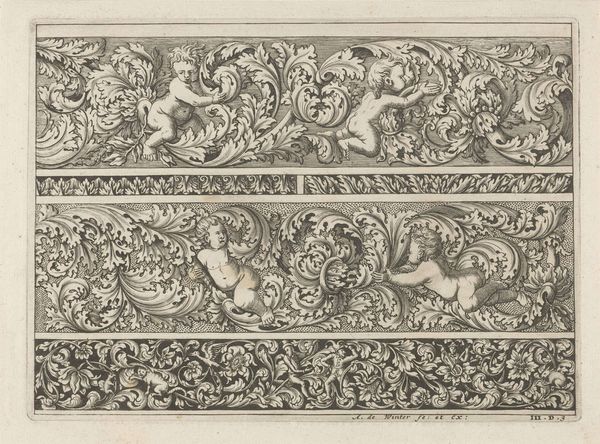
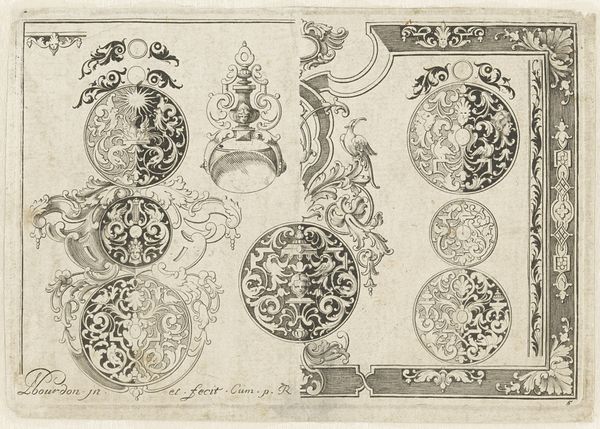
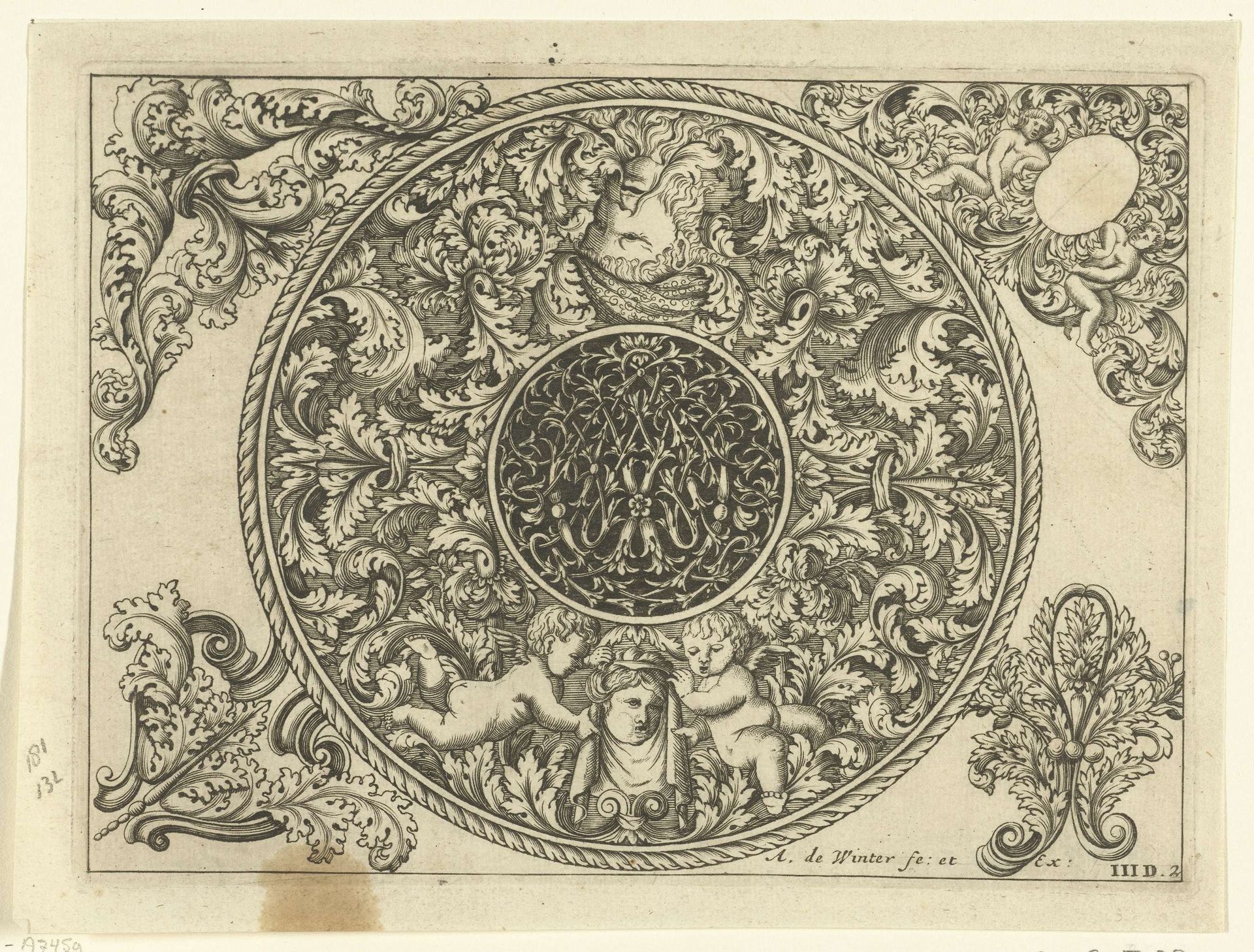
Anthonie de Winter created this print, "Edge of a Round Plate with Leaf Tendrils, Masks, and Putti," likely in the late 17th century. The design commands attention with its dense composition and rich detail. A circular arrangement of foliage, masks, and putti swirls around a central medallion. Note how de Winter uses the contrast between light and shadow to create a sense of depth and movement, the forms interweaving to destabilize the boundary between the organic and the decorative. The print engages with ideas of metamorphosis and the interplay between nature and culture. The twisting leaf tendrils evoke the Baroque fascination with natural forms, yet they are meticulously arranged, contained by the circle's edge. This tension speaks to the period’s broader philosophical debates around order and chaos, reason and imagination. The semiotic system of signs, such as masks and putti, signify the cultural codes of the time. The circular form isn't merely aesthetic; it also functions as a symbol of wholeness, alluding to the cyclical nature of life and art's ongoing dialogue with history.
Rand van rond bord met bladranken, maskers en putti
1696

Anthonie de Winter
1653 - 1707Location
RijksmuseumArtwork details
- Medium
- drawing, print, engraving
- Dimensions
- height 137 mm, width 186 mm
- Location
- Rijksmuseum
- Copyright
- Rijks Museum: Open Domain
Tags
Comments
Share your thoughts
About this artwork
Anthonie de Winter created this print, "Edge of a Round Plate with Leaf Tendrils, Masks, and Putti," likely in the late 17th century. The design commands attention with its dense composition and rich detail. A circular arrangement of foliage, masks, and putti swirls around a central medallion. Note how de Winter uses the contrast between light and shadow to create a sense of depth and movement, the forms interweaving to destabilize the boundary between the organic and the decorative. The print engages with ideas of metamorphosis and the interplay between nature and culture. The twisting leaf tendrils evoke the Baroque fascination with natural forms, yet they are meticulously arranged, contained by the circle's edge. This tension speaks to the period’s broader philosophical debates around order and chaos, reason and imagination. The semiotic system of signs, such as masks and putti, signify the cultural codes of the time. The circular form isn't merely aesthetic; it also functions as a symbol of wholeness, alluding to the cyclical nature of life and art's ongoing dialogue with history.
Comments
Share your thoughts