

1805
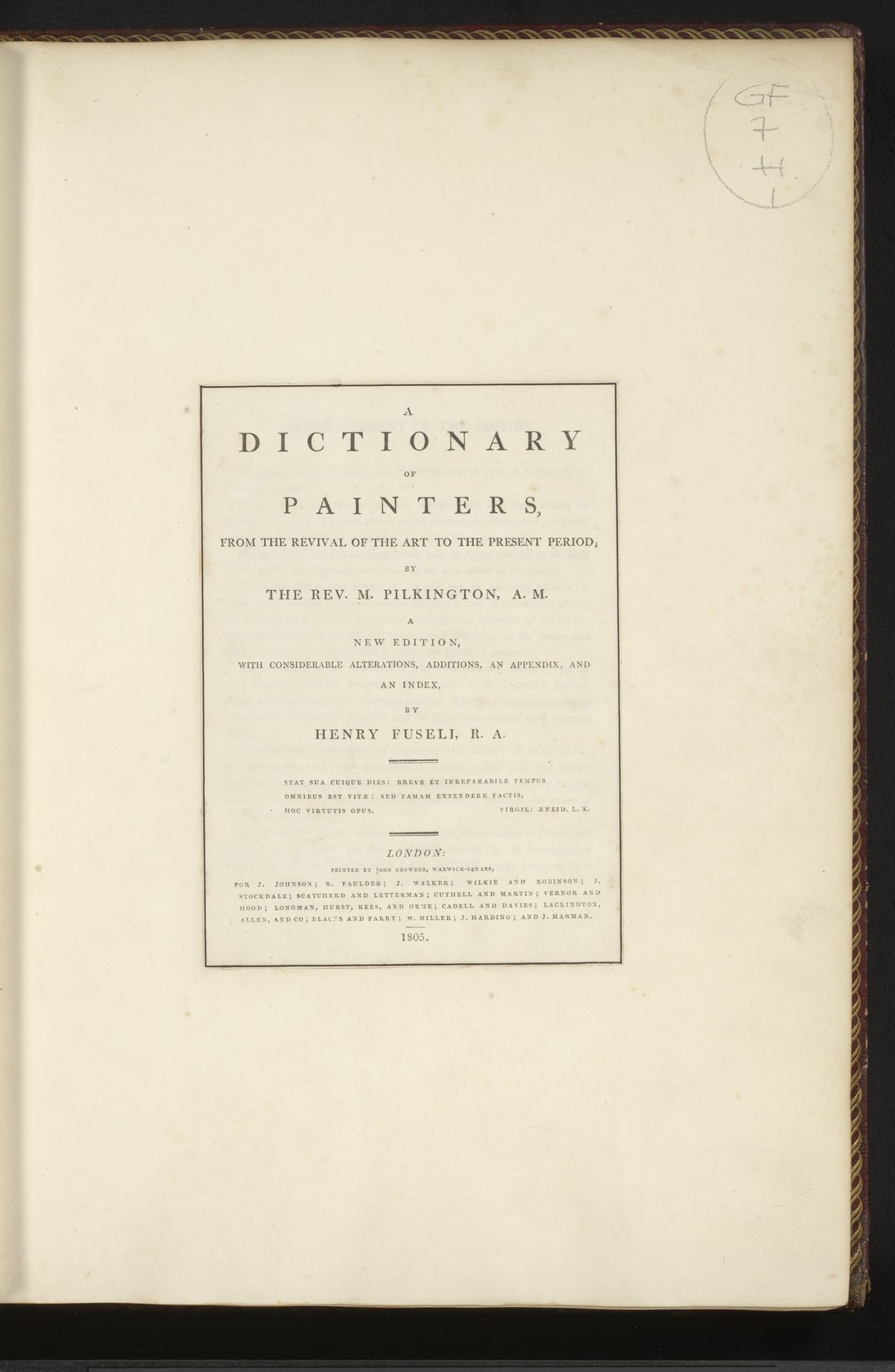
Titelpagina voor: Matthew Pilkington, A Dictionary of Painters, from the revival of the art to the present period, 1805

Listen to curator's interpretation
Curatorial notes
Editor: This is the title page of "A Dictionary of Painters" from 1805, engraved after Henry Fuseli, originally written by the Rev. M. Pilkington. It seems simple and straightforward, but something about the formality makes me curious. How do you interpret this work, thinking about its historical context? Curator: What stands out to me is precisely that formality, that attempt to categorize and contain knowledge of painters within a 'dictionary.' Think about who had access to these books, who defined "art," and whose narratives were included or excluded during this period. Neoclassicism, as a movement, sought order, but order defined by very specific power structures. Who gets remembered and who is forgotten? Editor: So, the book itself is participating in a system of value? Curator: Exactly. This "dictionary" isn’t a neutral archive. It is a carefully constructed narrative reflecting societal values and biases. What criteria were used to define which painters were important enough to include? What perspectives might have been marginalized in favor of a dominant, often male, perspective? Editor: That’s a really interesting point. It makes me consider the choices behind even compiling a list like this and the implications for later art history. Curator: Consider also the impact of printing and distributing knowledge. Who could afford to be recorded and remembered for history? I'm curious how this shaped artistic production at the time. What kind of networks existed? Editor: Thinking about access, even now, it’s a privilege to engage with historical artworks, and our understanding is shaped by the frameworks we inherit. Curator: Precisely. This title page, seemingly just a list, invites us to question how those frameworks are built. Editor: I hadn't considered it that way, that even this introduction page embodies a certain worldview. Thanks, that was very enlightening!