About this artwork
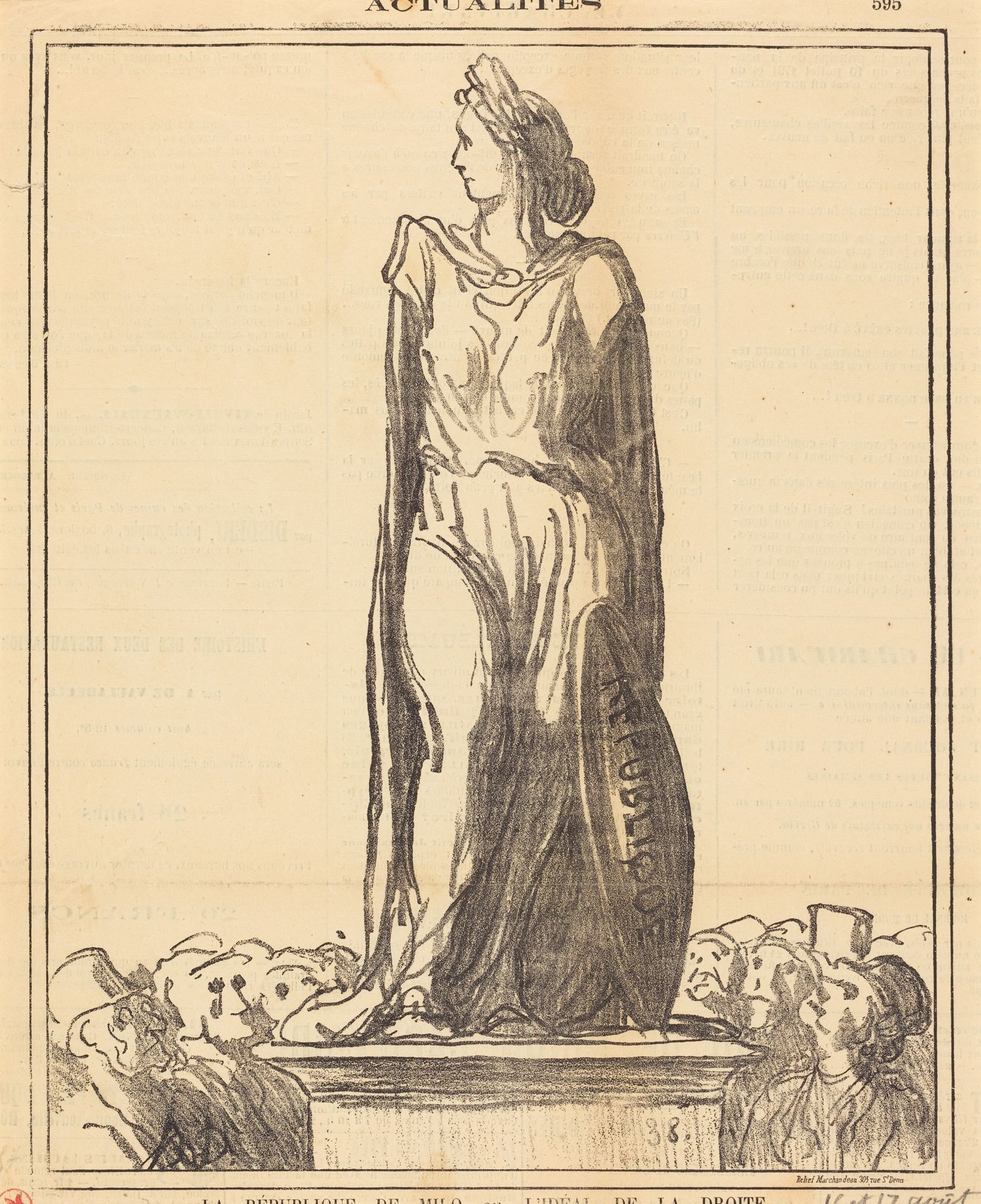
Editor: This lithograph by Honoré Daumier, titled "La République de Milo...", created in 1871, depicts a figure reminiscent of the Venus de Milo. But it feels…satirical. It’s rough, almost unfinished, and the crowd at the base seems unimpressed. How do you interpret this work? Curator: It's definitely a commentary on the socio-political climate of France at the time. The title itself, "The Republic of Milo...", alludes to the famous armless statue. Consider that this was created shortly after the Franco-Prussian War and the establishment of the Third Republic. Daumier uses the visual of a damaged classical sculpture to symbolize a flawed or incomplete republic. Editor: So, the "armlessness" of the statue is not just a visual pun, but a direct comment on the Republic's weaknesses? Curator: Precisely! The figures gazing upwards with skeptical expressions emphasize public distrust or disillusionment with the new regime. What's powerful here is how Daumier uses a readily recognizable symbol of beauty and ideal form and corrupts that for political critique. Editor: I notice the word "Republique" is written on a shield. Is this like a shield of shame or something? Curator: It’s fascinating you say that because it can also been seen as defense - yet damaged and defaced. Remember this lithograph would have appeared in a popular journal; its intent was to shape public discourse around national identity. The image really gets one thinking about who constructs meaning around powerful works. Editor: That's a darker read than I initially thought! I learned how much the historical context shapes a satirical image. Curator: And I think your initial reaction of 'unfinished' speaks volumes about the mood of the public at the time. These prints provided sharp commentary for contemporary viewers!


Artwork details
- Medium
- drawing, lithograph, print, graphite
- Copyright
- National Gallery of Art: CC0 1.0
Tags
Comments
Share your thoughts
About this artwork
Editor: This lithograph by Honoré Daumier, titled "La République de Milo...", created in 1871, depicts a figure reminiscent of the Venus de Milo. But it feels…satirical. It’s rough, almost unfinished, and the crowd at the base seems unimpressed. How do you interpret this work? Curator: It's definitely a commentary on the socio-political climate of France at the time. The title itself, "The Republic of Milo...", alludes to the famous armless statue. Consider that this was created shortly after the Franco-Prussian War and the establishment of the Third Republic. Daumier uses the visual of a damaged classical sculpture to symbolize a flawed or incomplete republic. Editor: So, the "armlessness" of the statue is not just a visual pun, but a direct comment on the Republic's weaknesses? Curator: Precisely! The figures gazing upwards with skeptical expressions emphasize public distrust or disillusionment with the new regime. What's powerful here is how Daumier uses a readily recognizable symbol of beauty and ideal form and corrupts that for political critique. Editor: I notice the word "Republique" is written on a shield. Is this like a shield of shame or something? Curator: It’s fascinating you say that because it can also been seen as defense - yet damaged and defaced. Remember this lithograph would have appeared in a popular journal; its intent was to shape public discourse around national identity. The image really gets one thinking about who constructs meaning around powerful works. Editor: That's a darker read than I initially thought! I learned how much the historical context shapes a satirical image. Curator: And I think your initial reaction of 'unfinished' speaks volumes about the mood of the public at the time. These prints provided sharp commentary for contemporary viewers!
Comments
Share your thoughts