drawing, painting, print, paper, watercolor
#
drawing
#
allegory
#
narrative-art
#
painting
# print
#
charcoal drawing
#
figuration
#
paper
#
oil painting
#
watercolor
#
romanticism
#
history-painting
#
charcoal
Dimensions: 529 × 446 mm
Copyright: Public Domain
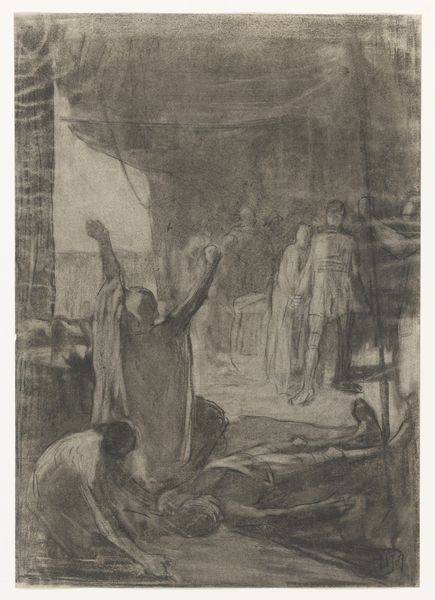
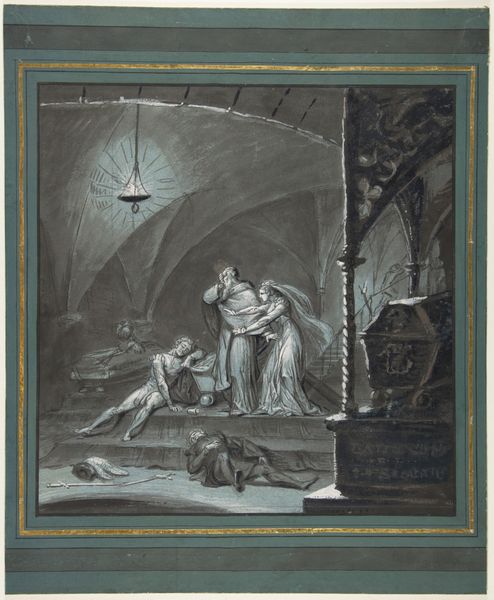
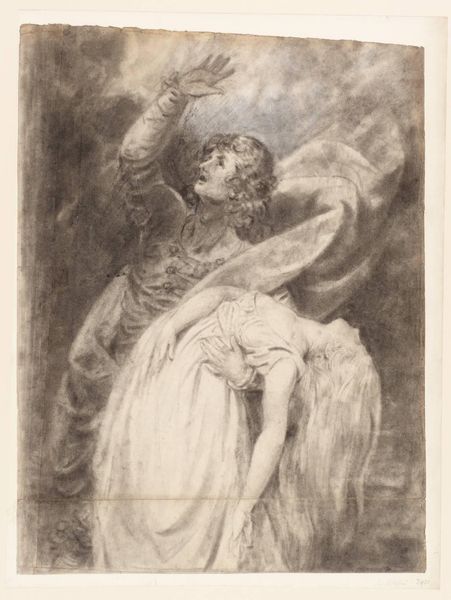
Editor: We're looking at Henry Fuseli's "Study for Inquisition, Illustration to Columbiad," created around 1806. It's a watercolor and charcoal drawing. The overall impression is quite dramatic – it's somber and unsettling, especially the figure lying prone at the bottom. What strikes you about the composition? Curator: Immediately, the pyramidal structure compels attention: the dead or sleeping figure anchors the base, ascending through the draped woman wielding a sword and a fiery chalice or torch, terminating in that ominous figure lurking in shadow to the right. Consider the tension arising from Fuseli's limited palette— predominately shades of grey, heightened by touches of fiery reds. Editor: The restricted color scheme certainly adds to the drama. But what about the gesture of the central figure, with the elevated chalice and sword? What do you make of it? Curator: Semiotically, such a gesture invites speculation. Observe how Fuseli has employed line and chiaroscuro to direct our gaze upwards, thereby implying a connection between terrestrial suffering below, and potentially divine judgment above. Editor: That's a really interesting way of looking at it. I was focused on the figures themselves, rather than the directional force of the light. Are you suggesting then, that Fuseli's precise arrangement is designed to invoke certain readings? Curator: Undeniably. His strategic disposition of forms— the dynamic lines created through light and dark—all conspire to shape meaning. This study offers, more than any narrative depiction could, a structural foundation upon which one might consider the final print. Editor: So, it’s not just what is depicted, but how it's depicted that's most meaningful. Curator: Precisely. The arrangement, the tones, these are not arbitrary choices. Each contributes to the creation of an intensely wrought visual argument.
Comments
No comments
Be the first to comment and join the conversation on the ultimate creative platform.
 Collect
 React
React Comment
More like this