Dimensions: Sheet: 3 15/16 in. × 7 in. (10 × 17.8 cm) Plate: 3 13/16 × 6 7/8 in. (9.7 × 17.5 cm)
Copyright: Public Domain
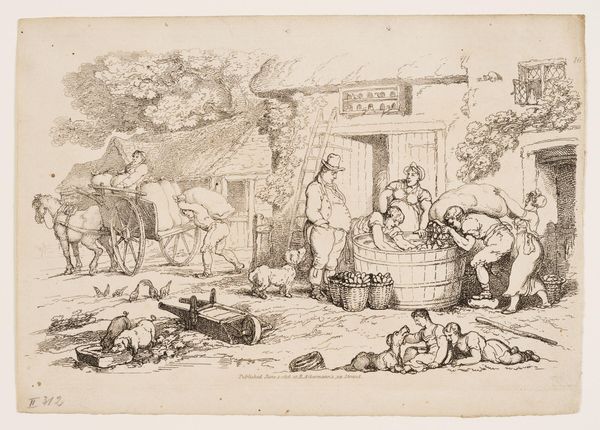
Curator: This etching is titled "The Dinner of the Painter Casanova." It dates back to somewhere between 1727 and 1800. The artist is Francesco Casanova. Editor: My first thought? Discomfort. There's a strange blend of aspiration and dilapidation here. The stagecoach screams wealth, but then there’s the crude, makeshift kitchen, a haze of smoke, and figures in states of evident labor. The materials shown depict a sort of artistic chaos. Curator: I see it as an allegory, of sorts. Look at how Casanova presents himself: the confident painter with a pipe. Is the meal truly *his*? Or is he just a guest consuming the fruit of another’s hard work? Editor: Precisely! That smoke and the crude cooking arrangements drive that point home. Someone labored intensely to create that meal. And it’s fascinating to me that the actual *making* is the centerpiece, the main material concern. Curator: Absolutely, that smoke becomes a symbolic veil! It suggests a hidden aspect, perhaps the messy, unseen labor that fuels the polished surface of the artistic profession. It could allude to social inequality, with Casanova enjoying a privilege that contrasts with the laborer's toiling. Editor: It's a critique of the artist’s social position, highlighting class and how those dynamics affect the means of art production. How Casanova represents the dinner as *labor*, the transformation from raw materials into edible food, is essential here. We should think about consumption as a process. Curator: I think the tilted, unfinished canvas lying near the dog points towards Casanova’s relationship to *inspiration*. There’s something disrupted here. Like even inspiration can sometimes be left as rubbish after artistic vision has dined. Editor: The canvas reminds us art is rarely complete, despite being displayed that way. It requires effort, materials, and can be, like any industry, very messy, particularly when other bodies contribute to the labor required. Curator: Yes, "The Dinner of the Painter Casanova" is a deceiving work, its symbolic components weaving a narrative that invites the viewer to look beyond the self-proclaimed painter and contemplate the systems behind his apparent autonomy. Editor: Seeing how materials and means intersect provides much more perspective, especially on an age steeped in luxury but built upon hard work, even abuse. Thank you.
Comments
No comments
Be the first to comment and join the conversation on the ultimate creative platform.
 React
React Comment