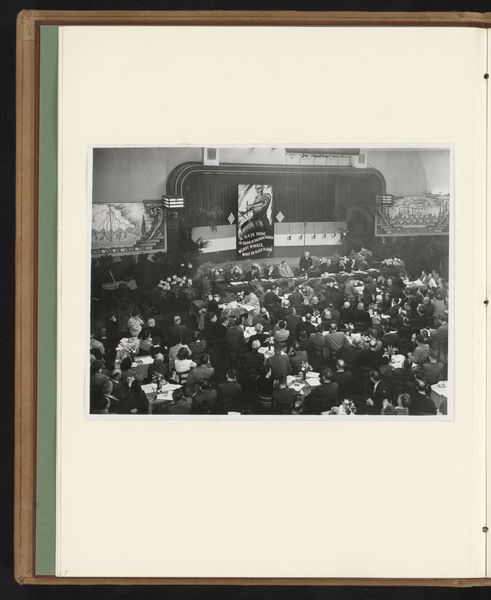
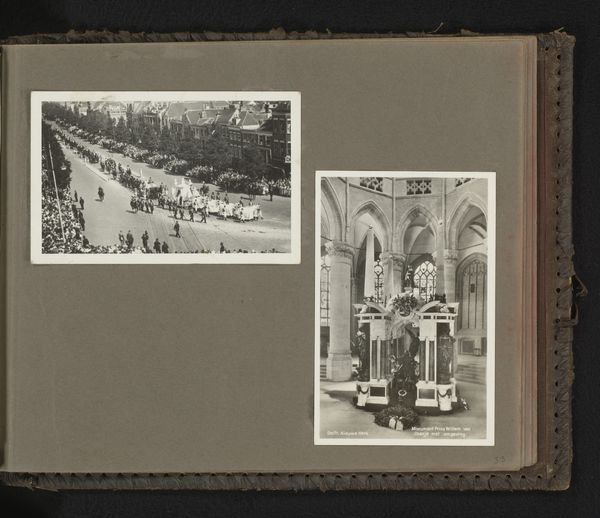
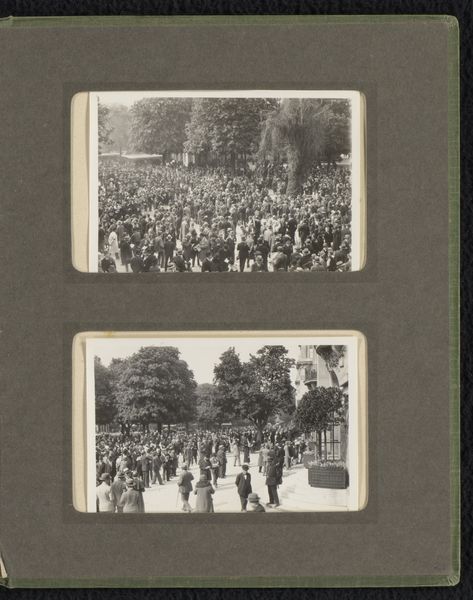
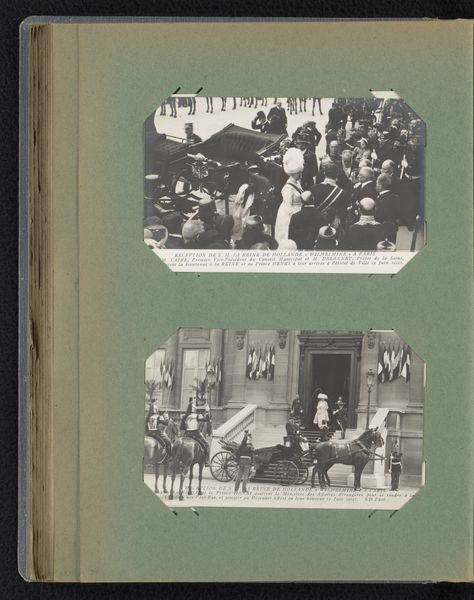
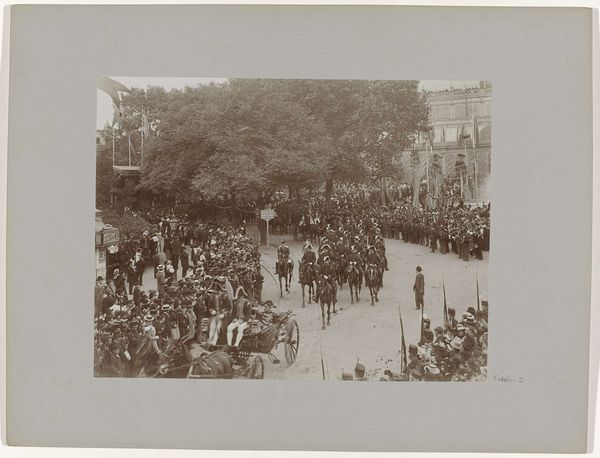
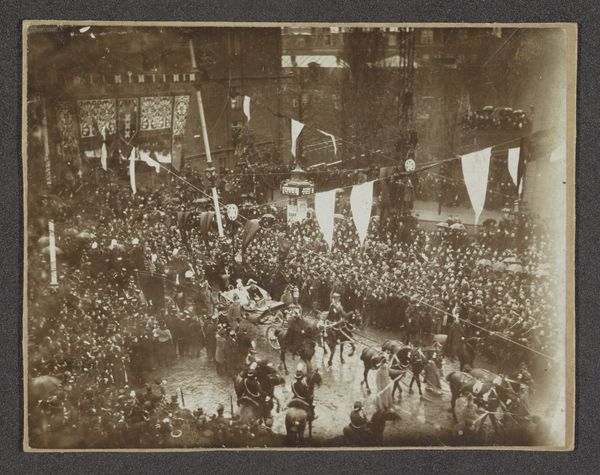
Koetsen, ruiters en mensen op de Markt te Delft voor de uitvaart van koningin-moeder Emma 1934
0:00
0:00

anonymous
Rijksmuseum
photography, gelatin-silver-print
#
portrait
#
photography
#
photojournalism
#
gelatin-silver-print
#
history-painting
#
realism
Dimensions: height 220 mm, width 262 mm
Copyright: Rijks Museum: Open Domain
Editor: Here we have an aerial photograph entitled "Koetsen, ruiters en mensen op de Markt te Delft voor de uitvaart van koningin-moeder Emma," taken in 1934. It's a gelatin silver print, capturing what appears to be a somber event. The composition, looking down onto a packed town square, is striking. What strikes you when you look at this piece? Curator: The aerial perspective immediately positions us as observers, almost detached, yet it also provides a comprehensive view of grief made public. I see a carefully orchestrated display of national mourning – the carriages, the regimented lines of soldiers, the throngs of onlookers all contribute to a potent tableau. Notice how the monochrome tones amplify the gravity, almost stripping away any sense of vibrancy or life. Editor: It definitely feels very staged and official. What do you make of that? Is that a product of it being a historical moment being documented, or is there something else at play? Curator: Well, photography at the time was often about crafting a narrative, even in ostensibly documentary contexts. I think here, there’s a deliberate attempt to convey order, respect, and the enduring power of the monarchy amidst a personal loss. And yet, within that framework, are those individuals leaning forward, trying to catch a glimpse? Are they purely reverent, or also curious? Perhaps the photograph inadvertently reveals something beyond the official narrative, hinting at human complexities. Editor: It's amazing how a single image can hold so many layers of meaning. It really makes you think about the power of a photograph, not just to record history, but to shape it. Curator: Precisely! And to stir a whisper of human experience from beyond the archival page... it is an emotional and very striking document.
Comments
No comments
Be the first to comment and join the conversation on the ultimate creative platform.
 Collect
 React
React Comment
More like this