painting, acrylic-paint
#
cubism
#
painting
#
landscape
#
acrylic-paint
#
form
#
geometric
#
abstraction
#
line
#
modernism
Dimensions: 68 x 53 cm
Copyright: Public domain
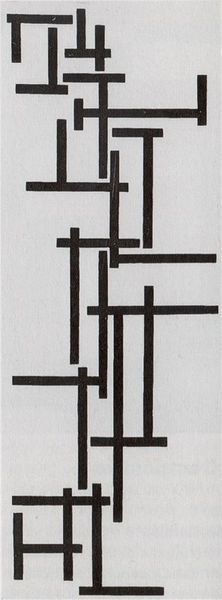
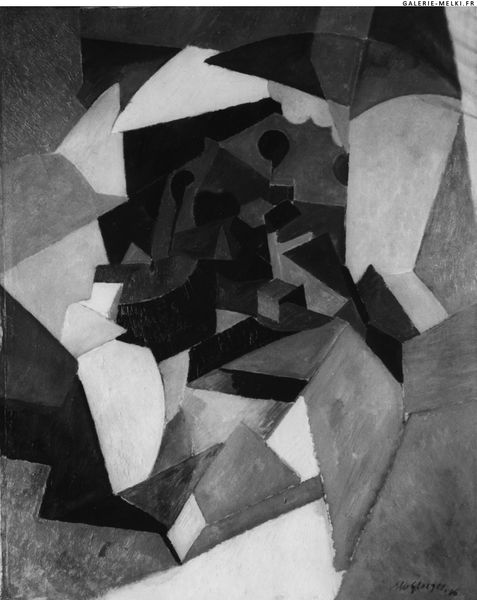
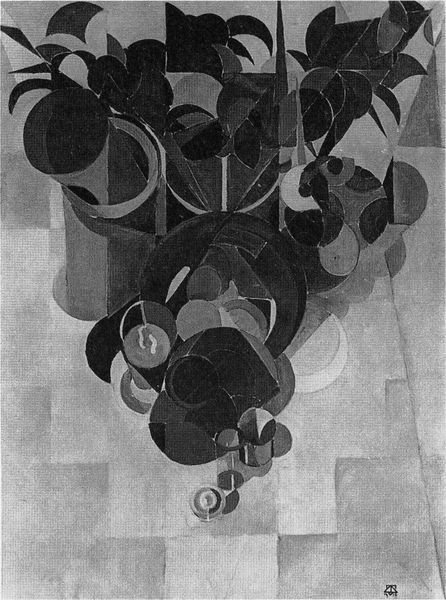
Editor: This is Theo van Doesburg’s "Landscape (study for composition XII)", made with acrylic paint in 1918. It's a striking image, a study in stark black and white, seemingly balancing abstraction with a recognisable landscape. How do you interpret this work? Curator: For me, this piece is a powerful commentary on the societal upheaval following World War I. Doesburg, like many artists of his time, was grappling with a world irrevocably changed by violence and industrialization. How does the simplification of form here reflect a desire for social restructuring, for building anew from the ruins? Editor: That's interesting! I see the geometric forms as purely aesthetic. Are you saying he's using abstraction as a form of social critique? Curator: Absolutely. Consider the De Stijl movement, of which Doesburg was a key figure. It sought a universal visual language, free from individual expression, to promote a more egalitarian and harmonious society. Doesn't the reduction of the landscape to these essential forms reflect that utopian aspiration, a vision of a world rebuilt on rational principles? Editor: I hadn't considered that! I always thought of abstraction as being disconnected from social issues. Curator: And yet, can we ever truly separate art from the context in which it’s created? Think about how the emphasis on order and clarity in the composition might speak to a yearning for stability amidst chaos, a reimagining of social space after unprecedented destruction. Editor: So, seeing it that way, the painting isn't just about lines and shapes; it's a statement about society's hopes and fears during a tumultuous period. I will think about that when approaching other art works in the future. Thanks! Curator: Precisely! And that's the beauty of art, isn't it? It invites us to question, to challenge, and to see the world around us with fresh eyes.
Comments
No comments
Be the first to comment and join the conversation on the ultimate creative platform.
 Collect
 React
React Comment
More like this