

1937
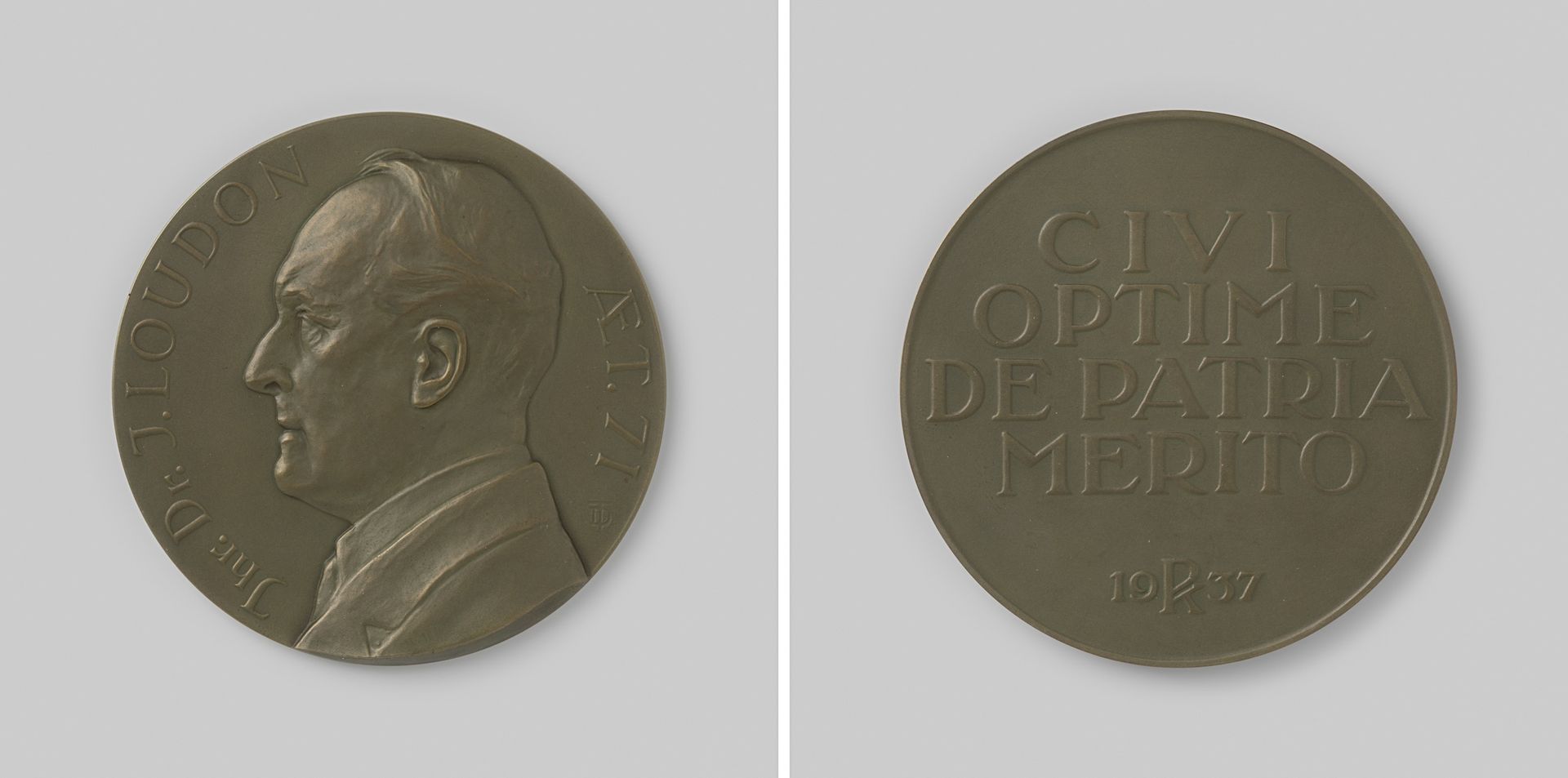
Penning jhr. dr. J. Loudon, oud minister Buitenlandse Zaken (1913-1918)

Toon Dupuis
1877 - 1937Location
RijksmuseumListen to curator's interpretation
Curatorial notes
Curator: Today, we are looking at a 1937 metal medal by Toon Dupuis, located here at the Rijksmuseum. It's titled "Penning jhr. dr. J. Loudon, oud minister Buitenlandse Zaken (1913-1918)", a commemorative medal of Jonkheer Dr. J. Loudon, the former Minister of Foreign Affairs. Editor: It has an immediate sense of austerity and somber commemoration. The material itself contributes to this; it feels heavy, both literally and figuratively. Curator: The choice of metal, of course, speaks to the enduring quality of Loudon's legacy. Consider Loudon's tenure during WWI, his politics aimed to uphold Dutch neutrality—this medal marks an elder statesman viewed as a key figure during turbulent times. Editor: Looking closely at the relief, I'm struck by the controlled modulation of the surface. Dupuis uses a limited range to articulate form—look how Loudon's profile is precisely rendered, conveying dignity and restraint through a masterful handling of light and shadow. Curator: Indeed. And if we turn our attention to the reverse, we see the inscription "CIVI OPTIME DE PATRIA MERITO" - "To the citizen who has done great service to the fatherland." Dupuis underscores the ideals of national service. This isn't merely a portrait; it's a statement about citizenship, duty, and national identity in a period overshadowed by international strife. The style itself shows traits of Modernism, the idea of rational thinking and advancement. Editor: And there is something fascinating in how the inscriptions act as a frame; they contain and monumentalize the image of Loudon while also providing historical context. Dupuis clearly understood the power of symbolism in the roundness and edges to evoke history in art. Curator: The weight of this medal reflects both the significance of its subject and the period in which it was created. It serves as a historical artifact memorializing a very specific set of cultural values tied to Dutch political history during the early twentieth century. Editor: Exactly. It's an artifact where material and image create meaning beyond a mere representation; rather, it exists as an eloquent symbolic synthesis.