

About this artwork
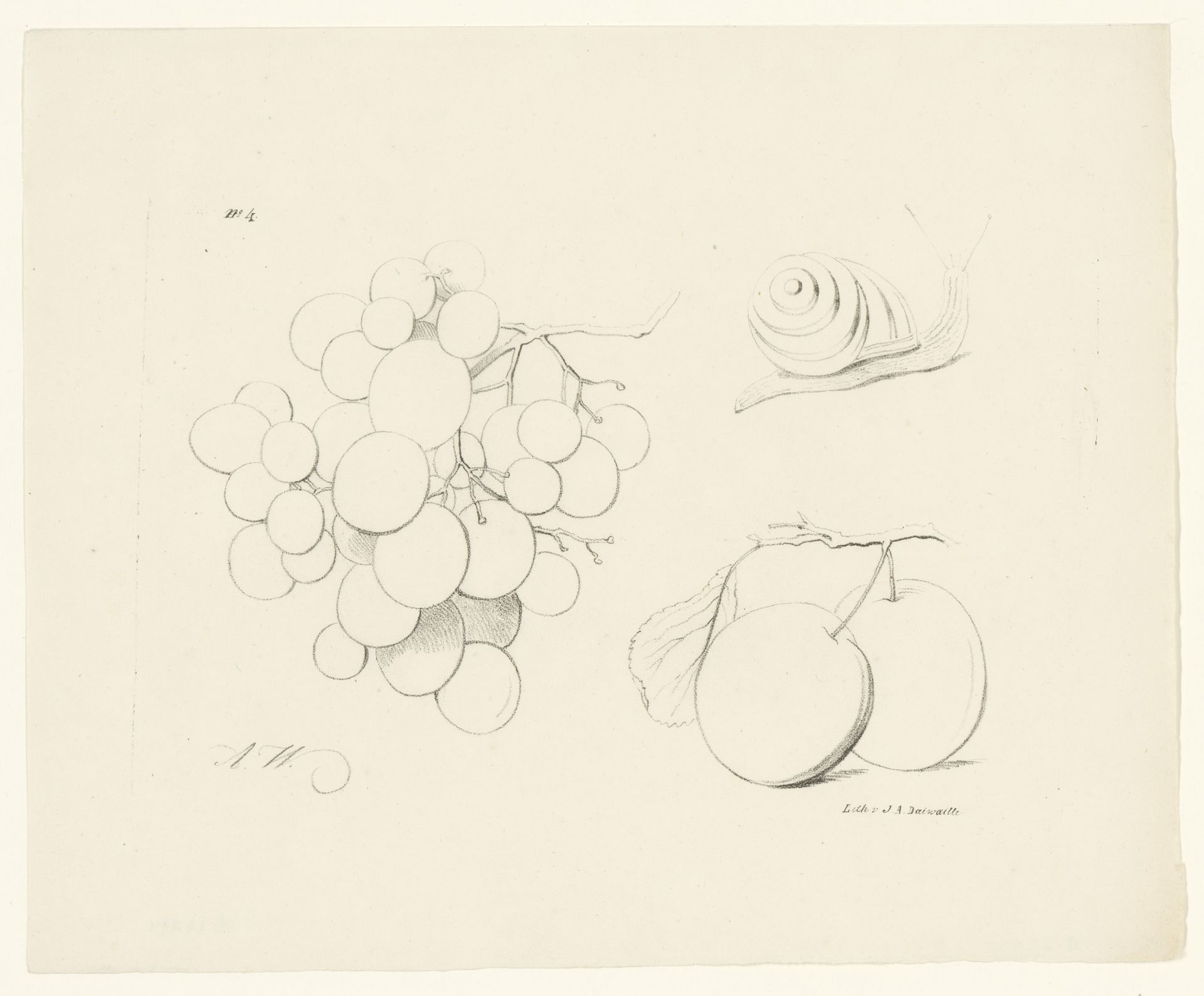
Editor: So, this drawing, “Druiven, slak en appels,” or “Grapes, snail and apples,” made sometime between 1820 and 1833, is a pencil drawing. It’s simple, almost scientific in its approach. I'm curious, how do you interpret this work beyond just a study of natural objects? Curator: It's interesting you pick up on that almost scientific quality. This wasn't just about documenting nature; it reflects a changing world. Consider the context: The Enlightenment had emphasized reason and observation, influencing art's role in understanding the world. How might that connection between scientific observation and the emerging industrial society affect art production and the perception of nature? Editor: That’s a great question! It pushes me to see beyond the surface, because I am thinking how it relates to today and a world that feels mass-produced and separated from natural objects. Curator: Precisely! Realism was emerging as a potent force in art. Think of how the style itself can act as a political statement. How does choosing to depict everyday objects realistically challenge existing artistic conventions or social norms? Consider who had access to such imagery. Was this drawing intended for a broad audience, or was it geared toward a more exclusive group with the privilege to engage with art? Editor: I hadn't considered the class dimension before. Thinking about it now, even a seemingly simple drawing reflects broader issues of access and representation. Curator: Exactly! This image operates within a larger framework of power and privilege, and interrogating it allows us to develop a richer understanding of its significance. How might a feminist reading of this image shift our understanding of its context? What alternative narratives or perspectives can we explore? Editor: This has completely shifted my perspective! What I saw as just a simple rendering is connected to power, observation, and politics! Curator: It’s these layers of interpretation that make art so compelling and reveal a more comprehensive view of how we communicate today.

Artwork details
- Medium
- drawing, pencil
- Dimensions
- height 205 mm, width 252 mm
- Location
- Rijksmuseum
- Copyright
- Rijks Museum: Open Domain
Tags
drawing
fruit
pencil
academic-art
realism
Comments
Be the first to share your thoughts about this work.
About this artwork
Editor: So, this drawing, “Druiven, slak en appels,” or “Grapes, snail and apples,” made sometime between 1820 and 1833, is a pencil drawing. It’s simple, almost scientific in its approach. I'm curious, how do you interpret this work beyond just a study of natural objects? Curator: It's interesting you pick up on that almost scientific quality. This wasn't just about documenting nature; it reflects a changing world. Consider the context: The Enlightenment had emphasized reason and observation, influencing art's role in understanding the world. How might that connection between scientific observation and the emerging industrial society affect art production and the perception of nature? Editor: That’s a great question! It pushes me to see beyond the surface, because I am thinking how it relates to today and a world that feels mass-produced and separated from natural objects. Curator: Precisely! Realism was emerging as a potent force in art. Think of how the style itself can act as a political statement. How does choosing to depict everyday objects realistically challenge existing artistic conventions or social norms? Consider who had access to such imagery. Was this drawing intended for a broad audience, or was it geared toward a more exclusive group with the privilege to engage with art? Editor: I hadn't considered the class dimension before. Thinking about it now, even a seemingly simple drawing reflects broader issues of access and representation. Curator: Exactly! This image operates within a larger framework of power and privilege, and interrogating it allows us to develop a richer understanding of its significance. How might a feminist reading of this image shift our understanding of its context? What alternative narratives or perspectives can we explore? Editor: This has completely shifted my perspective! What I saw as just a simple rendering is connected to power, observation, and politics! Curator: It’s these layers of interpretation that make art so compelling and reveal a more comprehensive view of how we communicate today.
Comments
Be the first to share your thoughts about this work.