About this artwork
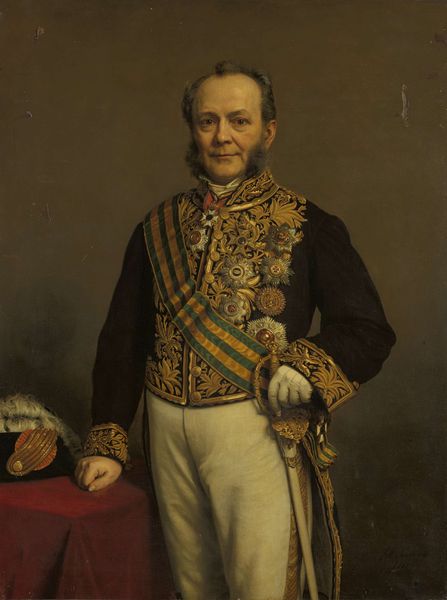
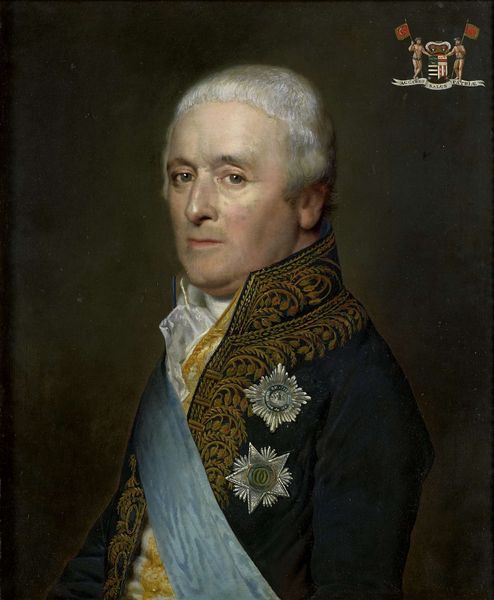
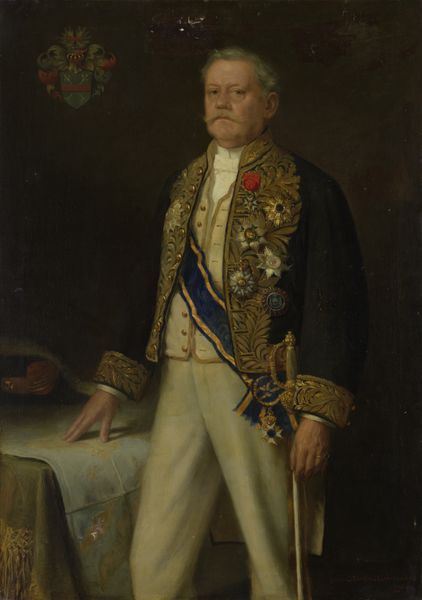
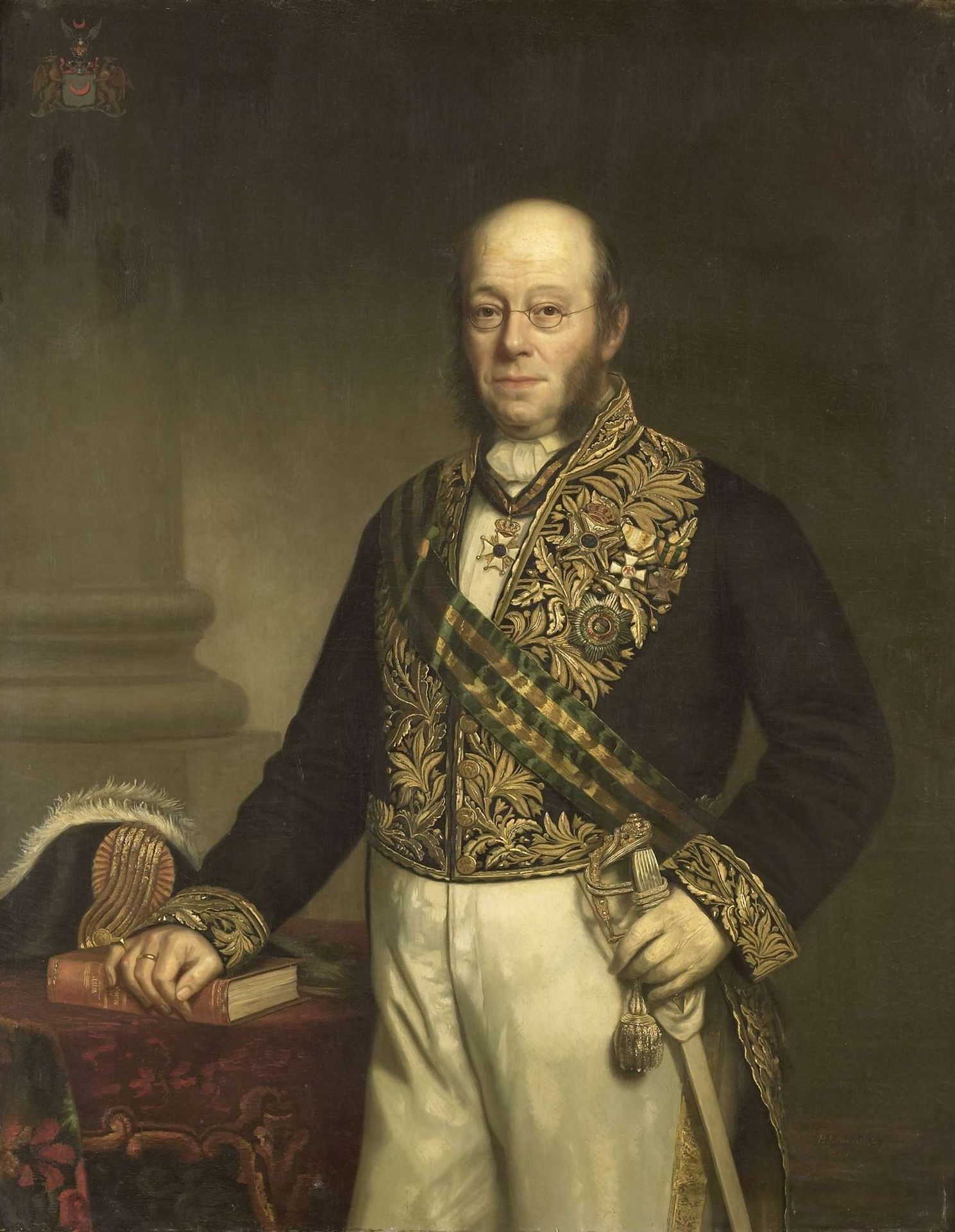
Editor: This painting, rendered in oil paint, depicts Ludolph Anne Jan Wilt Baron Sloet van de Beele, the Governor-General of the Dutch East Indies, created in 1867 by Barend Leonardus Hendriks. The weight of the subject’s regalia seems palpable, it's a pretty heavy portrait. What sort of statement do you think it’s trying to make? Curator: Well, beyond being a portrait, this is an artifact reflecting the construction and projection of colonial power in the 19th century. Sloet van de Beele’s ornate attire and the setting – note the subtle emblem at the top – all serve to reinforce Dutch authority and legitimacy in the East Indies. Consider, for instance, the inclusion of the sword. What message do you think *that* sends? Editor: It seems like a show of strength, like a quiet threat amidst all the formality. Was this how the Dutch wanted to be seen by those they governed? Curator: Precisely. These portraits served as powerful visual propaganda, intended to impress upon both European and Indonesian audiences the might and sophistication of the Dutch colonial administration. Academic art was a tool. Who do you think it would appeal to in society at that time? Editor: I imagine wealthy patrons who benefitted from colonial trade and the military figures. It presents a very controlled and orderly image. Curator: It does, and that is very much the point. Now consider, who *isn't* represented, whose perspectives are absent in this carefully constructed image of power? And what implications might *that* have? Editor: That makes me rethink the role of portraiture. It's not just capturing a likeness; it's a statement. Curator: Exactly. It invites us to critically examine the relationship between art, power, and historical narratives. We must also look beyond the surface in understanding these visuals.
Ludolph Anne Jan Wilt Baron Sloet van de Beele (1806-90). Gouverneur-generaal (1861-66)
1867

Artwork details
- Medium
- painting, oil-paint
- Dimensions
- height 133.5 cm, width 106 cm, depth 14.8 cm
- Copyright
- Rijks Museum: Open Domain
Tags
Comments
Share your thoughts
About this artwork
Editor: This painting, rendered in oil paint, depicts Ludolph Anne Jan Wilt Baron Sloet van de Beele, the Governor-General of the Dutch East Indies, created in 1867 by Barend Leonardus Hendriks. The weight of the subject’s regalia seems palpable, it's a pretty heavy portrait. What sort of statement do you think it’s trying to make? Curator: Well, beyond being a portrait, this is an artifact reflecting the construction and projection of colonial power in the 19th century. Sloet van de Beele’s ornate attire and the setting – note the subtle emblem at the top – all serve to reinforce Dutch authority and legitimacy in the East Indies. Consider, for instance, the inclusion of the sword. What message do you think *that* sends? Editor: It seems like a show of strength, like a quiet threat amidst all the formality. Was this how the Dutch wanted to be seen by those they governed? Curator: Precisely. These portraits served as powerful visual propaganda, intended to impress upon both European and Indonesian audiences the might and sophistication of the Dutch colonial administration. Academic art was a tool. Who do you think it would appeal to in society at that time? Editor: I imagine wealthy patrons who benefitted from colonial trade and the military figures. It presents a very controlled and orderly image. Curator: It does, and that is very much the point. Now consider, who *isn't* represented, whose perspectives are absent in this carefully constructed image of power? And what implications might *that* have? Editor: That makes me rethink the role of portraiture. It's not just capturing a likeness; it's a statement. Curator: Exactly. It invites us to critically examine the relationship between art, power, and historical narratives. We must also look beyond the surface in understanding these visuals.
Comments
Share your thoughts