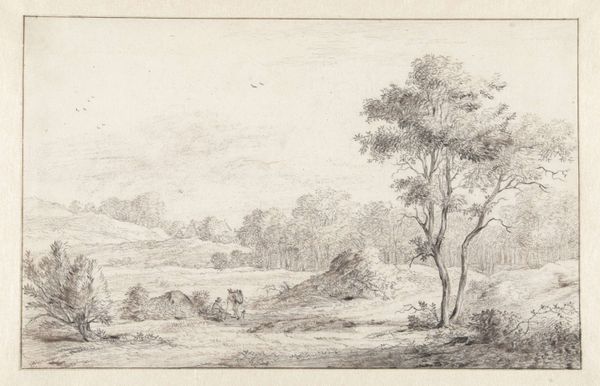
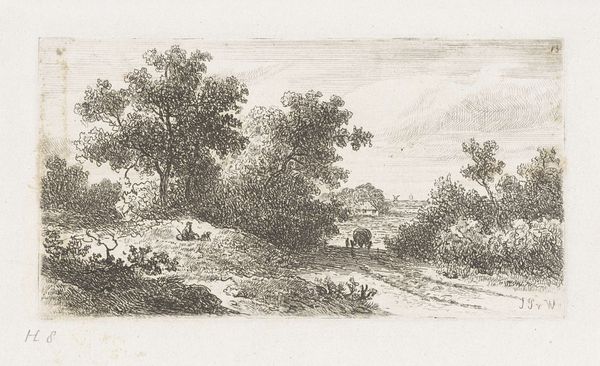
drawing, etching
#
drawing
#
dutch-golden-age
#
pen sketch
#
etching
#
landscape
#
genre-painting
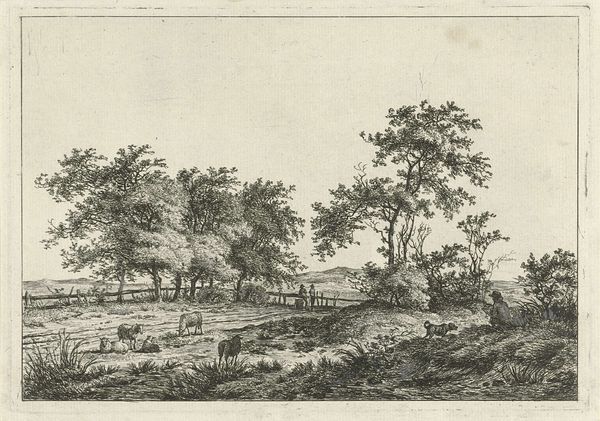
Dimensions: height 104 mm, width 145 mm
Copyright: Rijks Museum: Open Domain
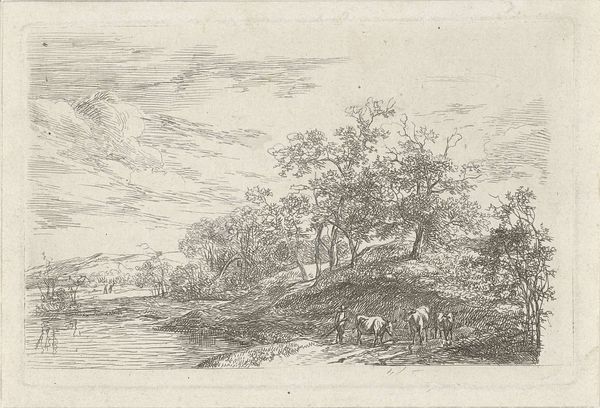
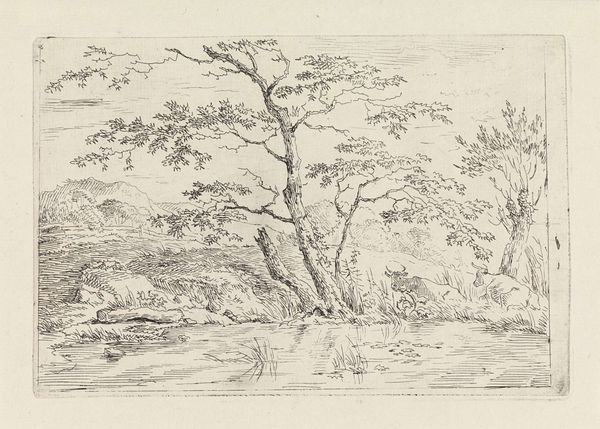
Editor: Here we have Johannes Janson's "Landscape with Shepherds Conversing," created between 1761 and 1784. It's an etching, a technique that gives it a delicate, almost dreamlike quality. The composition feels very staged to me; almost like a pastoral tableau. What do you see in this piece, particularly considering the period in which it was created? Curator: It’s interesting you pick up on the 'staged' quality. Janson was working in a period where landscape art was increasingly tied to national identity and ideals. This image presents a carefully constructed vision of rural life, arguably more aspirational than documentary. Notice how the shepherds, the animals, and the landscape are all neatly arranged, creating a sense of order and harmony. Editor: So, it's not just about representing reality? Curator: Not entirely. Think about who was commissioning and consuming these images. The rising middle class and wealthy merchants wanted to see reflections of their own values – industriousness, prosperity, and control over the natural world. The seemingly simple scene becomes a commentary on the desired social order. Does that perspective shift how you see the scene? Editor: Definitely. It's less a spontaneous snapshot and more a carefully crafted message about social stability, viewed from an upper-class position. Curator: Precisely. Consider, too, the rise of the public museum during this era. Art wasn't just for private collections, but for shaping public understanding. Landscape imagery played a part in defining national identity, projecting this idyllic image for public consumption and perhaps to gloss over some difficult realities of rural life at the time. Editor: That really makes me reconsider the 'dreamlike' quality I mentioned earlier. It's a constructed dream, reflecting a particular socio-political perspective. Curator: Indeed. It invites us to look critically at whose dreams are being represented and whose realities are being obscured.
Comments
No comments
Be the first to comment and join the conversation on the ultimate creative platform.
 Collect
 React
React Comment
More like this