About this artwork
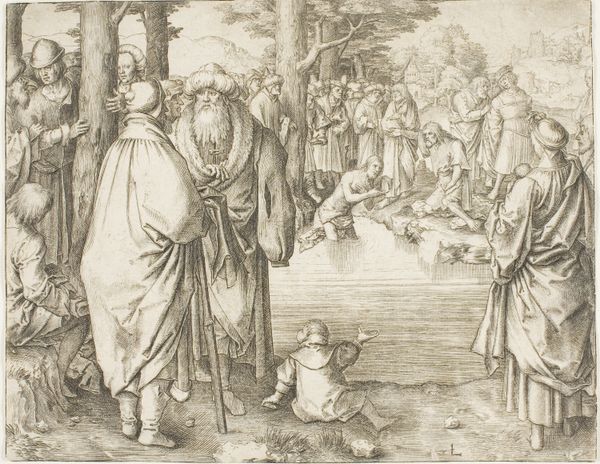
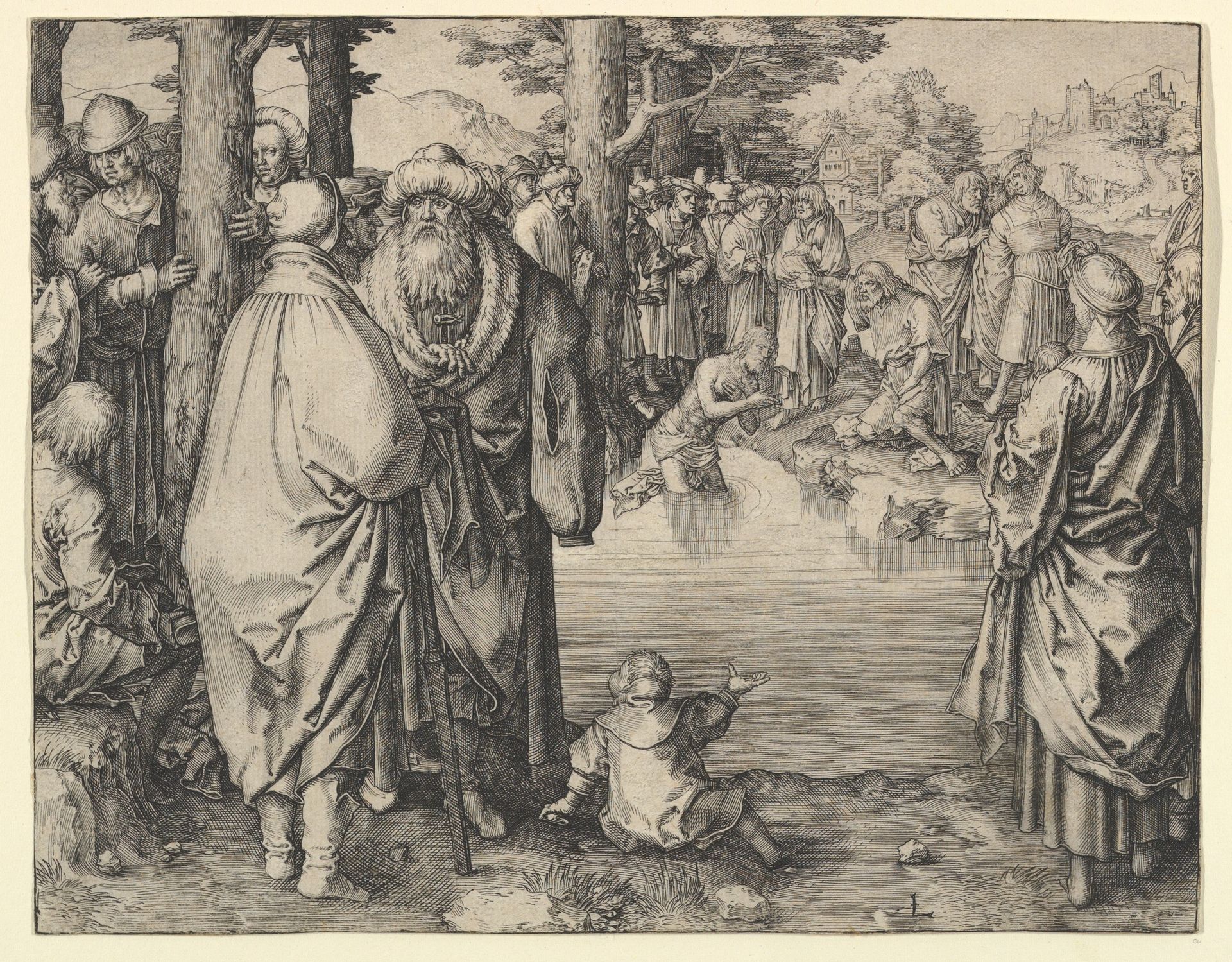
Lucas van Leyden created this engraving, "The Baptism of Christ in the River Jordan," in the 16th century. The composition is meticulously structured, drawing the eye through carefully arranged groups of figures towards the central act of baptism. The artist’s skilled use of line, evident in the complex drapery and varied textures, creates a rich visual tapestry. Note how the density of lines darkens the foreground, setting off the lighter, more open space where the baptism occurs. Van Leyden’s work employs a semiotic language, where gestures and positioning symbolize deeper theological meanings. The formal arrangement reflects the period’s religious and philosophical concerns. Consider the engraving's role in challenging established visual norms through its innovative approach to space and form, destabilizing traditional representations. The artist compels us to reconsider the narrative's visual and cultural implications, recognizing that art is a site of ongoing dialogue and renewed understanding.
The Baptism of Christ in the River Jordan
1505 - 1515


Artwork details
- Medium
- drawing, print, intaglio
- Dimensions
- sheet: 5 5/8 x 7 1/4 in. (14.4 x 18.3 cm)
- Location
- Metropolitan Museum of Art, New York, NY
- Copyright
- Public Domain
Tags
Comments
Share your thoughts
About this artwork
Lucas van Leyden created this engraving, "The Baptism of Christ in the River Jordan," in the 16th century. The composition is meticulously structured, drawing the eye through carefully arranged groups of figures towards the central act of baptism. The artist’s skilled use of line, evident in the complex drapery and varied textures, creates a rich visual tapestry. Note how the density of lines darkens the foreground, setting off the lighter, more open space where the baptism occurs. Van Leyden’s work employs a semiotic language, where gestures and positioning symbolize deeper theological meanings. The formal arrangement reflects the period’s religious and philosophical concerns. Consider the engraving's role in challenging established visual norms through its innovative approach to space and form, destabilizing traditional representations. The artist compels us to reconsider the narrative's visual and cultural implications, recognizing that art is a site of ongoing dialogue and renewed understanding.
Comments
Share your thoughts