

1884 - 1927
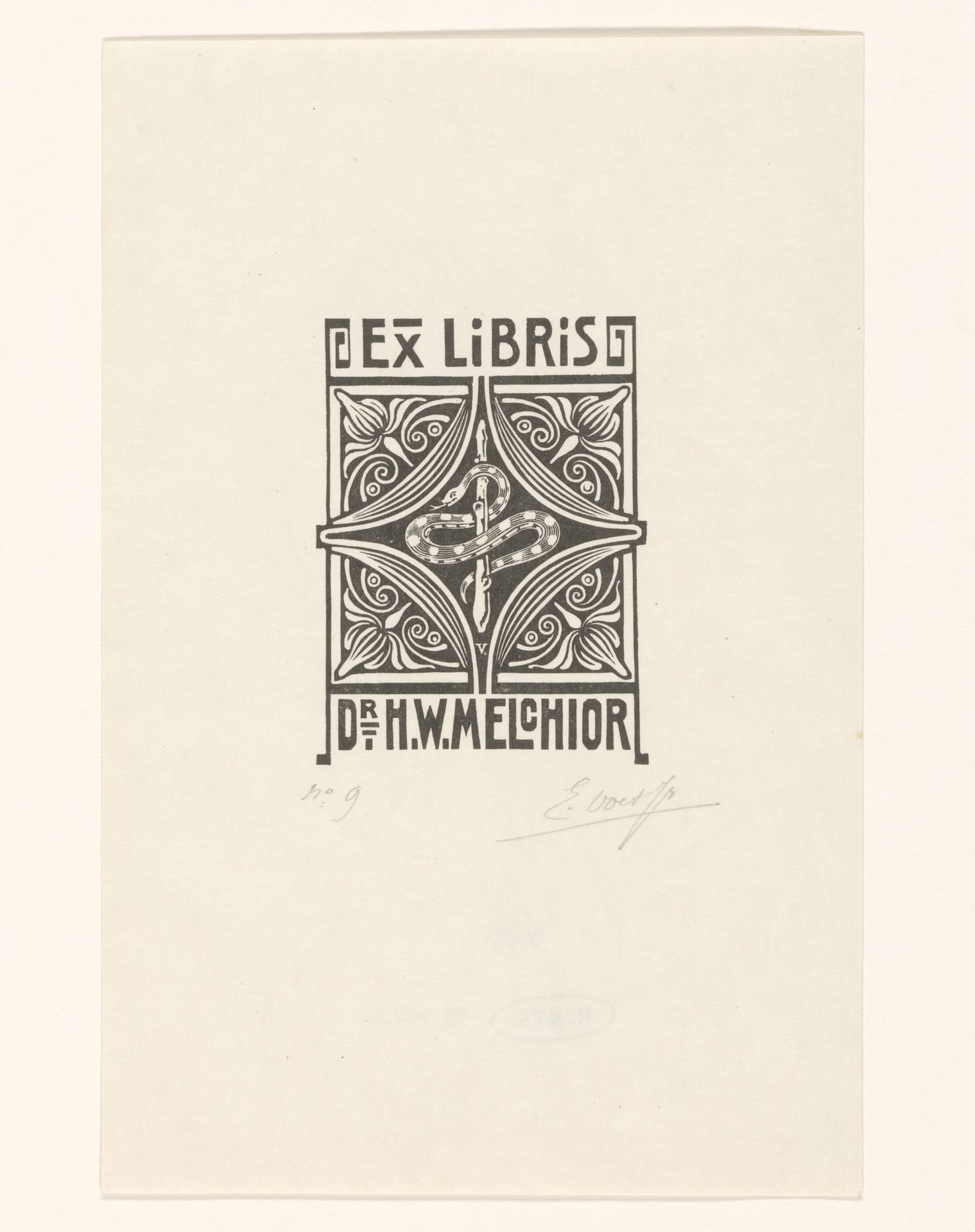
Ex libris van Hendrik Willem Melchior

Listen to curator's interpretation
Curatorial notes
Editor: Here we have Elias Voet jr.’s "Ex libris van Hendrik Willem Melchior", made between 1884 and 1927. It’s an etching in ink. I’m struck by the intricacy of the design, how the eye is drawn into the central symbol of the snake, while the floral patterns create an almost decorative frame. How do you approach this piece? Curator: Initially, it's crucial to recognize the dominance of line in defining the composition. Notice how the artist uses varying line weights to establish a clear hierarchy. The bolder, geometric lines of the frame contain and emphasize the finer, more sinuous lines of the snake and foliage. Observe how the composition is balanced—almost symmetrical—contributing to its visual harmony. This symmetry, however, is subtly disrupted, preventing any sense of static uniformity. Can you see those minor variations? Editor: I do. The curls are not quite identical on either side. So, it is the slight deviations from perfect symmetry that animate it? Curator: Precisely. These variations invite closer scrutiny. Consider also how the artist manipulates positive and negative space. The careful distribution of the dark ink against the white paper creates a dynamic interplay, highlighting certain elements while receding others. Ask yourself: How does this interplay contribute to the overall aesthetic impact? Editor: I see. The white spaces define the leaves and add to the sense of depth despite the print being so flat. So, we are less concerned with its function as a bookplate, but rather with the choices the artist made in its creation. Curator: Exactly. While its historical context is relevant, we are primarily interested in analyzing the artist’s formal decisions and their aesthetic consequences. How the lines, shapes, and overall structure create a compelling visual experience. Editor: That’s a perspective shift for me, thinking less about context and more about the artistic mechanics at play. Curator: And sometimes, by exploring artistic mechanics, you find out more about historical context and its artistic reflections, like how art nouveau embraced the power of lines.