About this artwork
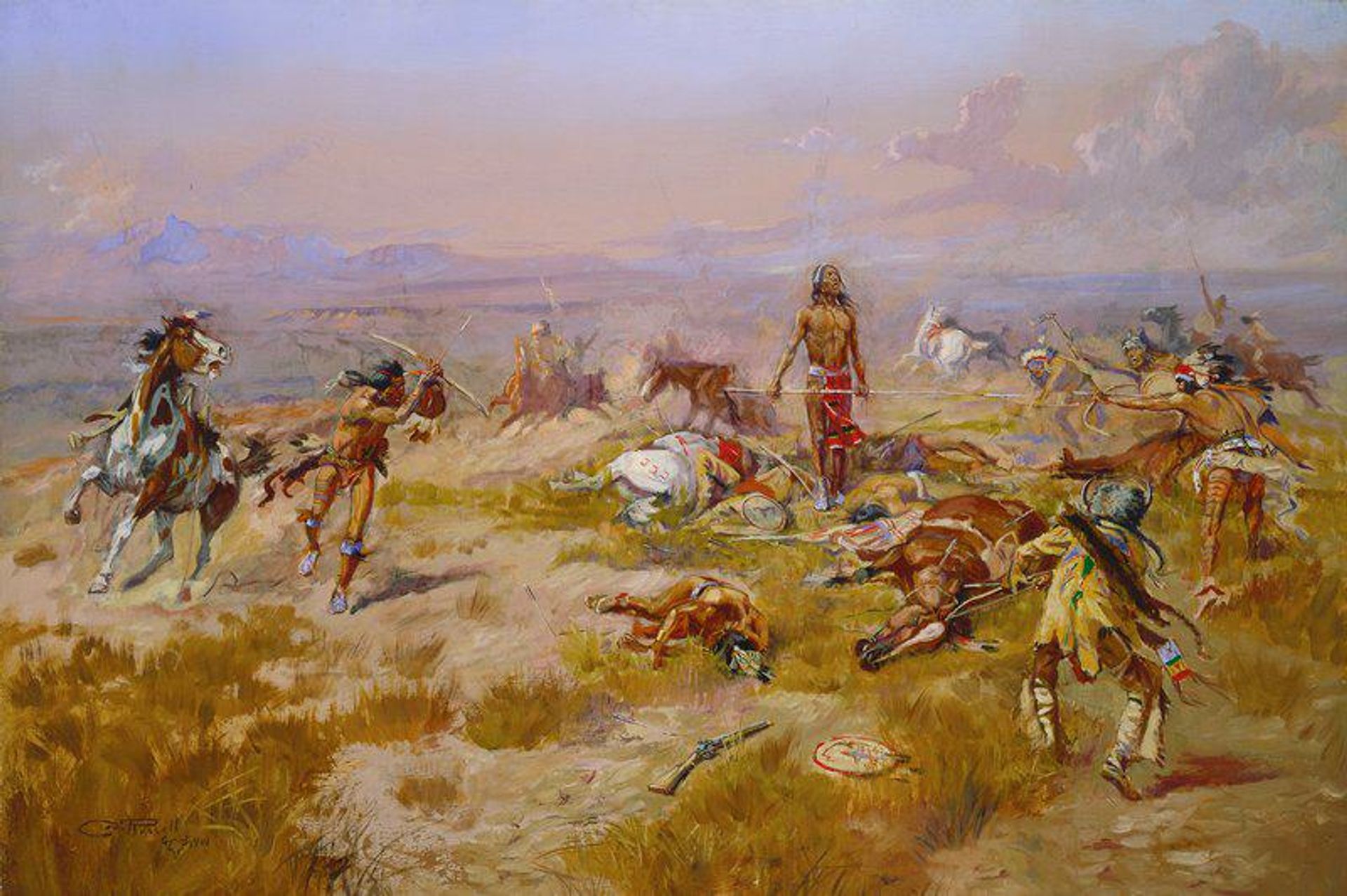
Curator: Let’s turn our attention to “The Death Song of Lone Wolf,” an oil painting by Charles M. Russell completed in 1901. You can find it here at the Minneapolis Institute of Art. Editor: What strikes me first is the dramatic, almost chaotic composition. The eye struggles to find a resting place amid the figures and the sense of urgent motion, despite the presence of so many fallen figures. Curator: Indeed. Russell, celebrated for his depictions of the American West, evokes potent historical themes here. Notice how he depicts the scene through the lens of narrative art and genre painting. Editor: The dynamism in the use of line is quite remarkable, though, don’t you think? The way the artist uses line to create forms, such as galloping horses or taut bows, generates a very potent sense of depth, yet feels stylistically "flat", so to speak. Curator: Absolutely. And if you consider the lone figure standing amidst the fallen—the titular Lone Wolf, perhaps—the symbolic weight of that character anchors the whole scene, representing the decimation of Indigenous agency and freedom in the face of Western expansion. There's a profound emotionality here, I think. Editor: Symbolism abounds, even in the incidental objects. The fallen rifle and overturned shield in the foreground speak volumes about the power dynamics at play here. It's a very deliberate articulation of contrasting forces, rendered beautifully with shape and tone. Curator: The very title invites you to meditate upon loss. Through imagery steeped in cultural memory, the artist provides continuity of cultural narratives around violence, change, and marginalization in the United States. Editor: Yes, an extremely engaging piece to reflect upon—the interplay of action and stasis alone provides the viewer with plenty of aesthetic territory to survey. Curator: The canvas pulses with visual storytelling. I always learn something new with each look, as the symbolic significance unfolds further and further.
The Death Song of Lone Wolf
1901


Artwork details
- Medium
- painting, oil-paint
- Dimensions
- 23 1/2 x 36 1/2 in. (59.69 x 92.71 cm) (sight)32 x 43 7/8 x 2 1/4 in. (81.28 x 111.44 x 5.72 cm) (outer frame)
- Location
- Minneapolis Institute of Art
- Copyright
- No Copyright - United States
Tags
Comments

Charles M. Russell was born in St. Louis, Missouri. Shortly after his sixteenth birthday, he left for Montana to pursue his lifelong dream of being a cowboy. Russell worked as a cowboy and wrangler for eleven years and documented his experiences through sketches, paintings, and modeled figures. His close observation of Native Americans is revealed through details in this painting that indicate the tribal or even individual identities of some of the men. The man at the left, running alongside a horse, is likely of the Apsáalooke (Crow) or Assiniboine tribe. The shield in the forefront with a thunderbird above a four-pointed form belonged to a man called Swift Dog (1834–1925), of the Oglala Lakota, and is now in the collection of the Minikhada Country Club. The scene portrayed has long been thought to be inter-tribal conflict, though it is unknown if Russell was showing a specific or imagined event.
About this artwork
Curator: Let’s turn our attention to “The Death Song of Lone Wolf,” an oil painting by Charles M. Russell completed in 1901. You can find it here at the Minneapolis Institute of Art. Editor: What strikes me first is the dramatic, almost chaotic composition. The eye struggles to find a resting place amid the figures and the sense of urgent motion, despite the presence of so many fallen figures. Curator: Indeed. Russell, celebrated for his depictions of the American West, evokes potent historical themes here. Notice how he depicts the scene through the lens of narrative art and genre painting. Editor: The dynamism in the use of line is quite remarkable, though, don’t you think? The way the artist uses line to create forms, such as galloping horses or taut bows, generates a very potent sense of depth, yet feels stylistically "flat", so to speak. Curator: Absolutely. And if you consider the lone figure standing amidst the fallen—the titular Lone Wolf, perhaps—the symbolic weight of that character anchors the whole scene, representing the decimation of Indigenous agency and freedom in the face of Western expansion. There's a profound emotionality here, I think. Editor: Symbolism abounds, even in the incidental objects. The fallen rifle and overturned shield in the foreground speak volumes about the power dynamics at play here. It's a very deliberate articulation of contrasting forces, rendered beautifully with shape and tone. Curator: The very title invites you to meditate upon loss. Through imagery steeped in cultural memory, the artist provides continuity of cultural narratives around violence, change, and marginalization in the United States. Editor: Yes, an extremely engaging piece to reflect upon—the interplay of action and stasis alone provides the viewer with plenty of aesthetic territory to survey. Curator: The canvas pulses with visual storytelling. I always learn something new with each look, as the symbolic significance unfolds further and further.
Comments
Charles M. Russell was born in St. Louis, Missouri. Shortly after his sixteenth birthday, he left for Montana to pursue his lifelong dream of being a cowboy. Russell worked as a cowboy and wrangler for eleven years and documented his experiences through sketches, paintings, and modeled figures. His close observation of Native Americans is revealed through details in this painting that indicate the tribal or even individual identities of some of the men. The man at the left, running alongside a horse, is likely of the Apsáalooke (Crow) or Assiniboine tribe. The shield in the forefront with a thunderbird above a four-pointed form belonged to a man called Swift Dog (1834–1925), of the Oglala Lakota, and is now in the collection of the Minikhada Country Club. The scene portrayed has long been thought to be inter-tribal conflict, though it is unknown if Russell was showing a specific or imagined event.