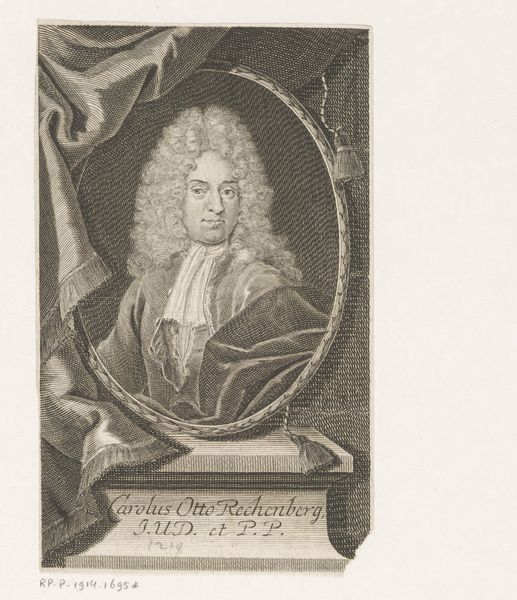
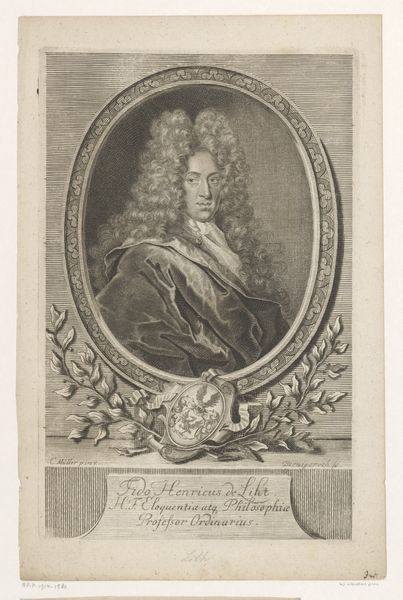
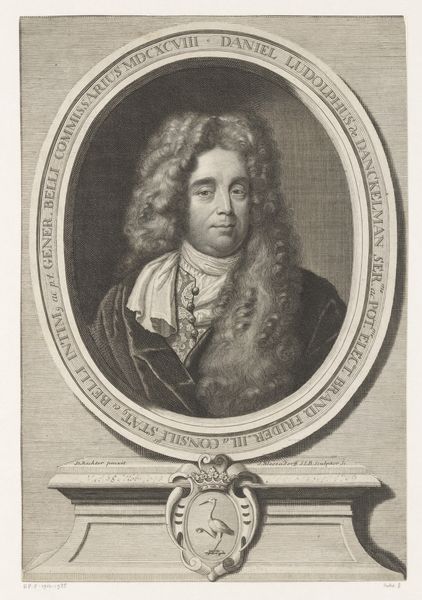
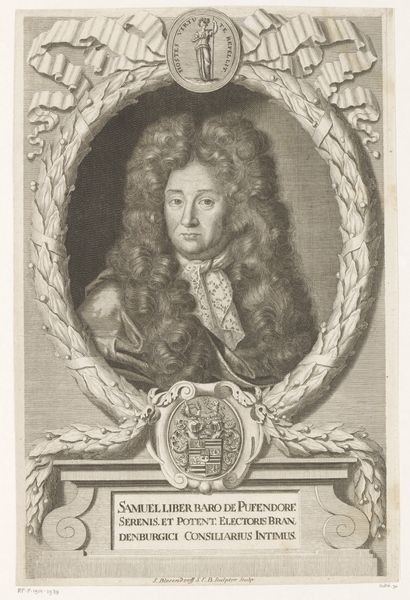
drawing, print, engraving
portrait
drawing
neoclacissism
engraving
Dimensions: sheet (trimmed within plate mark): 21.6 x 14.7 cm (8 1/2 x 5 13/16 in.)
Copyright: National Gallery of Art: CC0 1.0
Curator: This print from 1805 depicts Charles Le Brun and was created by Augustin de Saint-Aubin. Editor: It's stark, almost severe in its presentation. The textures created with the engraving, however, are surprisingly detailed. I immediately get a sense of formal rigidity, almost a manufactured air of importance. Curator: Well, look closely at the lines that form the portrait. Consider the technical skill and the labor that goes into each precisely etched line. How does the artist achieve the effects of light and shadow simply through these variations? Engraving was no simple feat; the printing process itself was an undertaking involving various artisanal skills and tools. Editor: Absolutely. And I can’t ignore that this isn't just a depiction of a man, but of status, too. Le Brun wears a prominent medal; his luxuriant hair is meticulously styled, these are signifiers. We need to consider how this portrait communicates power, and how Le Brun used imagery to assert his social and cultural position within the complex hierarchy of the French court. It's an identity carefully constructed. Curator: Constructed perhaps through very labor-intensive means, yes. Every swirl of hair, every bit of shading on the face, represents countless focused actions using metal and acid. Even the paper quality speaks to specific social conditions concerning its production and distribution. This was, I suspect, part of a larger series? It would be useful to analyze its production in relationship to the art market. Editor: Agreed, seeing it as part of a series illuminates its role further. As part of a broader narrative about French identity, what message does repeatedly showcasing figures like Le Brun send? It reinforces certain notions about achievement, taste, and power, shaping cultural ideals and who gets remembered by history. Curator: Ultimately, even a portrait rendered via reproduction can become a document of both skilled labor and of cultural authority—even through relatively humble means. Editor: Indeed, analyzing art in its socio-historical contexts really adds layers of meaning. I think the engraving acts almost like a visual manifesto. It encapsulates power and process, history and identity all in one striking image.
Comments
No comments
Be the first to comment and join the conversation on the ultimate creative platform.
 React
React Comment