print, engraving
#
baroque
# print
#
old engraving style
#
figuration
#
history-painting
#
engraving
Dimensions: height 449 mm, width 329 mm
Copyright: Rijks Museum: Open Domain
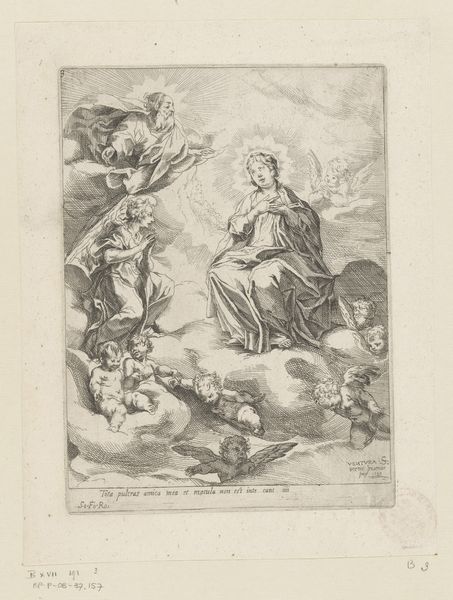
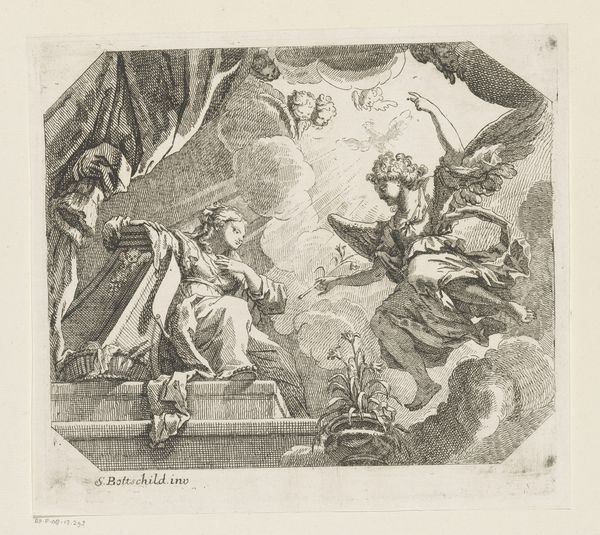
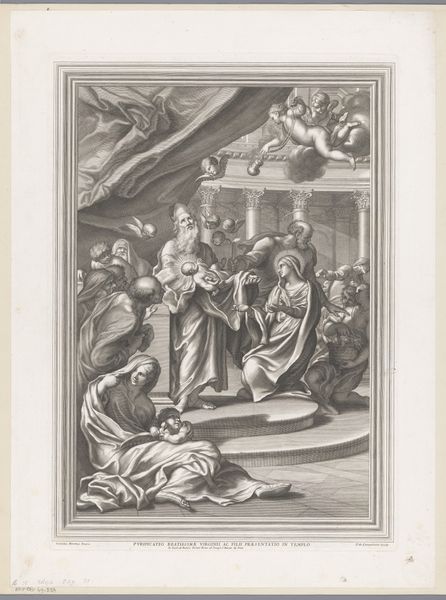
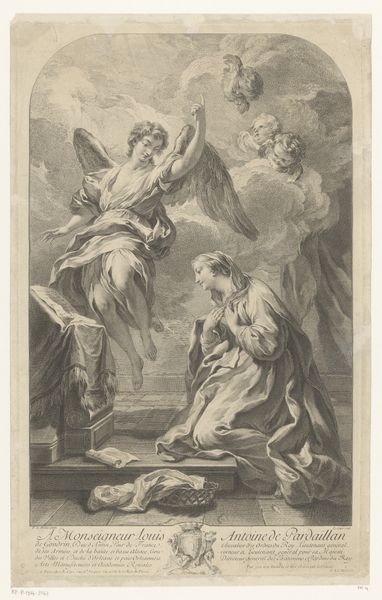
Curator: Here we have François Langot's "Annunciation," an engraving created sometime between 1600 and 1672. Editor: It's a bit theatrical, isn’t it? Dramatic lighting, swirling robes… and cherubs galore. The artist really knew how to stage a scene. Curator: Indeed. Observe how Langot masterfully utilizes line to create depth and texture. The interplay of light and shadow is particularly striking, lending a tangible quality to the divine event. Editor: The divine certainly takes center stage, doesn't it? But I'm struck by how the piece places Mary within a larger political and social framework, reinforcing prevailing power structures of the time through religious allegory. It’s not just a moment of spiritual awakening; it's a depiction of submission within a highly structured world. Curator: An interesting point. However, from a purely formal standpoint, note how the artist uses a Baroque stylistic mode to render space, how he controls tone. I can feel that, more than interpret any immediate political idea. Editor: That’s the core problem with formal analysis. It isolates art from meaningful cultural exchange. It flattens art into mere aesthetics and tone, turning a blind eye to everything but composition. The power relations, the complex subjectivities are disregarded. This risks missing what the image *does*. What social function did Langot hope to achieve with his composition? Curator: Granted, viewing art through a strictly formal lens might limit interpretive horizons, but by turning away from structural issues, one ignores how that impact is manufactured and delivered. Editor: Precisely why interdisciplinary analyses of visual representation are critical. They help us comprehend how images not only reflect but also actively shape cultural realities and historical discourse. Curator: I suppose our dialogue highlights how one artwork can be examined using differing methodologies and perspectives, inviting diverse and perhaps even conflicting readings of its meaning and impact. Editor: Yes. To look at the artist in totality and appreciate the full implication of their work in the wider world, one has to remember this interplay.
Comments
No comments
Be the first to comment and join the conversation on the ultimate creative platform.
 Collect
 React
React Comment
More like this