About this artwork
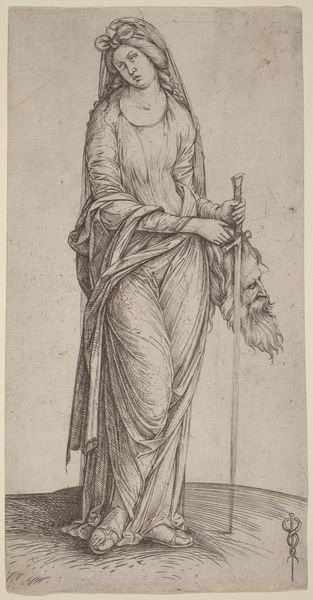
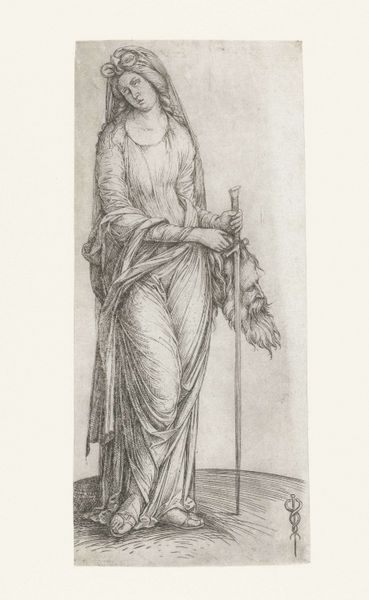
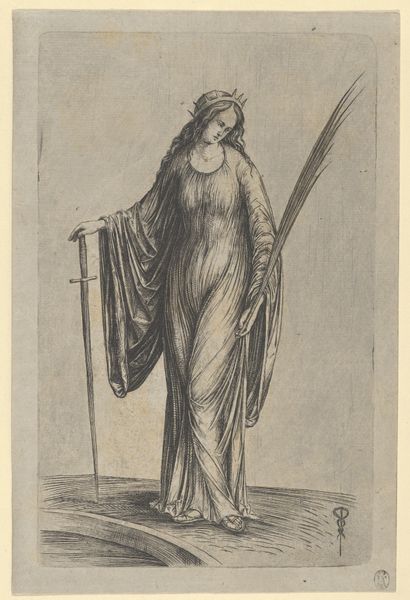
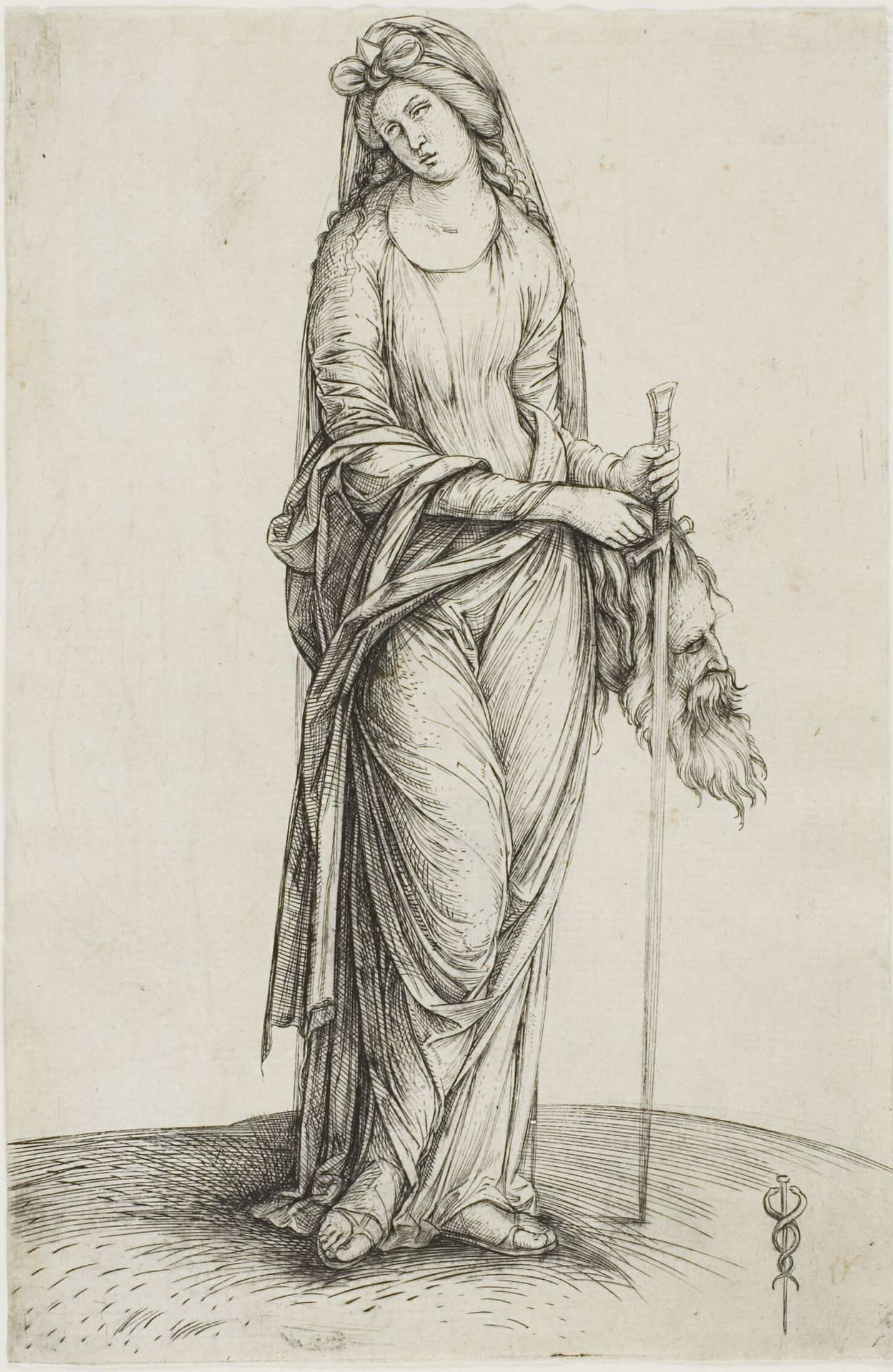
Jacopo de' Barbari created this engraving, "Judith Holding the Head of Holofernes," around the turn of the 16th century. The story of Judith, a widow who saves her people by seducing and then beheading the Assyrian general Holofernes, was a popular subject in Renaissance art, often interpreted through a lens of female empowerment. Here, de’ Barbari complicates that reading by depicting Judith not in triumph, but with a downcast gaze, holding the sword and Holofernes' head with what appears to be some weariness. De’ Barbari presents Judith as a figure caught between roles: the chaste widow, and the forceful heroine. Her androgynous features challenge simple gender norms, and the artist invites us to consider how acts of violence affect even the victor, troubling the line between resistance and retribution. Consider how de' Barbari skillfully captures Judith’s complex emotional state, inviting reflection on the burdens of leadership, cultural expectations, and the personal cost of political action.
Judith Holding the Head of Holofernes
c. 1500


Artwork details
- Medium
- drawing, print, intaglio, paper, engraving
- Dimensions
- 182 × 120 mm (image/sheet, trimmed within platemark)
- Location
- The Art Institute of Chicago
- Copyright
- Public Domain
Tags
Comments
Share your thoughts
About this artwork
Jacopo de' Barbari created this engraving, "Judith Holding the Head of Holofernes," around the turn of the 16th century. The story of Judith, a widow who saves her people by seducing and then beheading the Assyrian general Holofernes, was a popular subject in Renaissance art, often interpreted through a lens of female empowerment. Here, de’ Barbari complicates that reading by depicting Judith not in triumph, but with a downcast gaze, holding the sword and Holofernes' head with what appears to be some weariness. De’ Barbari presents Judith as a figure caught between roles: the chaste widow, and the forceful heroine. Her androgynous features challenge simple gender norms, and the artist invites us to consider how acts of violence affect even the victor, troubling the line between resistance and retribution. Consider how de' Barbari skillfully captures Judith’s complex emotional state, inviting reflection on the burdens of leadership, cultural expectations, and the personal cost of political action.
Comments
Share your thoughts