

1846 - 1876
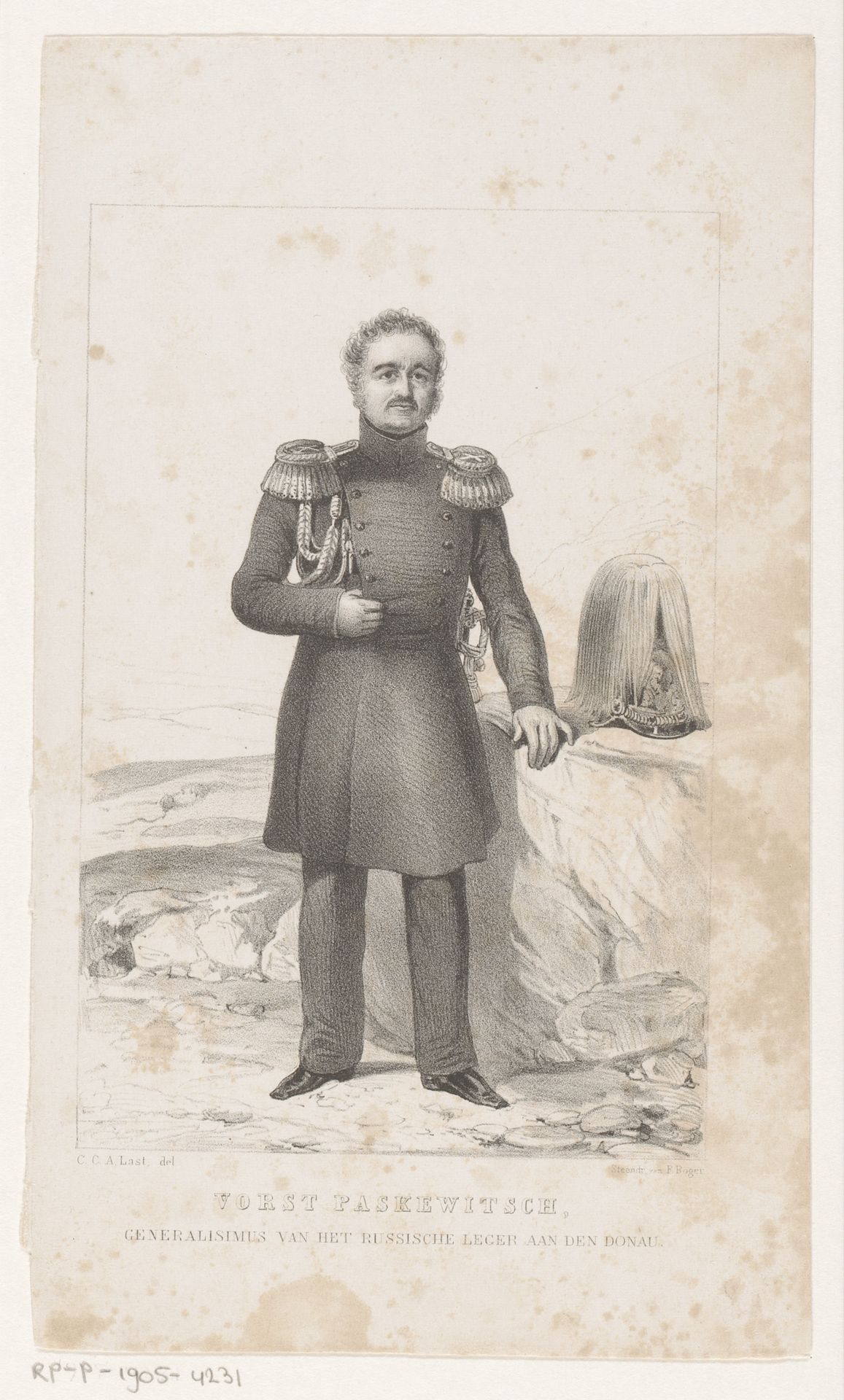
Portret van Iwan Fjodorowitsch Paskewitsch

Carel Christiaan Antony Last
1808 - 1876Location
RijksmuseumListen to curator's interpretation
Curatorial notes
Curator: Here we have an engraving dating from sometime between 1846 and 1876, attributed to Carel Christiaan Antony Last: a portrait of Iwan Fjodorowitsch Paskewitsch, held in the Rijksmuseum collection. Editor: The man’s bearing—imposing but not quite regal—conjures an interesting tension. His stance and dress are undoubtedly designed to communicate authority, yet something in the lines of the engraving softens that initial read. Curator: Let's consider the technique. The details are so fine, particularly in the depiction of the uniform’s embellishments and the textures. Look at the metallic glint suggested through the varying densities of the engraved lines and dots—the labor alone to produce this likeness is astonishing. Editor: Absolutely, the craftsmanship is undeniable, and look at how Last uses symbolism through attire! The elaborate epaulettes, the meticulously rendered decorations...these speak volumes about Paskewitsch's status, even if he doesn't wear a crown, it makes a clear impression about his social placement. Curator: A crucial insight, the uniform, of course, indicates a Generalissmus within the Russian army. The image production underscores power, but it's also bound up with industrial processes that allow that message to circulate so readily, and to a wider public. I'd wager the materiality of the engraving—paper, ink, and the technology required—directly influenced perceptions of Paskewitsch’s power. Editor: A military leader of such stature, however, wasn't meant for mass consumption; thus, I read that slightly melancholic cast in his face—and indeed in the landscape surrounding him—as the weariness and weight of expectation on those meant to embody ideals of national strength. He has become a symbol not of only power but burden of great service to the Russian empire. Curator: In the end, considering the physical nature of the engraving allows us to reassess power not as some abstract ideal, but the outcome of manufacturing, labour, and deliberate circulation strategies in that moment of the nineteenth century. Editor: A perspective shift reminding us that behind every perceived great historical icon, there is a web of imagery meant to uphold his persona and that the visual signifiers contribute to creating our own idea about it.