About this artwork
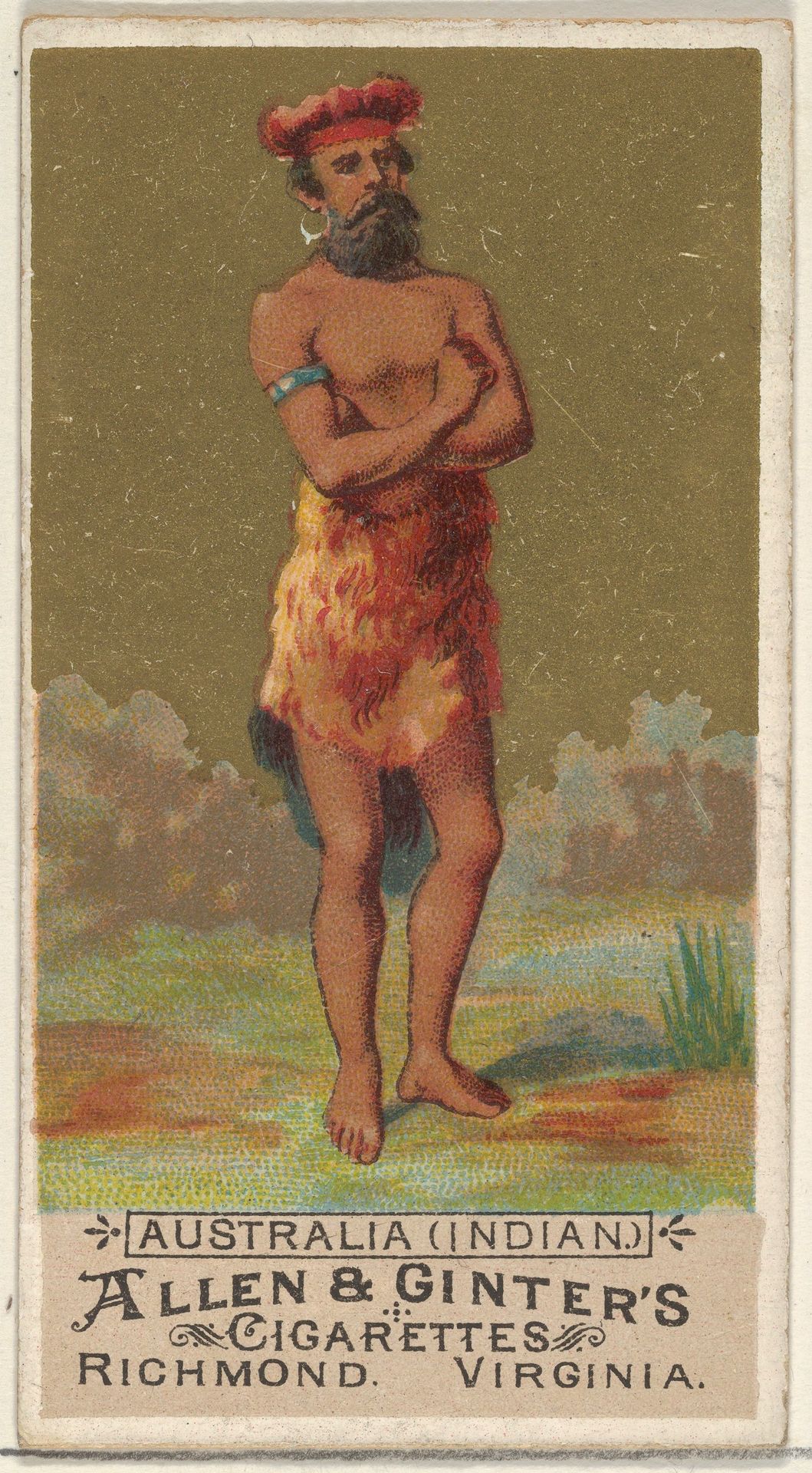
This cigarette card, part of Allen & Ginter’s "Natives in Costume" series, presents a figure labeled "Australia (Indian)." He is adorned with a red headband, armbands, and a skirt made of what appears to be animal hide or fiber. His arms are crossed defensively. Note the way the figure stands, arms tightly crossed. This posture, though simple, echoes across cultures as a sign of defensiveness or reservation, present in classical sculptures and renaissance paintings alike, revealing a universal language of body language. Consider its use by early Renaissance artists to convey the inner turmoil of their subjects. This gesture evokes a palpable sense of cultural tension. Such symbols, once tools of assertion and identity, can be reinterpreted as signs of resistance, highlighting the cyclical and ever-evolving nature of visual language. It is a potent reminder of how cultural symbols persist, transform, and resurface.
Australia (Indian), from the Natives in Costume series (N16) for Allen & Ginter Cigarettes Brands
1886


Artwork details
- Medium
- Dimensions
- Sheet: 2 3/4 x 1 1/2 in. (7 x 3.8 cm)
- Location
- Metropolitan Museum of Art, New York, NY
- Copyright
- Public Domain
Tags
Comments
Share your thoughts
About this artwork
This cigarette card, part of Allen & Ginter’s "Natives in Costume" series, presents a figure labeled "Australia (Indian)." He is adorned with a red headband, armbands, and a skirt made of what appears to be animal hide or fiber. His arms are crossed defensively. Note the way the figure stands, arms tightly crossed. This posture, though simple, echoes across cultures as a sign of defensiveness or reservation, present in classical sculptures and renaissance paintings alike, revealing a universal language of body language. Consider its use by early Renaissance artists to convey the inner turmoil of their subjects. This gesture evokes a palpable sense of cultural tension. Such symbols, once tools of assertion and identity, can be reinterpreted as signs of resistance, highlighting the cyclical and ever-evolving nature of visual language. It is a potent reminder of how cultural symbols persist, transform, and resurface.
Comments
Share your thoughts