![Cranes and Waves [left of a pair] by Soga Shōhaku](https://d2w8kbdekdi1gv.cloudfront.net/eyJidWNrZXQiOiAiYXJ0ZXJhLWltYWdlcy1idWNrZXQiLCAia2V5IjogImFydHdvcmtzL2M1OWY1OWI3LTgyMTAtNGVjNy1iMjdjLWQyZmFjNzg1N2Q1MS9jNTlmNTliNy04MjEwLTRlYzctYjI3Yy1kMmZhYzc4NTdkNTFfZnVsbC5qcGciLCAiZWRpdHMiOiB7InJlc2l6ZSI6IHsid2lkdGgiOiAxOTIwLCAiaGVpZ2h0IjogMTkyMCwgImZpdCI6ICJpbnNpZGUifX19)
c. 1760s
Cranes and Waves [left of a pair]


Listen to curator's interpretation
Curatorial notes
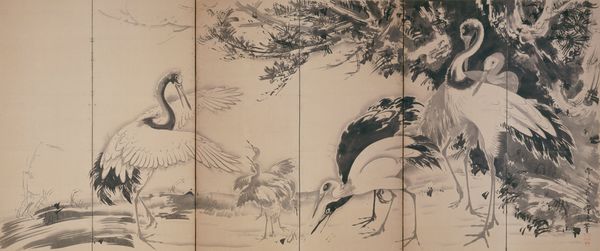
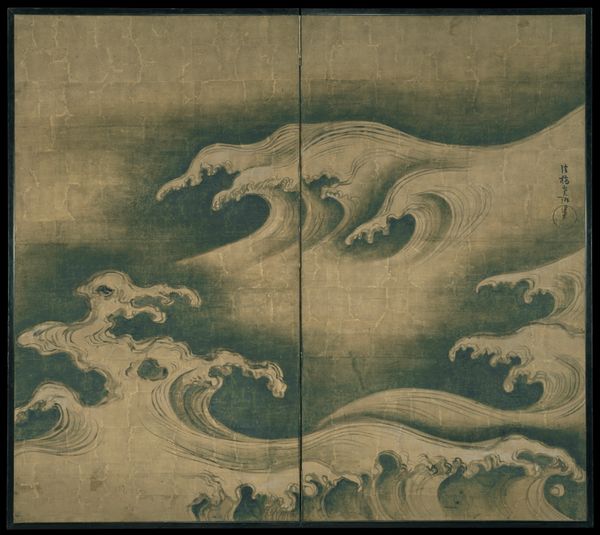
Editor: So, here we have "Cranes and Waves" created around the 1760s by Soga Shōhaku. It's ink on paper, and one half of a pair of screens. What strikes me is how dynamic it is despite the monochrome palette. What stands out to you in terms of visual elements? Curator: The dialectic tension between the agitated waves and the placid crane creates a powerful visual statement. Consider how Shōhaku employs stark contrasts in tonality to delineate form. The application of ink is particularly telling; observe the gestural brushstrokes rendering the roiling waves in contrast to the smoother application defining the crane's plumage. Does this tension provoke questions regarding representation and realism? Editor: It does, the waves are so energetic, almost abstract, while the crane seems more representational. Is that contrast intentional? Curator: Precisely. This tension transcends mere mimesis. Shōhaku seems less interested in perfect replication and more in evoking an emotional response through compositional choices. The interplay between positive and negative space also dictates the movement of the eye across the panels. Editor: So it’s not necessarily about the cranes or the waves themselves, but how they interact on the canvas? The formal arrangement takes precedence over a literal interpretation? Curator: Yes. It is through line, texture and compositional balance that we can decode this work, inviting us to contemplate what it is, beyond a narrative. The artist uses the stark juxtaposition of stillness and motion, rendered solely through ink and brush, to question the viewer's perception. This goes beyond merely *seeing* the image and compels an act of *reading* the piece. Editor: I see what you mean. I was initially drawn in by the image itself, but focusing on the contrast and brushstrokes gives a whole new perspective. Thanks! Curator: Indeed. Paying close attention to form enables a greater understanding of content and function within an aesthetic framework.