

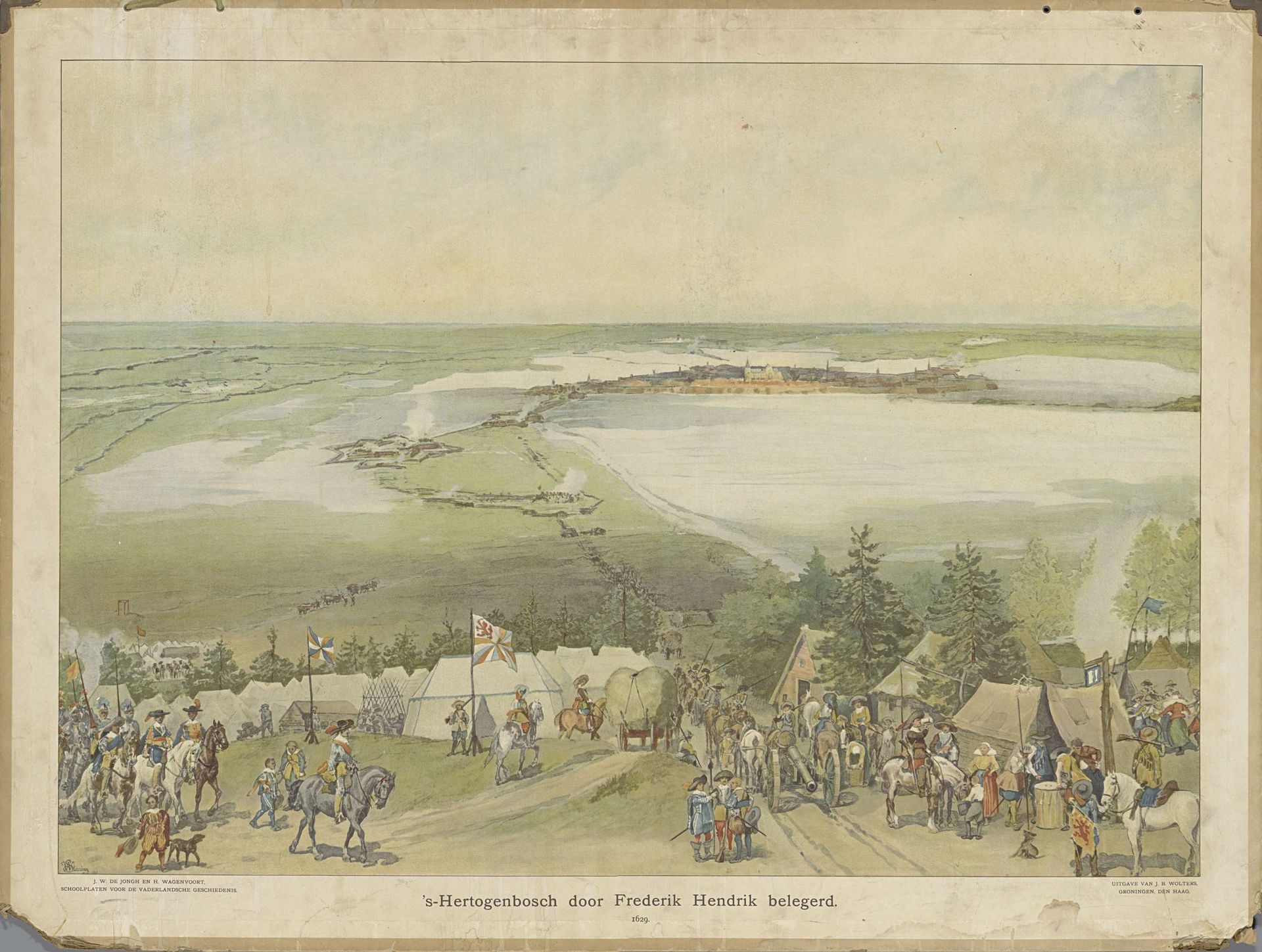
1911
's-Hertogenbosch door Frederik Hendrik belegerd 1629

Listen to curator's interpretation
Curatorial notes
Editor: Here we have Willem Constantijn Staring's "'s-Hertogenbosch door Frederik Hendrik belegerd 1629," created in 1911, using watercolor and coloured pencil. The light palette gives it a calm feeling, despite depicting a siege. What stands out to you in this piece? Curator: For me, it’s the very process of creating this image in 1911 to represent an event from 1629. Look at the use of watercolour and colored pencil, common materials found in personal sketchbooks. How does that inform our understanding of historical documentation and the means through which historical narratives are constructed? What is the artist suggesting by returning to this historical event? Editor: That's a good point, I didn't really consider that. So you're focusing on how the *act* of creating this after the fact colors its meaning? Curator: Precisely. It’s not just a historical painting; it's a late historical *representation* made through readily available and relatively inexpensive material –raising questions about labor, accessibility and consumption. Staring deliberately used craft media. I wonder, were other, ‘finer’ materials rejected or unavailable? Is this then about bringing grand historical narrative into the sphere of domesticity? Editor: So, by using everyday materials, Staring democratizes a historical moment, making it relatable rather than simply heroic? I guess it challenges this boundary between “high art” and the art of everyday life? Curator: Exactly. Consider too how widespread illustrations like these became via mass production in the early 20th century, shaping popular historical consciousness. We aren’t only viewing a siege, but also observing the manufacturing of history itself. Editor: Wow, that shifts my perspective. I was just seeing a pretty landscape, but now I recognize how the medium itself speaks to accessibility and challenges conventional ideas of historical representation. Curator: Indeed, it shows us that even the choice of materials has an important contribution to how historical narratives are delivered and perceived by mass audience.