

1907
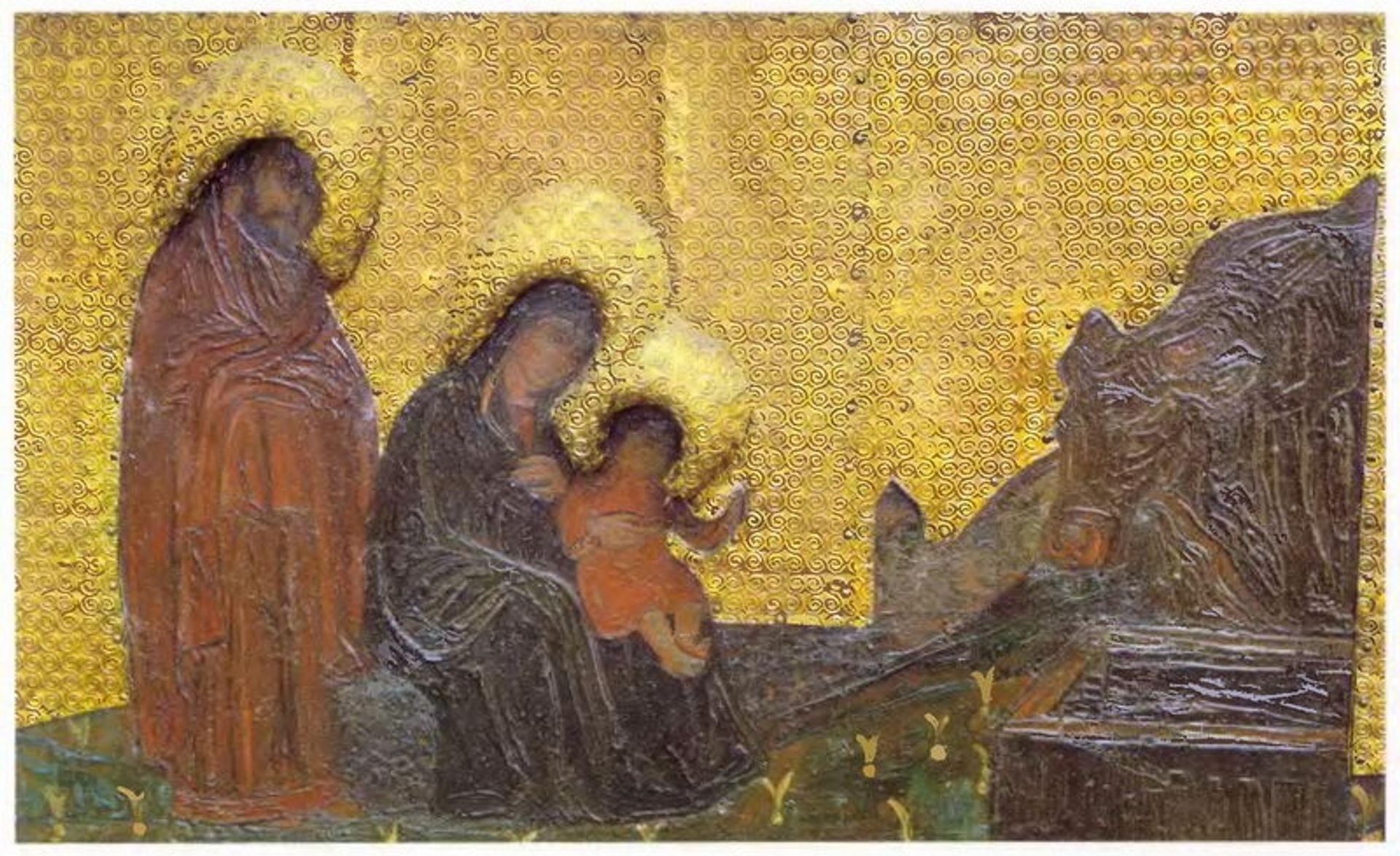
The Virgin Holidays. Introduction of the Virgin in Temple. Holy Family.

Nicholas Roerich
1874 - 1947Location
Perm State Art Gallery, Perm, RussiaListen to curator's interpretation
Curatorial notes
Curator: Look at the radiant shimmer of this work by Nicholas Roerich, created in 1907. It's entitled *The Virgin Holidays. Introduction of the Virgin in Temple. Holy Family*. It is crafted with tempera and is part of the collection at the Perm State Art Gallery in Russia. Editor: It feels very raw, almost archaic, despite its relatively recent creation. The limited color palette, combined with that dazzling golden backdrop, gives it a sort of solemn monumentality. Curator: The application of tempera, itself a very traditional, almost archaic medium, contributes to that impression, I think. Roerich was very interested in historical continuity, linking present artistic production to ancient methods and, importantly, to spiritual traditions. He wasn't simply recreating medieval icons; rather, he integrated their visual language into his modern artistic vision. Editor: And look how that integration isn’t seamless – the rough textures, the visibly worked surface, it’s like he’s showing us the process of creating meaning. The deliberate mark-making transforms what could be a purely devotional image into something quite visceral, something you can almost feel the maker's hand in. Considering the Russian art scene at the time, it's pretty fascinating that Roerich combined the modernist art world with the Medieval past. Curator: Absolutely. And notice, too, how the socio-political context of early 20th-century Russia, with its yearning for national identity and spiritual revival, surely influenced Roerich's approach. His choices also resonated within broader European trends, movements which grappled with pre-industrial, handmade quality in contrast to mass-produced industrial objects. It’s no accident he’s embracing craft, embracing what's considered a pre-modern set of techniques. Editor: The scale of this artwork, too, affects its impact. Standing before it, you might appreciate how it avoids becoming overly precious. Its substantial size ensures the piece actively demands consideration, urging us to not just passively admire it but contemplate the conditions surrounding its making and the religious connotations embedded within its imagery. Curator: I agree. It’s interesting how an artist can evoke a sense of the past while also pushing against conventional expectations of that past. Editor: Precisely. It challenges simple classification, resisting categorization as merely pastiche, opening us up to deeper examination of his process. Curator: Exactly, let's think about these interwoven narratives when we move on.