drawing, watercolor
#
portrait
#
drawing
#
narrative-art
#
landscape
#
figuration
#
watercolor
#
romanticism
#
watercolour illustration
#
genre-painting
#
watercolor
Dimensions: sight size: 30.7 x 37.8 cm (12 1/16 x 14 7/8 in.) framed: 40.6 x 47.6 cm (16 x 18 3/4 in.)
Copyright: National Gallery of Art: CC0 1.0
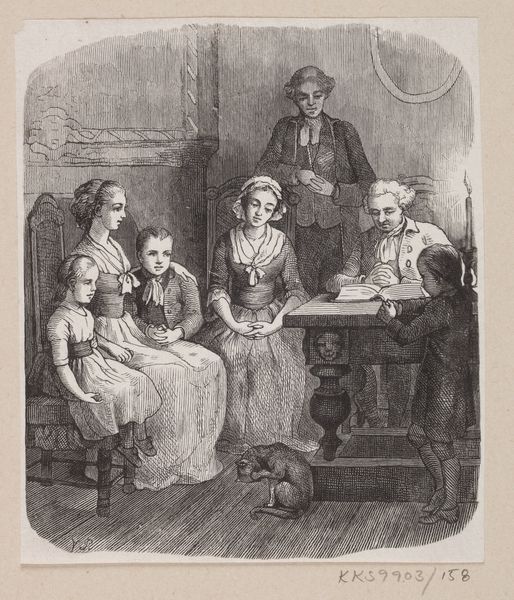
Editor: This watercolor drawing, "The Cotters Saturday Night," was created around 1815 by Eunice Pinney. It depicts a family gathered indoors, maybe reading? I find the stiff figures and oddly proportioned architecture really intriguing; almost like folk art with a political edge. What are your initial thoughts looking at it? Curator: It’s interesting that you see a political edge. Pinney worked during a period where art began to take on a public role. Consider the rise of nationalism and the construction of national identities at this time. Do you think that this seemingly simple domestic scene might be participating in a broader narrative? Editor: Maybe. The faces are so solemn, it feels like more than just a family evening. Is it about idealizing a certain kind of life? Curator: Exactly! This image engages with ideas of virtue and domesticity which were considered important moral touchstones in society. The emphasis on reading, likely religious texts, is very deliberate. Notice also the care given to depicting objects of simple, domestic life – the plates, the hanging hat, the candle. It is likely connected to promoting particular social values. Editor: So, it’s not just a snapshot of a family, but a carefully constructed statement about social and cultural values? It’s like a stage setting. Curator: Precisely! Think about how art institutions even then, such as newly founded museums, began shaping public taste and dictating what was valuable to portray. Even seemingly straightforward imagery could be part of that project. It is important to question which perspectives and values are highlighted and normalized in artwork of this type. Editor: That makes me think differently about the work. It's not just a charming scene, but a carefully constructed image operating within its specific historical and social context. I’ll definitely view art with a more critical eye now. Curator: It is rewarding to examine what we choose to frame, exhibit, and admire as a society and question the narratives that emerge.
Comments
No comments
Be the first to comment and join the conversation on the ultimate creative platform.
 Collect
 React
React Comment
More like this