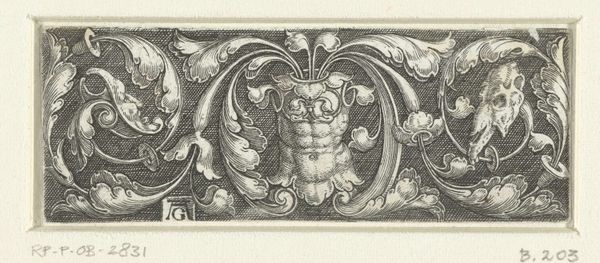
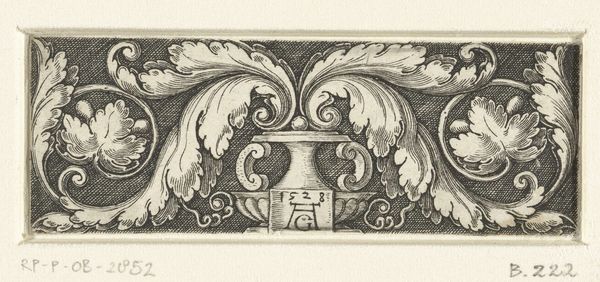
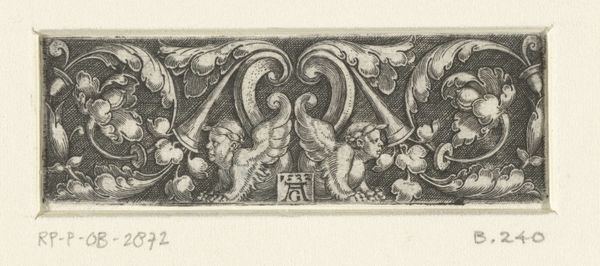
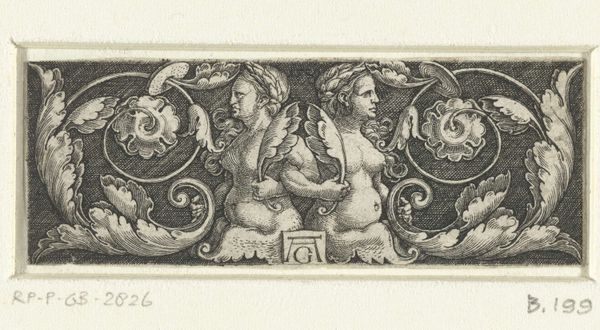
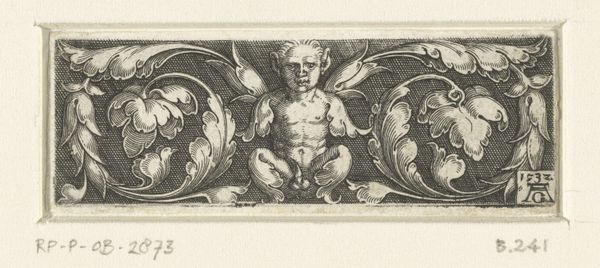
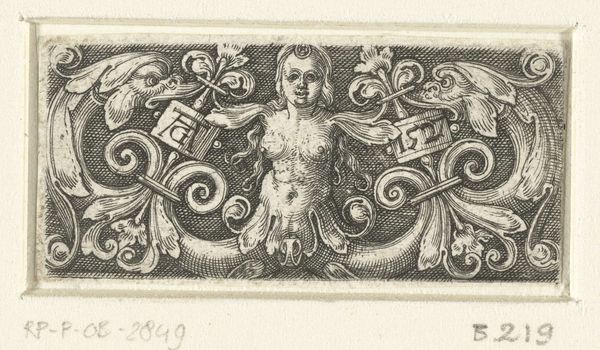
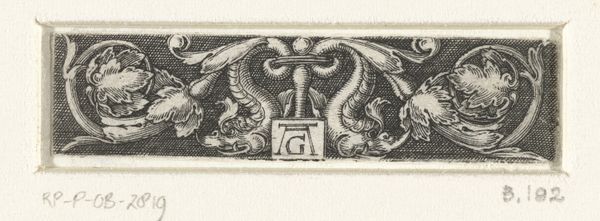
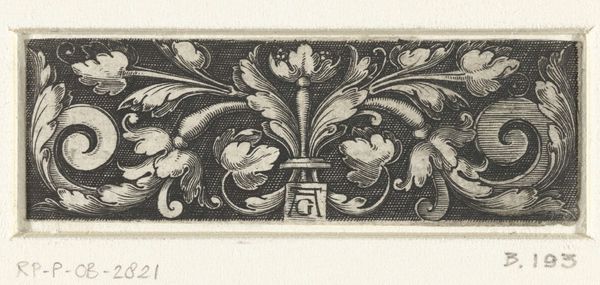
Fries met het bovenlichaam van een kind tussen twee dolfijnen. 1512 - 1560
0:00
0:00

heinrichaldegrever
Rijksmuseum
print, engraving
#
pen drawing
# print
#
figuration
#
line
#
northern-renaissance
#
engraving
Dimensions: height 25 mm, width 55 mm
Copyright: Rijks Museum: Open Domain
Editor: This is "Fries met het bovenlichaam van een kind tussen twee dolfijnen" by Heinrich Aldegrever, created sometime between 1512 and 1560. It's an engraving. It looks quite detailed. What can you tell me about it? Curator: This print intrigues me from a materialist perspective. Consider the production of prints like these during the Northern Renaissance. What kind of labor went into creating the engraved plate? How were these images circulated, and who had access to them? It suggests the rise of a market for portable, reproducible images. Editor: So it wasn't necessarily about high art, but more about access and distribution? Curator: Precisely. We must ask ourselves, what kind of social relationships did this kind of production enable? Engravings like this allowed for the wider dissemination of ideas and aesthetics. Consider the status of the engraver, then – were they seen as craftspeople, artists, or something in between? Editor: That’s a great point! I was so focused on the subject matter itself—the child and the dolphins—that I didn’t really think about the production aspect. Curator: The subject matter itself is almost secondary, in a way. The cherubic figure and dolphins, common Renaissance motifs, are visually interesting, sure. But really, this work exemplifies how art creation and consumption reflect economic and social forces at play. What do you think was its purpose? Decoration? Education? Editor: Maybe both? Now that I think about it, the very existence of multiples made it accessible. It completely changes my interpretation. Curator: And that's the power of the materialist approach: to shift the focus from individual genius to the broader context of artistic production and consumption. Editor: I'll definitely look at prints, and all art, in a new light. Thank you!
Comments
No comments
Be the first to comment and join the conversation on the ultimate creative platform.
 Collect
 React
React Comment
More like this