engraving
#
allegory
#
baroque
#
old engraving style
#
botany
#
engraving
Dimensions: height 75 mm, width 132 mm
Copyright: Rijks Museum: Open Domain
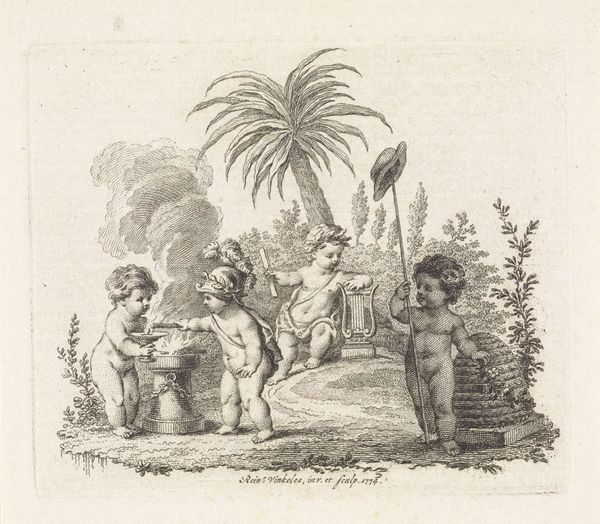
Bernard Picart crafted this allegory on botany with etching around 1713. We see cherubic figures amidst a diverse collection of potted plants, each species meticulously rendered. These cherubs, often associated with divine love and innocence, here embody the nurturing spirit of botany itself. This is not their only symbolism: we often see cherubs representing the souls of the dead in antiquity. But what of the plants? Consider the aloe vera in the foreground, a plant known for its medicinal properties. This recalls the ancient Greek association of plants with healing and divine knowledge, echoing through time to find resonance in contemporary medicine. Note how Picart captures the diverse textures and forms of each leaf and stem. The act of close observation in botany mirrors the act of interpretation in art, revealing the hidden layers of meaning. This engraving thus becomes an invitation to contemplate the cyclical relationship between nature, knowledge, and the human spirit.
Comments
No comments
Be the first to comment and join the conversation on the ultimate creative platform.
 Collect
 React
React Comment
More like this