carving, sculpture, marble
#
portrait
#
medieval
#
carving
#
head
#
stone
#
sculpture
#
sculpture
#
marble
Dimensions: 17.5 cm (height) x 12 cm (width) x 13.5 cm (depth) (Netto)
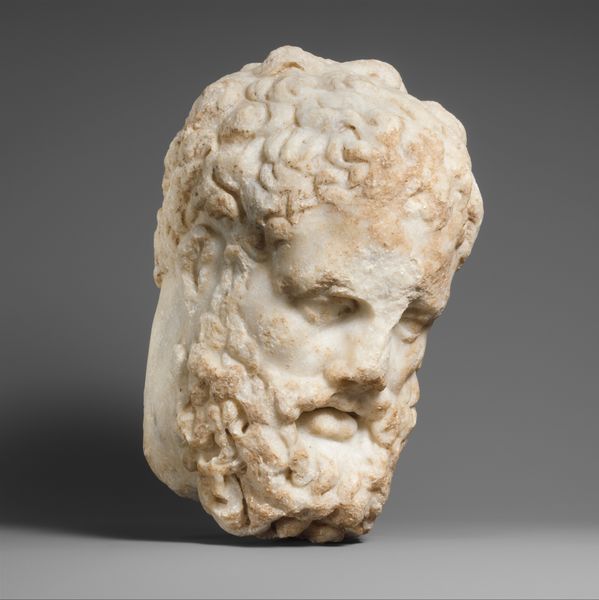
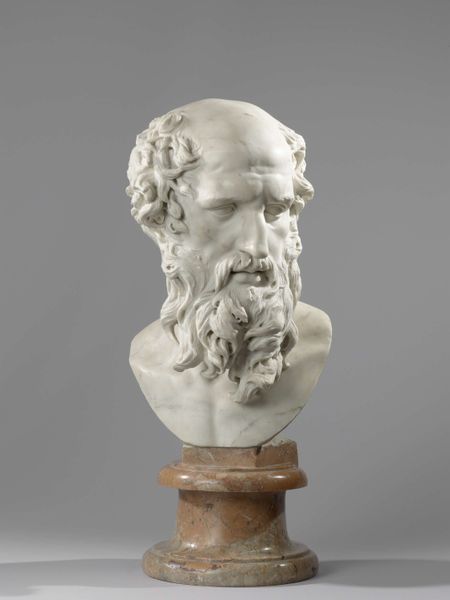
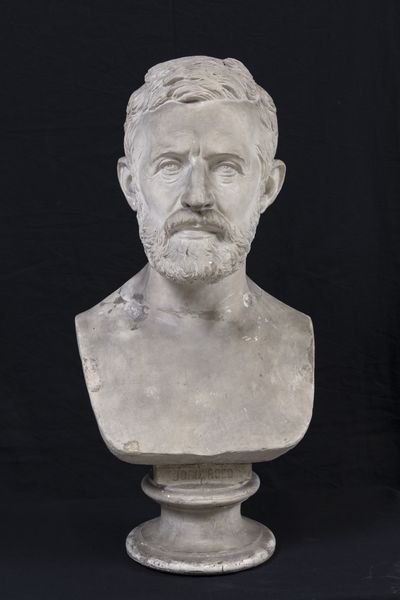
Editor: Here we have Giovanni Pisano’s “Head of a Bearded Man,” carved from marble around 1312-1314. There's a real intensity in his face; I immediately notice the furrowed brow and piercing gaze. What kind of statement do you think Pisano was trying to make? Curator: Pisano certainly wasn't aiming for passive beauty here. What do you make of the beard, the way it’s sculpted? Editor: It's very stylized, almost abstract, a mass of swirling forms. It feels more symbolic than realistic. Curator: Exactly. Think of the beard not just as facial hair, but as a symbol of wisdom, of age, of authority. During the medieval period, beards carried significant cultural weight. Editor: So, this isn't just a portrait, but a representation of power? Curator: It could be, or a carefully constructed symbol of the ideal man. Look at the period. There’s a tension growing between the religious and the more worldly ideas that feed the incoming Renaissance. He's negotiating ideas of classical wisdom with perhaps the stern authority of the church. He doesn’t quite belong to one set of ideals, does he? Editor: No, not really. He's caught between worlds, it seems. All that cultural memory is really packed into this one head! I would have just walked past without thinking about that! Curator: Cultural memory is a powerful thing, especially when an artist uses it consciously, which I think Pisano does here. We, today, bring something new, and still feel this portrait’s significance.
Comments

statensmuseumforkunst about 2 years ago
⋮
The head, an example of Italian late Gothic art, is believed to be by Giovanni Pisano who trained under his father Nicola Pisano (c. 1220/1225 - c. 1284) at his workshop, his so-called “botecca”.Style and techniqueIn terms of style and technique the head is reminiscent of the many sculptures appearing in the reliefs and pedestal bases of his principal work: the pulpit at the baptistery in Pisa, which was carve from marble between 1302 and 1310.Recent studies show that the head is presumably from the sepulchral monument, now destroyed, created for Margaret of Luxembourg in 1311.The sculpture's dramatic styleGiovanni Pisano was the greatest sculptor of his day because he mastered the art of assimilating the reliefs of classical Antiquity, used e.g. on sarcophagi, combining it with his own dramatic and highly narrative style.The face is very expressive and lifelike for its time. The drama is accentuated by the pronounced contrasts between light and shadow created by the holes bored into the hair and beard. Even the eyes have been brought to life with drilled holes. Highlights 2005, Eva de la Fuente Pedersen.


Join the conversation
Join millions of artists and users on Artera today and experience the ultimate creative platform.
 Collect
More like this