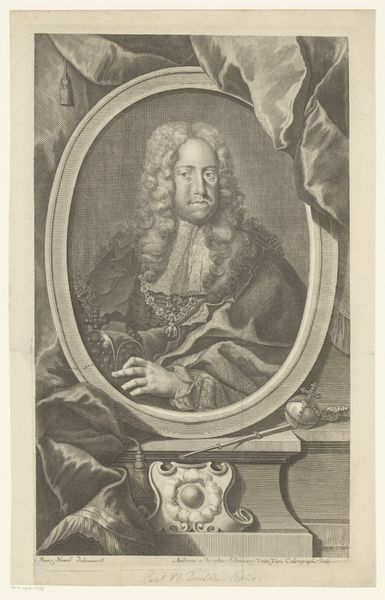
Portret van Willem II, prins van Oranje-Nassau, liggend op een steen 1734 - 1785
0:00
0:00

janstolker
Rijksmuseum
print, engraving
#
portrait
#
narrative illustration
#
baroque
# print
#
old engraving style
#
traditional media
#
caricature
#
history-painting
#
engraving
Dimensions: height 261 mm, width 180 mm
Copyright: Rijks Museum: Open Domain
Curator: Looking at this engraving by Jan Stolker, created sometime between 1734 and 1785, I’m struck by the peculiar blend of formality and almost satirical caricature. It’s titled "Portret van Willem II, prins van Oranje-Nassau, liggend op een steen"—Portrait of William II, Prince of Orange-Nassau, lying on a stone. Editor: My first impression is the overall strange arrangement of symbols. It’s baroque but with this bizarre lightning strike coming out of nowhere! The figure, although centered, feels off-kilter somehow, almost like a political cartoon. Curator: Exactly! Consider how rulers were traditionally depicted. Often with power symbols. Here, although armour alludes to strength, the inscription beneath—"Ridete quicquid domi est cachinnorum," or "Laugh at everything at home that is of laughter"—undermines the power ideal and points at domestic discord, I imagine, back in his personal life. The Rijksmuseum context frames it as more than just portraiture. Editor: So it's playing with his image, creating some public theater around the person of William II. The inclusion of specific iconography, like the column which usually implies the strengths, is softened by flowers, and is it only me or is that odd little face rather amusing. I feel that this work plays a huge role to deconstruct the iconization of such historical figures as William II. Curator: I completely agree. By exaggerating the likeness and embedding satirical elements, the print participates in, and possibly influences, the public’s perception and cultural memory of William II. Images are powerful cultural tools in shaping how future generations perceived him. Editor: So even centuries later, looking at it here, the caricature quality triggers almost an irreverent reaction in the contemporary eye, revealing how even traditional media may have the potential of a political spin. Curator: And through these subversive portrayals, cultural values and power dynamics of that era find continued expression into our time, sparking diverse reactions. Editor: Quite true! This image challenges a clearcut and traditional depiction of royalty by engaging into the emotional charge triggered in public media, allowing viewers from every time to rethink who they praise, fear, or hate.
Comments
No comments
Be the first to comment and join the conversation on the ultimate creative platform.
 Collect
 React
React Comment
More like this