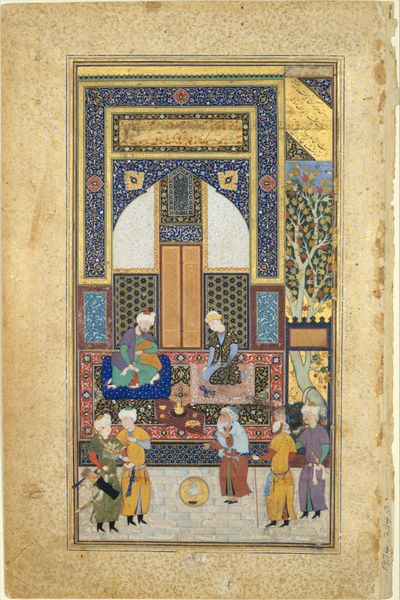
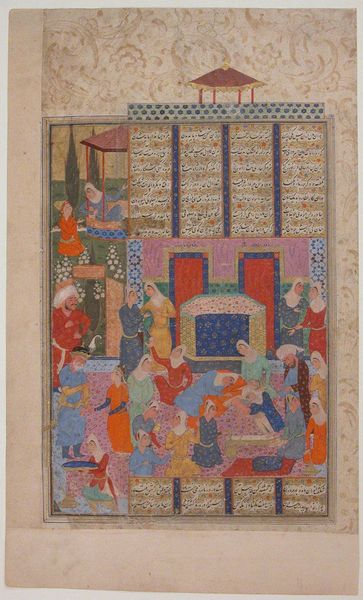
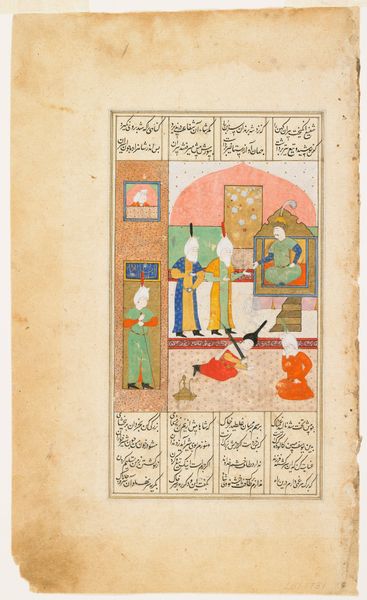
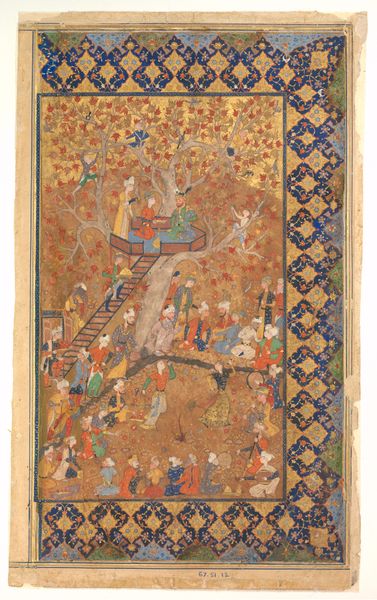
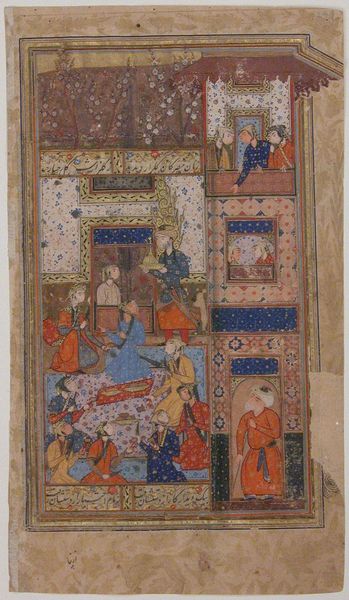
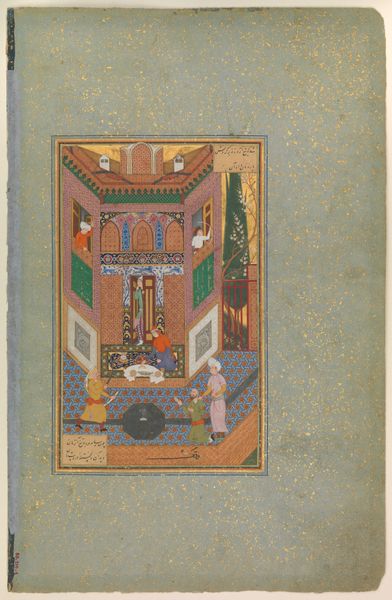
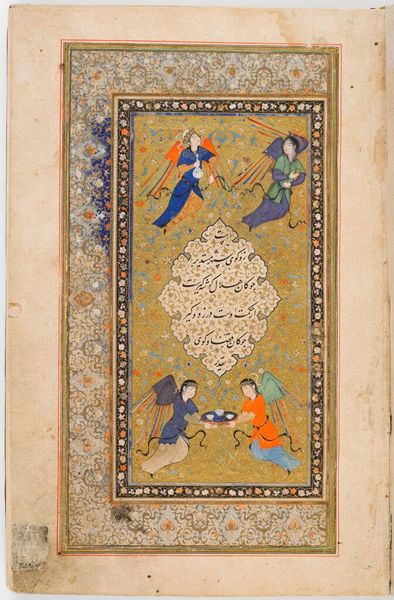
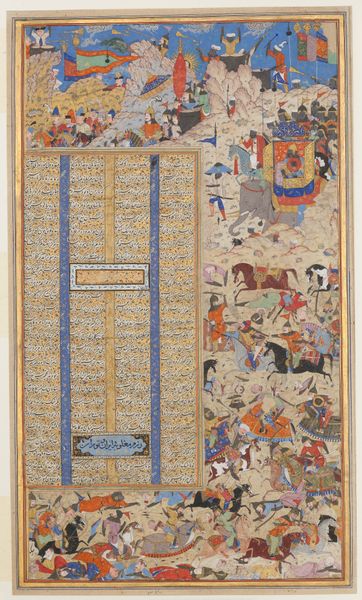
"A Scene of Conviviality at Court", Folio from a Divan (Collected Works) of Mir 'Ali Shir Nava'i 1555 - 1605
0:00
0:00


painting, watercolor
#
narrative-art
#
painting
#
watercolor
#
men
#
islamic-art
#
genre-painting
#
miniature
#
watercolor
Dimensions: Painting: H. 9 in. (22.9 cm) W. 5 7/8 in. (14.9 cm) Page: H. 10 5/8 in. (27 cm) W. 6 1/2 in. (16.5 cm) Mat: H. 19 1/4 in. (48.9 cm) W. 14 1/4 in. (36.2 cm)
Copyright: Public Domain
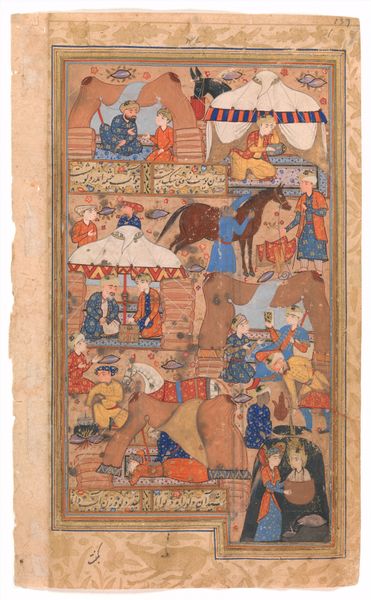
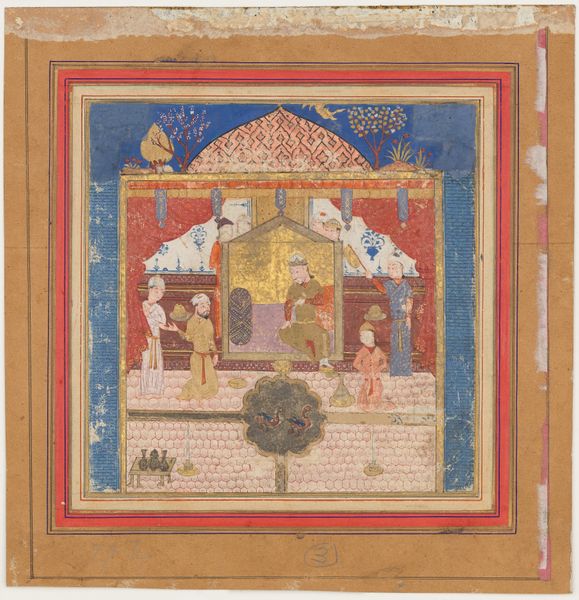
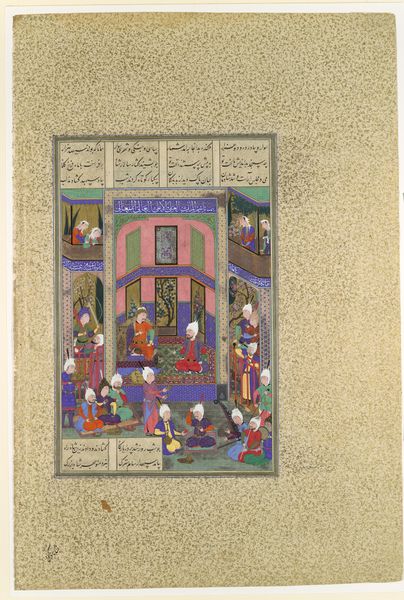
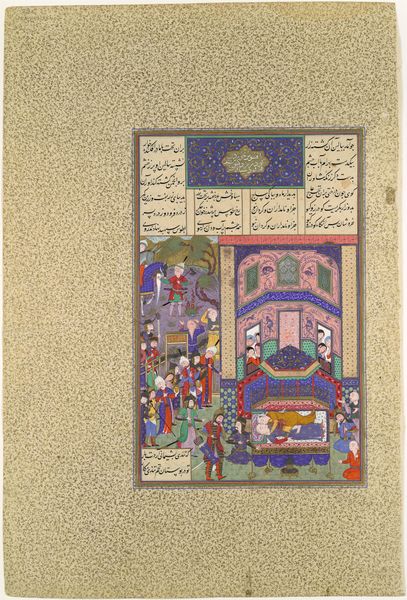
Editor: This is "A Scene of Conviviality at Court," a watercolor folio from a Divan of Mir 'Ali Shir Nava'i, dating from 1555 to 1605. It feels so vibrant, almost jewel-like, despite being a miniature. The intricate details draw me in. How do you interpret this work from an art expert’s perspective? Curator: Initially, consider the masterful application of watercolor. The medium itself lends a luminosity that contributes to the vibrant quality you observed. Notice how the artist uses color not naturalistically, but structurally. The contrasting hues of the figures against the ground create a dynamic surface. The decorative border isn't merely ornamental; it echoes the patterns within the scene, reinforcing a sense of structured harmony. Editor: So, it's about the relationship between the colors and shapes, not necessarily what they represent? Curator: Precisely. While narrative certainly exists, the formal arrangement transcends mere illustration. Observe how the artist has rendered the figures – they are almost flattened, stylized. It serves to emphasize the composition as a unified, decorative plane rather than a three-dimensional space. The perspective is intentionally ambiguous. The purpose isn't realism; it’s about design and the interplay of forms. What visual elements strike you the most? Editor: I see how the repeated motifs and flattened perspective create a distinct visual language, prioritizing aesthetic unity over realistic representation. I hadn't fully appreciated the impact of the stylistic choices on the overall composition. Thanks! Curator: Indeed, it’s in these formal relationships that the artwork's true power resides. Close study reveals a rich visual texture crafted from deliberate artistic choices.
Comments
No comments
Be the first to comment and join the conversation on the ultimate creative platform.
 Collect
 React
React Comment
More like this