drawing, print, etching, paper
#
drawing
# print
#
impressionism
#
etching
#
figuration
#
paper
#
cityscape
#
genre-painting
#
watercolor
Dimensions: height 402 mm, width 568 mm
Copyright: Rijks Museum: Open Domain
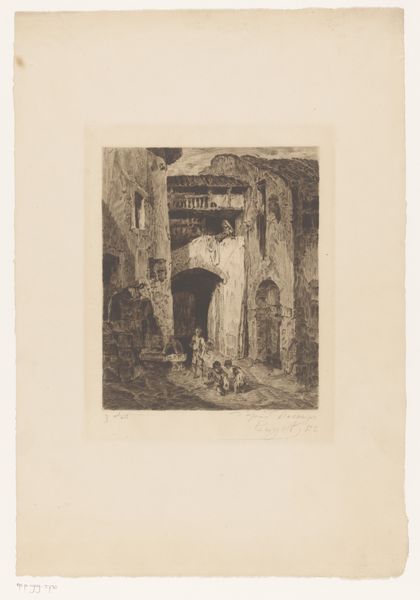
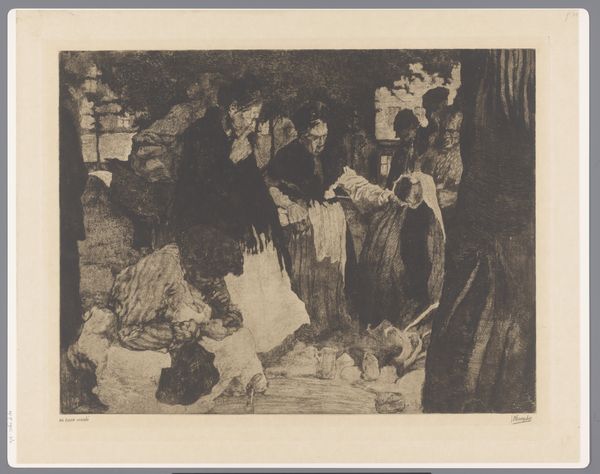
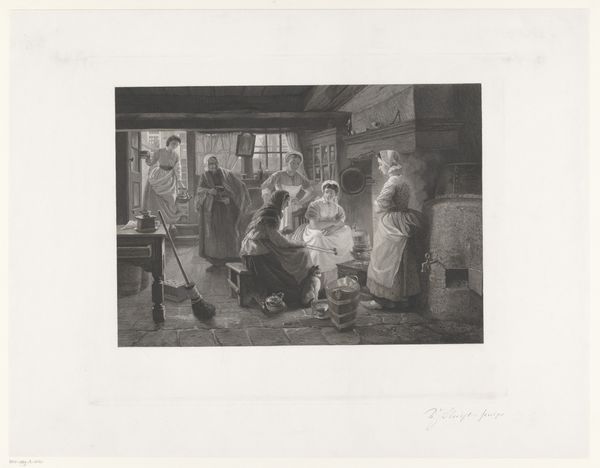
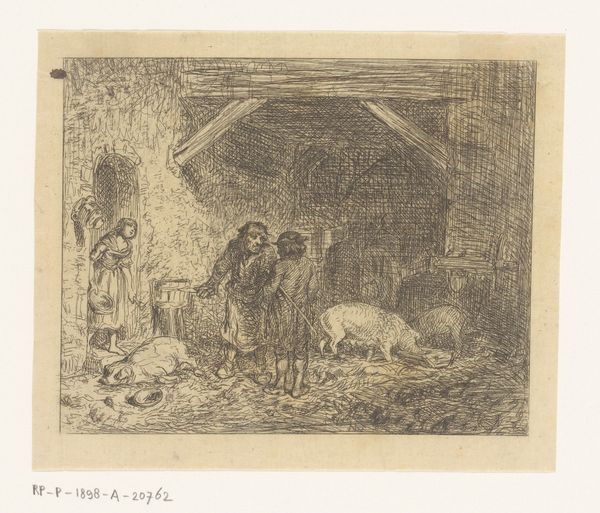
Editor: Here we have Philip Zilcken's "Families Walking Down a Wooden Staircase," an etching from 1888 held in the Rijksmuseum. The print depicts a bustling urban scene, almost a slice of daily life, rendered in stark lines and shadows. What draws my attention is the somewhat chaotic energy, with figures emerging from the structure, set against a backdrop of the city. What are your first thoughts? Curator: The seeming chaos you observed is a deliberate artistic choice. Consider the period: late 19th-century urbanization was rapidly changing the social landscape. Artists were increasingly interested in capturing the lived experience of the working class, the transient spaces of cities. Notice how Zilcken uses etching to create a sense of depth, but also visual noise. The institution exhibiting it also informs how this scene of quotidian life is valued, framed as worthy of contemplation in an important collection. What does this say about the power of representation? Editor: So, the setting isn't just a backdrop, but is integral to understanding the artwork’s meaning? Are you saying it comments on societal conditions? Curator: Precisely. It suggests a specific socio-economic environment, even hints at a commentary on social mobility given the emphasis on a transient state—families descend a staircase that belongs neither to them in entirety, or does it allow ascent without effort. Further, think about who *doesn't* get depicted. This raises questions about the selective nature of art historical narratives and their potential biases. Editor: I hadn't considered the implied socio-economic element of the movement through space. And the bias toward including certain types of people as the only worthy subject matter is even more interesting. Curator: Indeed. Zilcken offers not just a scene but a snapshot of a culture undergoing radical transformation and the institution framing the art adds another layer to the social relevance of this visual story. Editor: This makes me view it through a different lens, thank you. Curator: My pleasure, recognizing those complexities within what at first seems to be only just a simple image provides depth in looking at all works of art.
Comments
No comments
Be the first to comment and join the conversation on the ultimate creative platform.
 Collect
 React
React Comment
More like this