About this artwork
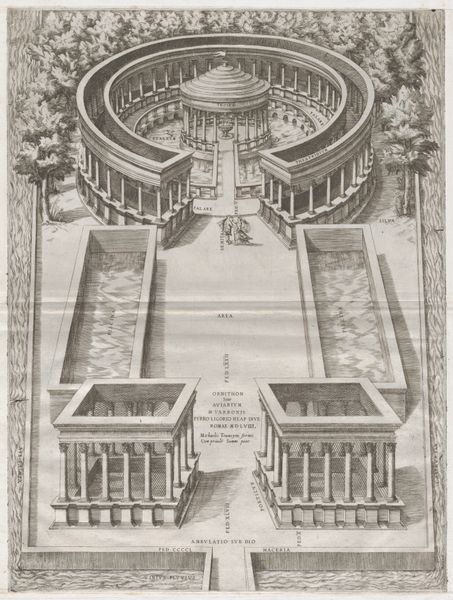
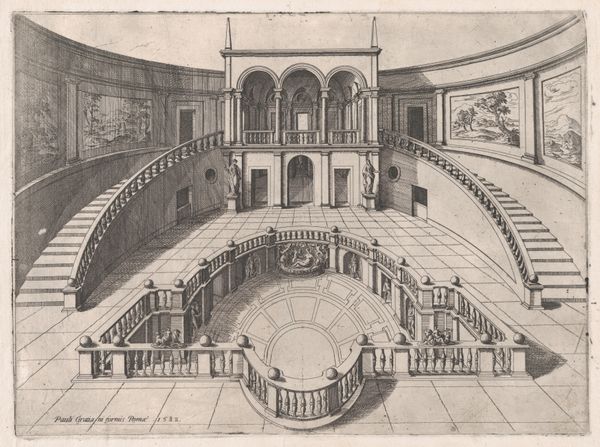
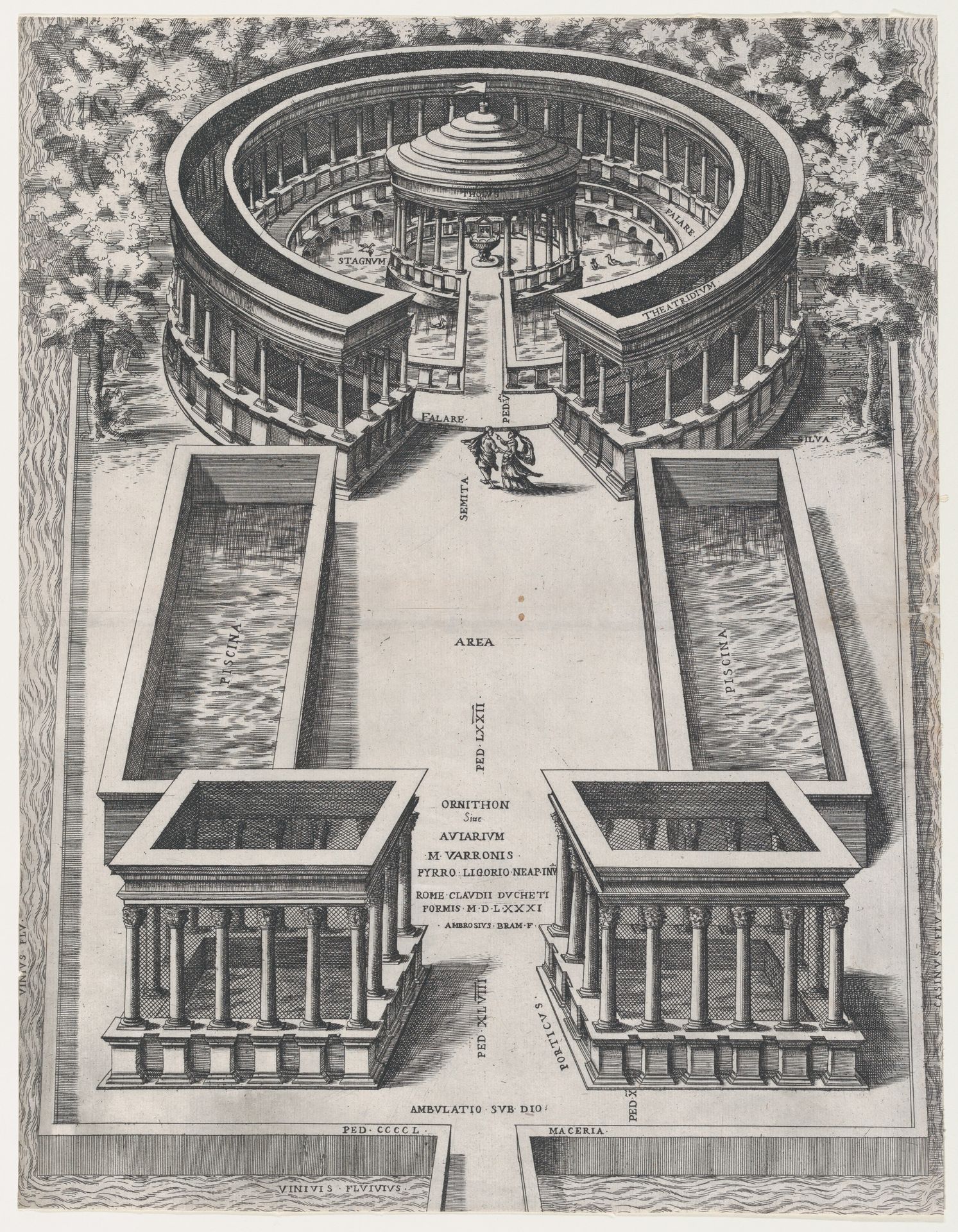
Giovanni Ambrogio Brambilla created this engraving, "Speculum Romanae Magnificentiae: Ornithon Sive Aviarum," around 1590. Note how the composition is rigidly structured with bilateral symmetry, giving the architectural space a sense of order and control. The print depicts an elaborate aviary. Brambilla meticulously renders each element, from the circular colonnade to the geometrically arranged pools, all contributing to the artwork's formal clarity. The strong contrast between the dark, densely etched areas and the white of the paper creates a striking visual texture, emphasizing the architectural details. This formal approach speaks to a broader cultural interest in the Renaissance with classical antiquity, seeking to reconstruct and understand the grandeur of ancient Roman structures through precise and detailed representation. The print not only documents but also interprets the architectural space, presenting it as a symbol of humanist ideals of order, reason, and the pursuit of knowledge.
Speculum Romanae Magnificentiae: Ornithon Sive Aviarum
1581

Giovanni Ambrogio Brambilla
1575 - 1599
The Metropolitan Museum of Art
Metropolitan Museum of Art, New York, NYArtwork details
- Medium
- drawing, print, etching, engraving, architecture
- Dimensions
- sheet: 18 1/4 x 14 1/8 in. (46.4 x 35.9 cm)
- Location
- Metropolitan Museum of Art, New York, NY
- Copyright
- Public Domain
Tags
Comments
Share your thoughts
About this artwork
Giovanni Ambrogio Brambilla created this engraving, "Speculum Romanae Magnificentiae: Ornithon Sive Aviarum," around 1590. Note how the composition is rigidly structured with bilateral symmetry, giving the architectural space a sense of order and control. The print depicts an elaborate aviary. Brambilla meticulously renders each element, from the circular colonnade to the geometrically arranged pools, all contributing to the artwork's formal clarity. The strong contrast between the dark, densely etched areas and the white of the paper creates a striking visual texture, emphasizing the architectural details. This formal approach speaks to a broader cultural interest in the Renaissance with classical antiquity, seeking to reconstruct and understand the grandeur of ancient Roman structures through precise and detailed representation. The print not only documents but also interprets the architectural space, presenting it as a symbol of humanist ideals of order, reason, and the pursuit of knowledge.
Comments
Share your thoughts