print, engraving
#
allegory
# print
#
figuration
#
11_renaissance
#
history-painting
#
engraving
Dimensions: width 193 mm, height 255 mm
Copyright: Rijks Museum: Open Domain
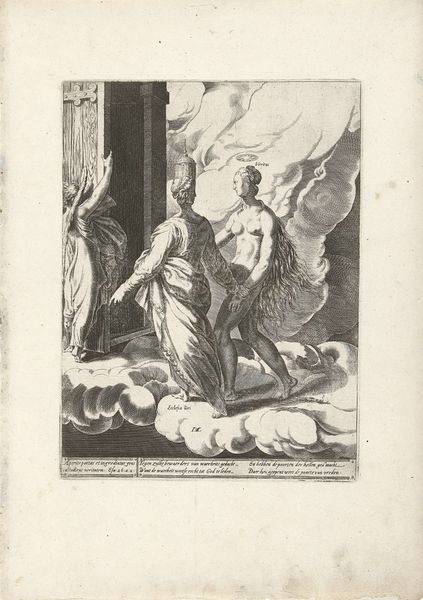
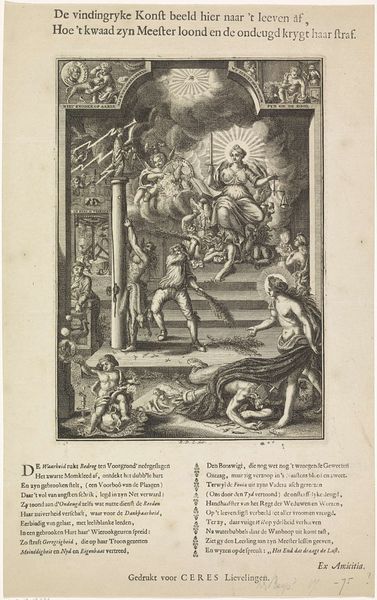
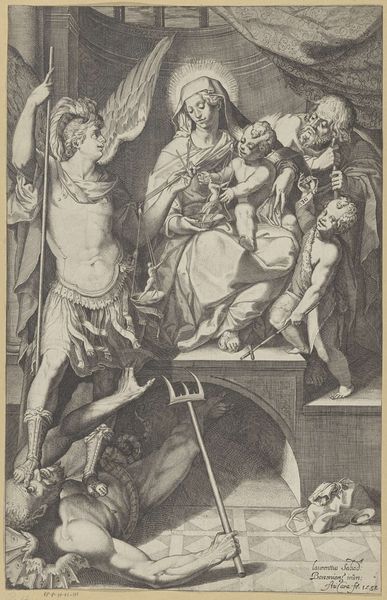
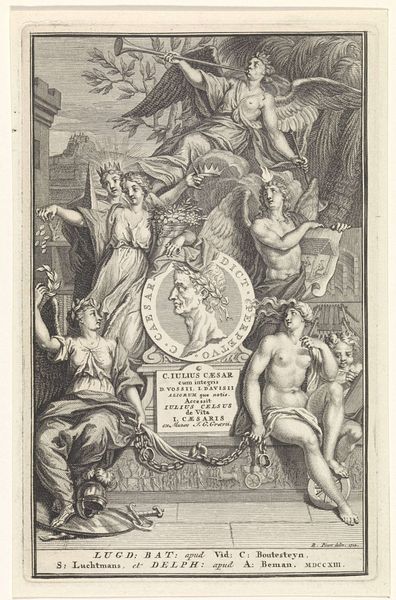
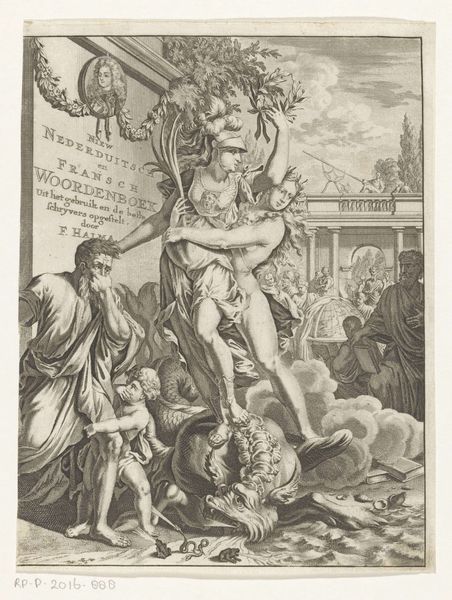
Editor: So here we have "Truth Teaches Man to Worship God," an engraving by Dirck Volckertsz Coornhert from around 1566-1578. The stark contrast and linear detail really give it a dramatic feel. What compositional elements stand out to you most? Curator: Observe how the composition hinges on a series of spatial divisions, beginning with the threshold framing the supplicant's introduction to a divinely-illuminated prospect. Notice also how light both reveals and obscures the forms, heightening the symbolic importance of truth. Editor: The way the bodies are rendered is very striking too. What does it say, technically and philosophically? Curator: Consider the idealized figures juxtaposed against the meticulous detailing of architectural structures. This creates a dialogue between form and content. The engraver’s technical mastery lends to an abstract inquiry into humanity's potential for divinity, seen through the very crispness of the line itself. Editor: Interesting. So, it's almost like the technique itself becomes part of the artwork's meaning, not just a means to an end? Curator: Precisely. The sharpness of the engraving mirrors the clarity with which Truth guides towards religious enlightenment. The physical attributes of the materials themselves underscore and deepen the engraving's thematic core. Editor: I never thought of it that way before. Thank you, that gives me a new perspective on how to view the construction and significance of an engraving. Curator: Indeed, recognizing how artistic choices in medium and presentation augment meaning offers an approach applicable to the whole of visual art history.
Comments
No comments
Be the first to comment and join the conversation on the ultimate creative platform.
 Collect
 React
React Comment
More like this