drawing, print, pencil
#
drawing
#
kinetic-art
#
conceptual-art
# print
#
pencil sketch
#
constructivism
#
geometric
#
pencil
#
abstraction
Copyright: National Gallery of Art: CC0 1.0
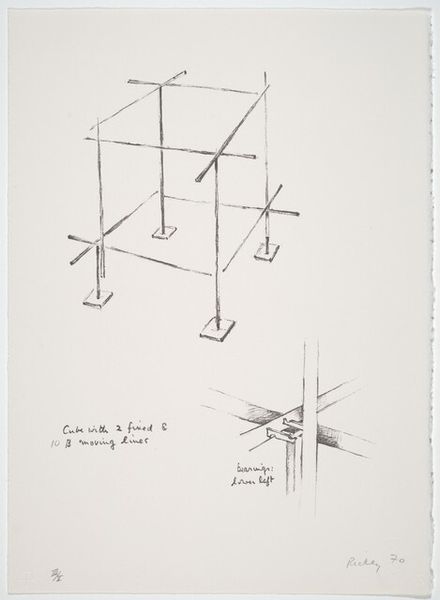
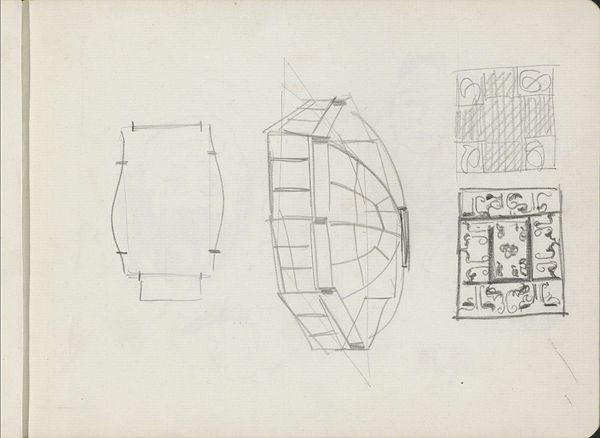
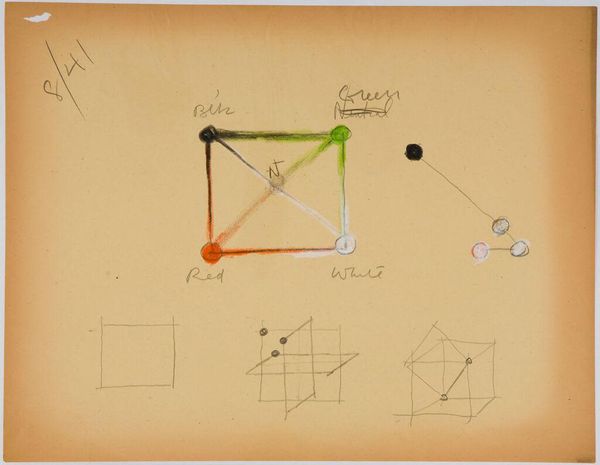
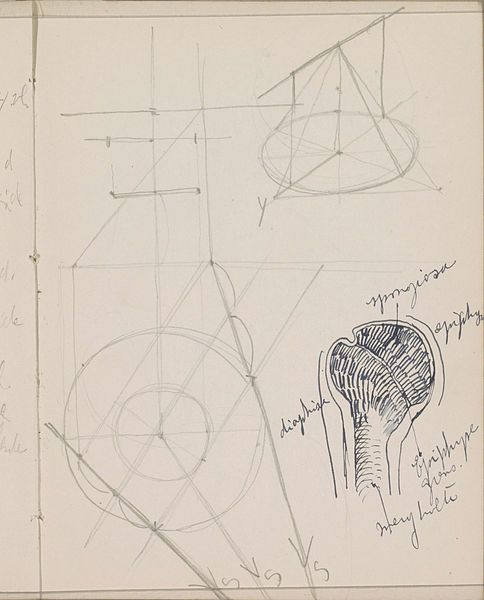
Editor: So, here we have George Rickey’s "Anatomy of a Cube of Six Hinged Planes," created in 1970. It's a pencil drawing, almost like a blueprint. It has this lovely, sort of technical drawing feel to it... How would you interpret this piece? Curator: This drawing sparks in my mind that moment of conception. It feels like sneaking a peek into Rickey’s playful, mathematical mind. Kinetic sculptures are his medium, which demands thinking about how things actually move. Here, it's all beautifully rendered by hand in soft graphite! I think it really invites us to meditate on motion itself - the way planes interact in space and the essence of how simple mechanics can produce something elegant. What aspects of this preliminary study stand out to you? Editor: The way he's broken down the cube, almost exploded it, feels really compelling. The handwritten notes also seem so personal. Curator: Absolutely, those notes pull us in! They let us see the artist’s planning – a reminder that even seemingly effortless movement starts with detailed contemplation. Perhaps what you feel with the cube “exploded” captures an artistic intent to liberate our everyday world by slowing down time to observe hidden poetry. It feels deeply thoughtful! Editor: It does give me a whole new perspective on movement. Now, seeing all the separate parts makes the final kinetic sculpture much more intriguing. Curator: Precisely. Thinking of forms shifting with a certain flow feels akin to philosophical inquiry... By illustrating all the hinges, we come to learn much about freedom in movement as much as restraint. This drawing isn’t just a diagram; it’s a beautiful little meditation on structure, flow, and, of course, a personal perspective.
Comments
No comments
Be the first to comment and join the conversation on the ultimate creative platform.
 Collect
 React
React Comment
More like this