About this artwork
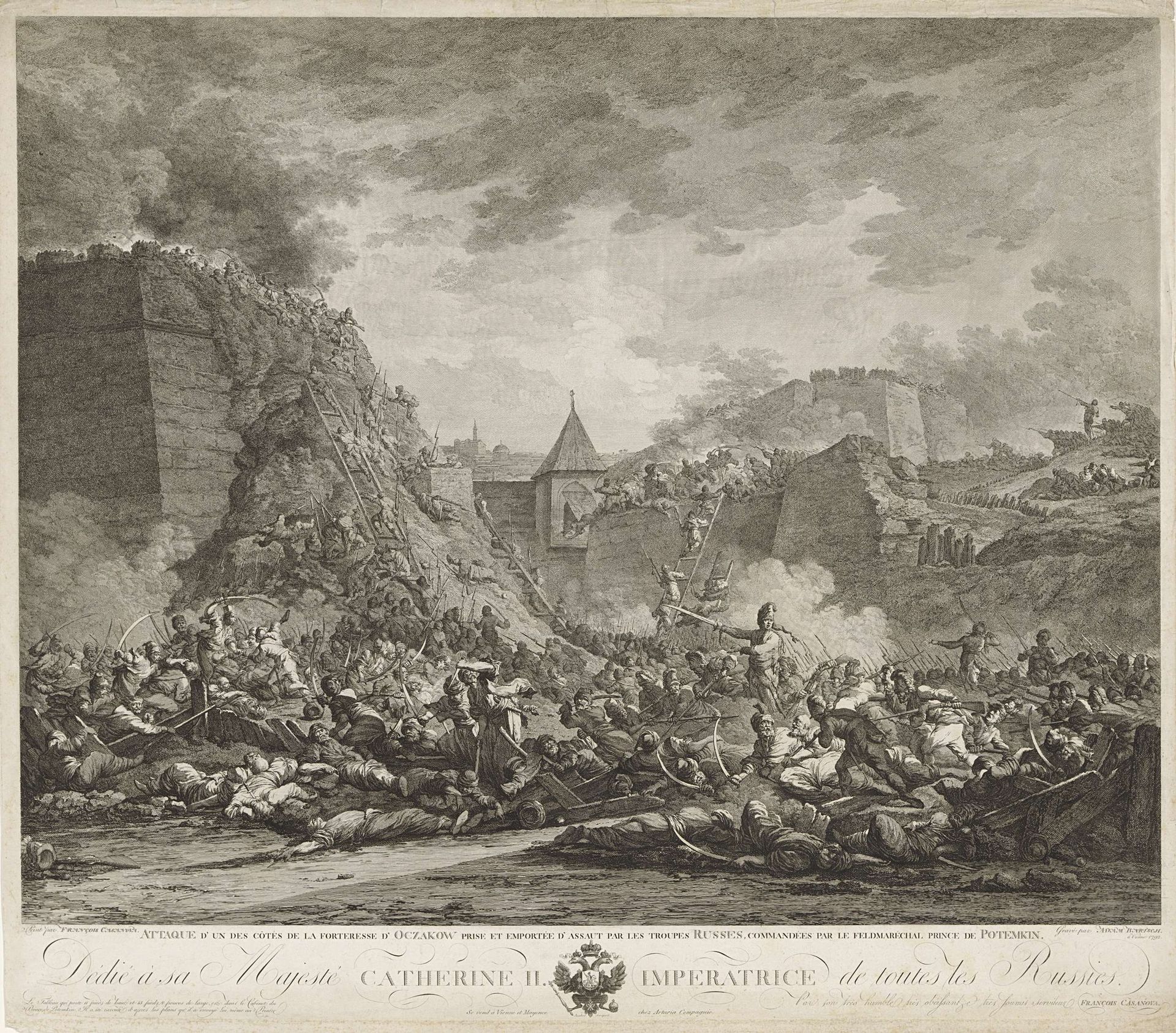
Adam von Bartsch made this print, "The Storming of the Ochakov Fortress by Russian Troops Led by Grigory Potemkin," likely in the late 18th century. It commemorates a key moment in Russia’s expansion under Catherine the Great. The print vividly depicts the brutal siege and capture of Ochakov, a fortress strategically important for controlling the Black Sea. Note how Bartsch emphasizes the overwhelming force of the Russian army, scaling the walls amidst intense combat. This image reflects the period's political climate, marked by Russian imperial ambitions and military might. The print underscores the role of art in shaping public perception of military events. Commissioned works like this one served to glorify military achievements and legitimize imperial power. Consider how the artist uses visual cues to portray the Russians as a disciplined, unstoppable force, reinforcing Catherine's image as a powerful ruler. To understand this piece fully, one might research the history of Russian expansion, the political context of Catherine's reign, and the role of art in promoting nationalistic sentiment.
Bestorming van de vesting van Ochakov, door de Russische troepen onder leiding van Grigorij Potemkin
1792

Adam von Bartsch
1757 - 1821Location
RijksmuseumArtwork details
- Dimensions
- height 670 mm, width 761 mm
- Location
- Rijksmuseum
- Copyright
- Rijks Museum: Open Domain
Comments
Share your thoughts
About this artwork
Adam von Bartsch made this print, "The Storming of the Ochakov Fortress by Russian Troops Led by Grigory Potemkin," likely in the late 18th century. It commemorates a key moment in Russia’s expansion under Catherine the Great. The print vividly depicts the brutal siege and capture of Ochakov, a fortress strategically important for controlling the Black Sea. Note how Bartsch emphasizes the overwhelming force of the Russian army, scaling the walls amidst intense combat. This image reflects the period's political climate, marked by Russian imperial ambitions and military might. The print underscores the role of art in shaping public perception of military events. Commissioned works like this one served to glorify military achievements and legitimize imperial power. Consider how the artist uses visual cues to portray the Russians as a disciplined, unstoppable force, reinforcing Catherine's image as a powerful ruler. To understand this piece fully, one might research the history of Russian expansion, the political context of Catherine's reign, and the role of art in promoting nationalistic sentiment.
Comments
Share your thoughts