lithograph, print
#
narrative-art
#
lithograph
# print
#
asian-art
#
genre-painting
#
realism
Dimensions: height 376 mm, width 460 mm
Copyright: Rijks Museum: Open Domain
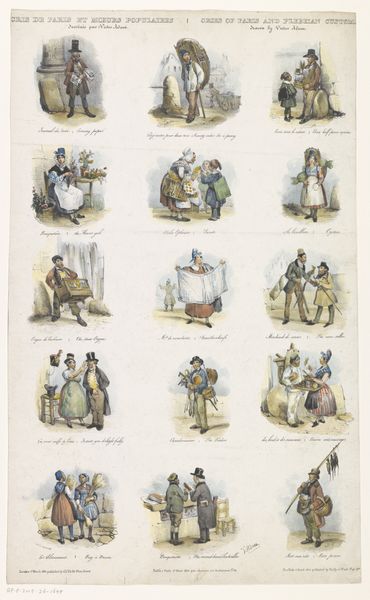
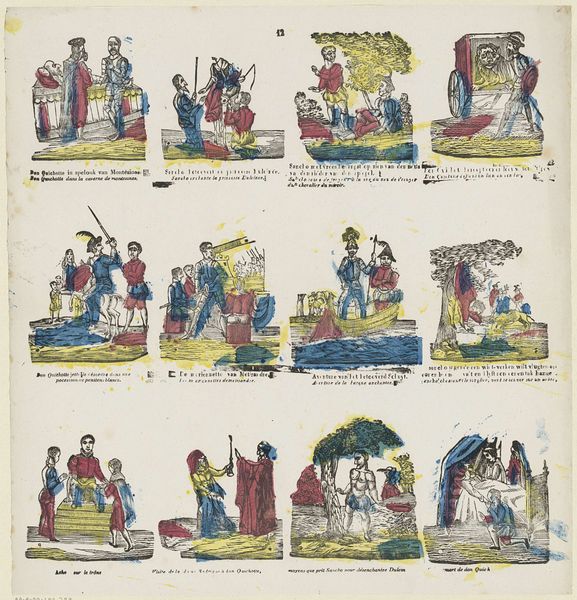
Editor: This is “Straatverkopers,” which I understand translates to "Street Vendors." It's a lithograph print from somewhere between 1868 and 1881 by Gualtherus Kolff, featuring a grid of little vignettes depicting different tradespeople in Indonesia. The style reminds me of educational posters, but I’m curious about the cultural context here. How do you interpret this work? Curator: You’re right; the grid format definitely suggests an intention for instruction. Notice how each vendor is carefully labeled, both with their trade and a short description in Dutch. The lithograph meticulously documents a variety of local occupations for a European audience, specifically within the context of Dutch colonial expansion in Indonesia. Editor: So, the cultural memory isn't from the vendors themselves, but from how they are represented for outsiders. I guess I was looking at this the wrong way around... Curator: Precisely. Consider the arrangement, a kind of typological study. What symbols recur and what story might the composition tell about the artist's values? Note the focus on specific objects related to their goods. Does that have anything to do with commodification? Editor: Yes! Because it spotlights and almost "fetishizes" certain trades or goods. Also, they all look posed, staged, almost like specimens. Curator: And that can signal a distance from the subject... This creates both a sense of documentation and perhaps also of control. Are the individuals, reduced to simple visual signs and representatives, more about control than knowledge? What do you make of that? Editor: I think so. Seeing them cataloged this way gives off the impression of transforming the individuals into data points within a larger colonial framework. I hadn’t quite picked up on that before. Curator: Exactly! That colonial framework is a vital layer to consider. Next time you view a historical document, look for symbols of order imposed upon local practices, that in themselves express certain values of cultural control.
Comments
No comments
Be the first to comment and join the conversation on the ultimate creative platform.
 Collect
 React
React Comment
More like this