About this artwork
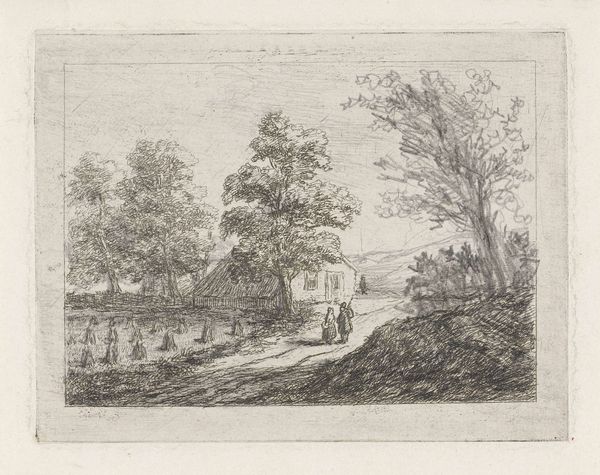
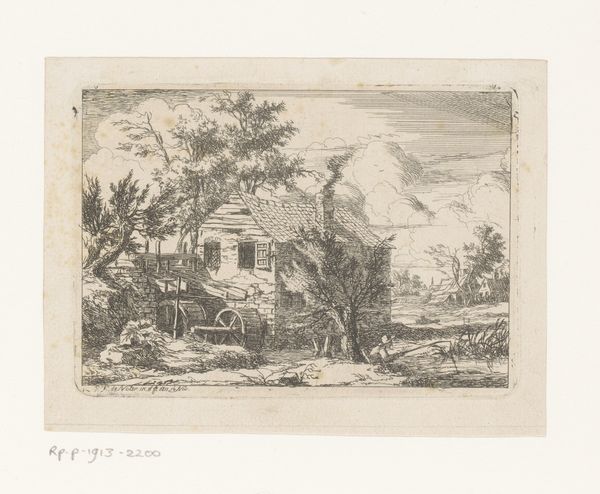
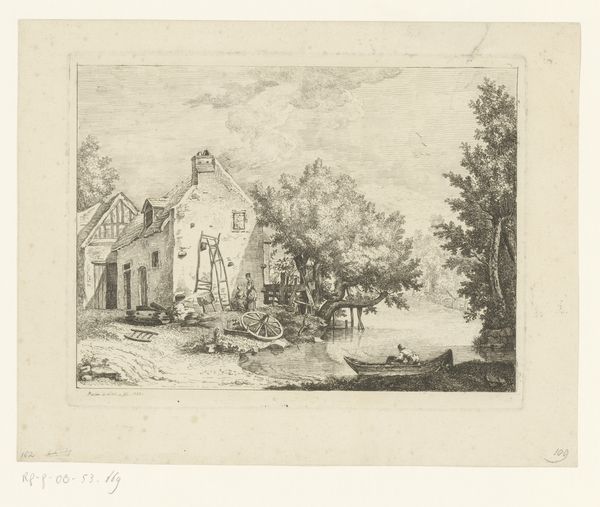
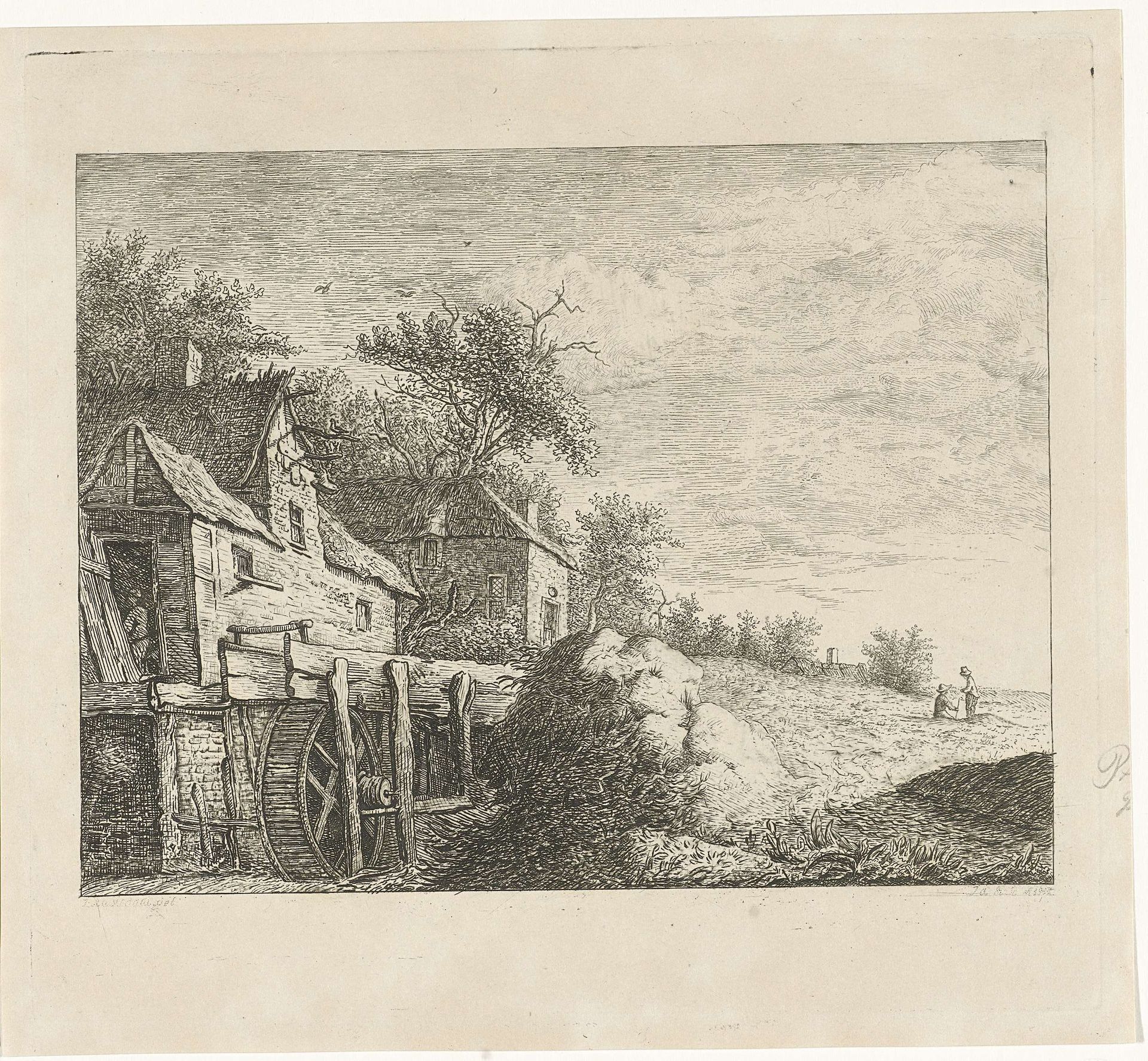
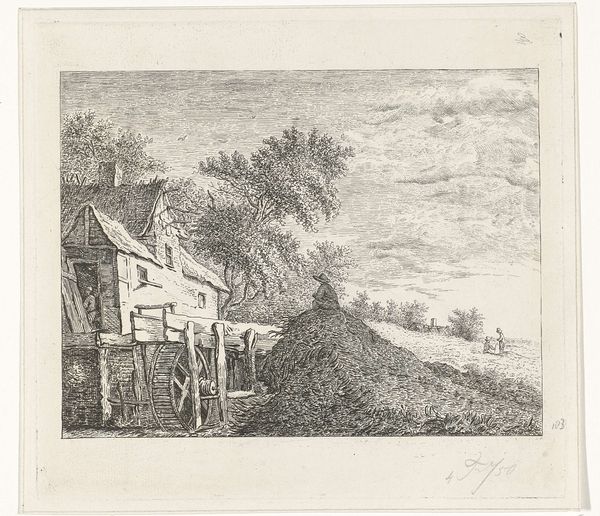
Editor: Here we have a print from between 1796 and 1856, "Watermolen in een landschap", or "Watermill in a Landscape," by Reinierus Albertus Ludovicus, Baron van Isendoorn à Blois. It's an etching, and it gives me such a feeling of peaceful simplicity. The composition, with the mill on the left and open landscape on the right, is interesting. What do you see in this piece? Curator: It breathes with a life both vigorous and hushed, doesn’t it? Look at the burr and soft textures achieved via etching - and just imagine those landscapes; a scene pulsating with pastoral rhythm in the moment. A place caught between progress of the watermill with it’s industry and that slower-paced serenity. Have you ever felt yourself living between the grinding stones of progress and the beckoning quietude of nature? Editor: That’s a very evocative way to put it! I hadn't thought of the tension between progress and nature. The watermill now seems less peaceful and more like an intrusion, almost. Curator: Indeed, this push and pull. Look at the figures to the right - almost secondary in scale; so diminutive compared with the mass of the watermill. What do you suppose this suggests? Editor: Maybe it's about humanity's place within, or even against, the landscape? Or that relationship changing because of technology. Curator: Precisely. It whispers questions of man's place amidst it all. Of ownership, encroachment. It asks us to contemplate if our pursuit of "more" steals a deeper serenity. But perhaps I am waxing too poetically for a simple watermill! Editor: No, not at all. I think seeing that conflict makes the work so much richer, so thanks. Curator: And thank you, your question brought it all back to life for me.
Watermolen in een landschap
1796 - 1856
Artwork details
- Medium
- print, etching
- Dimensions
- height 182 mm, width 202 mm
- Copyright
- Rijks Museum: Open Domain
Tags
Comments
Share your thoughts
About this artwork
Editor: Here we have a print from between 1796 and 1856, "Watermolen in een landschap", or "Watermill in a Landscape," by Reinierus Albertus Ludovicus, Baron van Isendoorn à Blois. It's an etching, and it gives me such a feeling of peaceful simplicity. The composition, with the mill on the left and open landscape on the right, is interesting. What do you see in this piece? Curator: It breathes with a life both vigorous and hushed, doesn’t it? Look at the burr and soft textures achieved via etching - and just imagine those landscapes; a scene pulsating with pastoral rhythm in the moment. A place caught between progress of the watermill with it’s industry and that slower-paced serenity. Have you ever felt yourself living between the grinding stones of progress and the beckoning quietude of nature? Editor: That’s a very evocative way to put it! I hadn't thought of the tension between progress and nature. The watermill now seems less peaceful and more like an intrusion, almost. Curator: Indeed, this push and pull. Look at the figures to the right - almost secondary in scale; so diminutive compared with the mass of the watermill. What do you suppose this suggests? Editor: Maybe it's about humanity's place within, or even against, the landscape? Or that relationship changing because of technology. Curator: Precisely. It whispers questions of man's place amidst it all. Of ownership, encroachment. It asks us to contemplate if our pursuit of "more" steals a deeper serenity. But perhaps I am waxing too poetically for a simple watermill! Editor: No, not at all. I think seeing that conflict makes the work so much richer, so thanks. Curator: And thank you, your question brought it all back to life for me.
Comments
Share your thoughts