

1660 - 1665
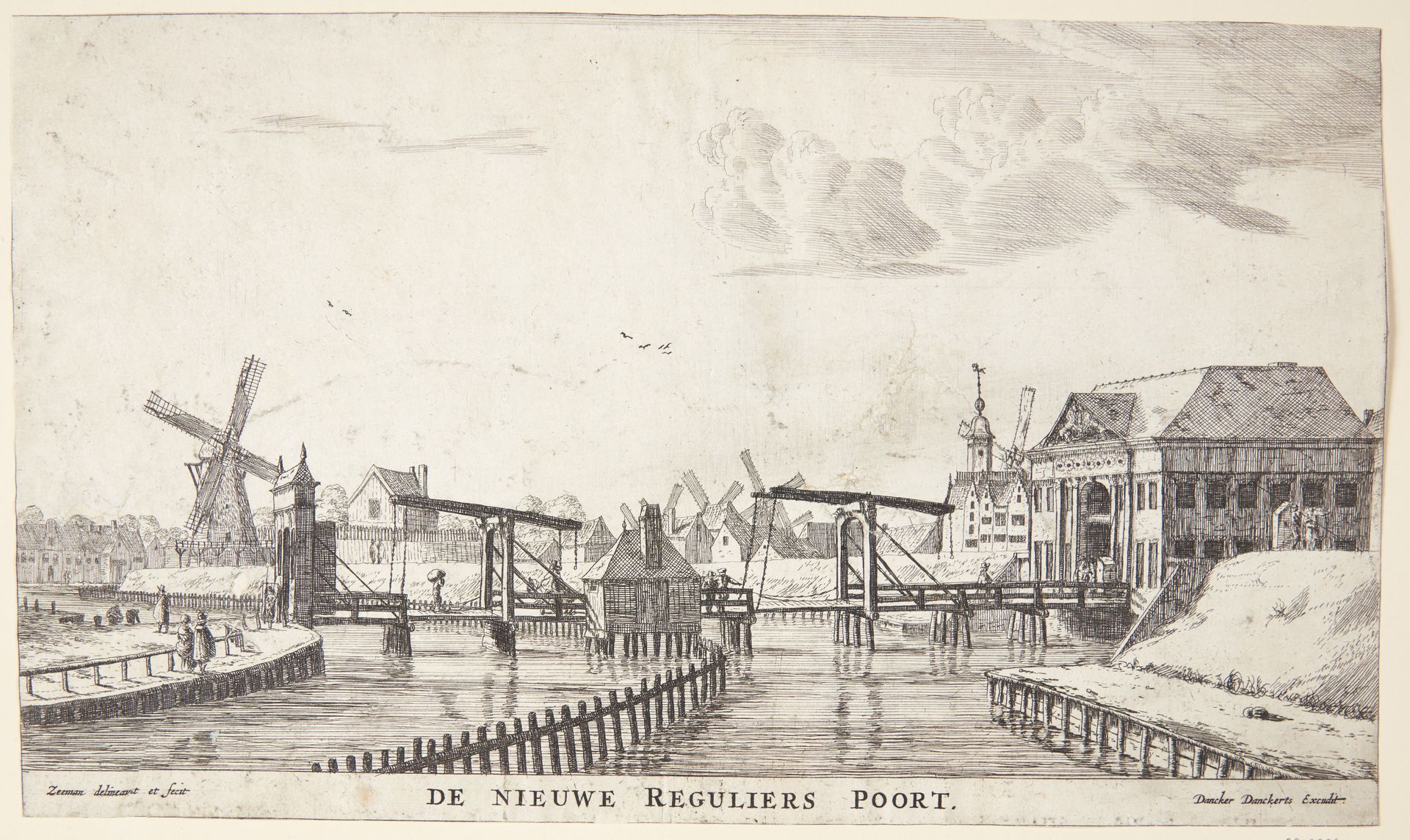
Den gamle Reguliers-port i Amsterdam


Listen to curator's interpretation
Curatorial notes
Curator: Up next, we have Reinier Nooms' etching, "Den gamle Reguliers-port i Amsterdam," created around 1660 to 1665. It is currently held at the SMK, the National Gallery of Denmark. Editor: The linear precision is really striking; it has an airy yet detailed atmosphere, capturing a subtle quietude of 17th-century Amsterdam. Curator: Indeed, Nooms, also known as Zeeman, was celebrated for his marine paintings and topographical views. What’s fascinating here is how printmaking enabled the wider distribution of imagery, essentially democratizing access to art and information. Think about the socio-economic implications! Editor: Absolutely, and the composition itself creates a hierarchy too: the way the bridges divide the space and direct the eye—those linear geometries. And observe how the balance is achieved between open sky and constructed forms of city, wind- and watermills? Curator: Consider that this etching wasn't produced in a vacuum. Nooms' workshop, the paper used, the tools, the patronage system, all contribute to how the art reflects the burgeoning mercantile power of the Dutch Republic. Who had access to this art, and what messages did it convey about Dutch prosperity? Editor: Still, the delicate lines and tonal range, achieved solely through the manipulation of the etched line—that speaks volumes. It’s the aesthetic treatment that elevates it. Note also the relationship between those clouds, that atmospheric diffusion, versus the firm architectural shapes. The windmills function in both! Curator: But is this "elevation" inherent, or a socially constructed value judgment? It depicts a working city—people moving, mills turning. Nooms doesn’t seem interested in ennobling Amsterdam, he documents the infrastructure crucial to its economic engine. Editor: A fascinating contrast of views, both deeply relevant. I see a harmonious composition brought forth by method, and you highlight art as a product of process and material conditions, which enhances our grasp of its worldliness. Curator: Precisely! Thanks to this interplay between form and context, listeners hopefully understand art is never created in isolation but is both part of and an influence upon, social currents.