c. 1886
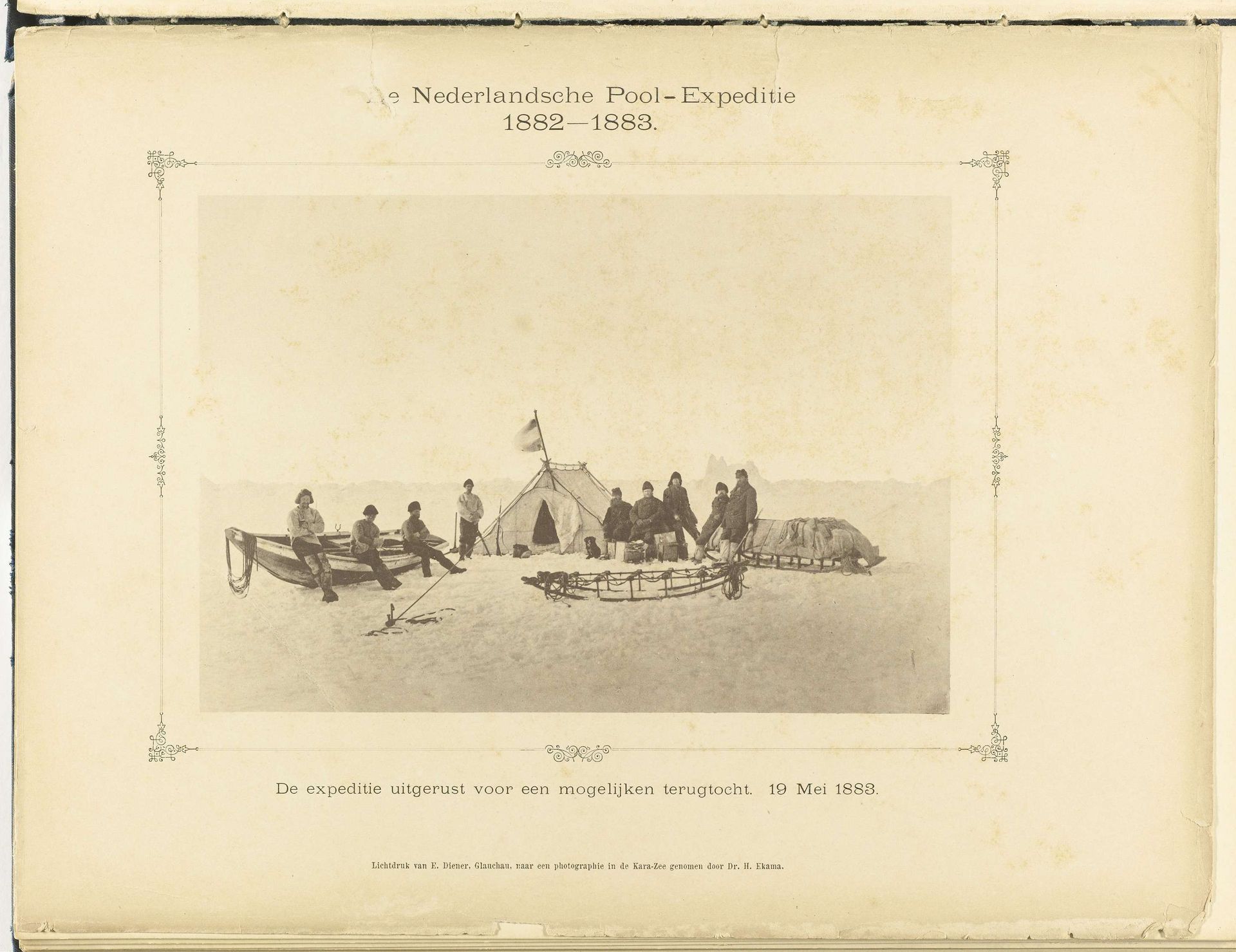
De expeditie uitgerust voor een mogelijken terugtocht. 19 mei 1883

Listen to curator's interpretation
Curatorial notes
Editor: Here we have a gelatin silver print by H. Ekama, made around 1886, titled "De expeditie uitgerust voor een mogelijken terugtocht. 19 mei 1883" It depicts an expedition scene, likely in a polar region. It's the cool-toned landscape with a camp setting that grabs my eye. What compositional elements stand out to you? Curator: The piece has a very clear linear perspective, drawing the eye from the figures to the tent and eventually fading into the stark white background. The symmetry, particularly with the placement of figures on either side of the central tent structure, lends the work balance and order, reflecting perhaps the planned and systematic nature of an expedition. It gives off the idea of preparation. Do you perceive any disruption within this seemingly ordered scene? Editor: I suppose the slight tilt of the Dutch flag and the varying poses of the figures create a bit of disruption within the symmetry. But I don’t see it as a full-blown disruption, more of a... deviation. Is there something you want me to see? Curator: Exactly! These visual ‘deviations’ inject life and human presence into what could otherwise be a sterile landscape, right? Reflect on the placement of objects. Observe how light and shadow are rendered in such limited tonal range? How does Ekama’s photographic treatment interact with what might be considered traditional landscape artistic style? Editor: Well, the restricted color palette and crispness remind me of earlier documentary photography. Perhaps Ekama deliberately blurs lines to evoke feeling from reality, aiming for a synthesis? I had not previously appreciated the formal elements and how they help the viewers connect with the image. Curator: Indeed. Understanding the balance between documentation and artistic rendering enriches our experience, and invites us to appreciate the artistic choices within photographic realism.