print, engraving
#
allegory
#
baroque
# print
#
old engraving style
#
figuration
#
history-painting
#
engraving
Dimensions: height 297 mm, width 208 mm
Copyright: Rijks Museum: Open Domain
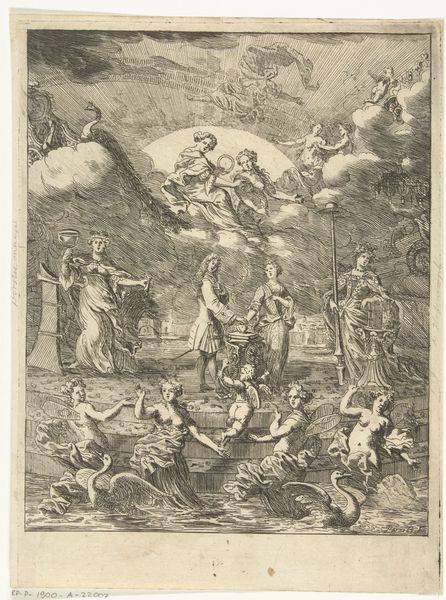
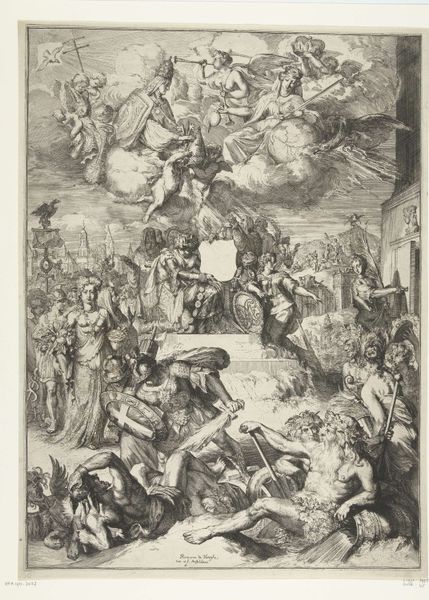
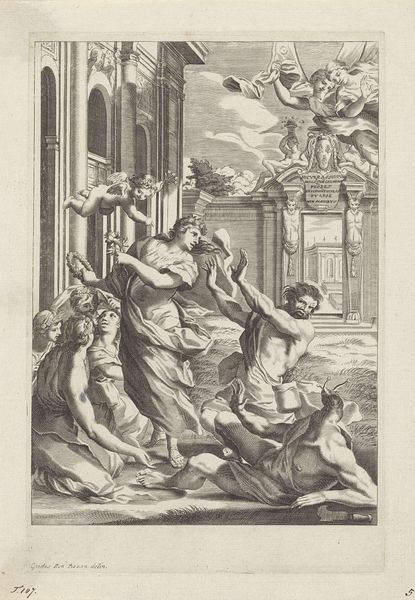
Editor: So, this is Cornelis Bloemaert’s engraving, “Drie Hesperiden brengen sinaasappelen naar Rome,” from the 1640s. The scene feels both classical and fantastical, and it’s full of figures. What catches your eye in terms of symbolism or hidden meanings? Curator: My attention is drawn to the layers of symbolic meaning. The Hesperides themselves, bearing the oranges—golden apples, really—represent abundance and perhaps immortality. Notice how the oranges, or rather the idea of oranges, transform as they journey to Rome, a center of power and civilization. What does that journey, and the transformation itself, signify to you? Editor: It’s interesting… Is it about bringing nature, and its inherent bounty, into the fold of civilization? I mean, is there a warning about losing something in that transition? Curator: Precisely. The river god, reclining with his waters flowing forth, and the putti, the small children...they establish Rome's origin in this natural abundance. Consider, too, the presence of what appears to be Capricorn above—connecting this terrestrial abundance to a celestial order. Are you familiar with the connection between Capricorn and Augustus? Editor: I think so – Wasn't Capricorn his zodiac sign, and thus became connected with his golden age of prosperity and abundance? Curator: Exactly! See how a simple orange speaks to ideas of civilization and heavenly power? What do you make of the medium? Editor: As an engraving, the sharp lines create a real sense of clarity and order, even in such a crowded scene, which seems to enforce the ideas you are speaking about. Curator: I find the print, made reproducible through mechanical means, signifies this transmission of a new golden age even more convincingly. These complex systems of images! It's a fascinating print.
Comments
No comments
Be the first to comment and join the conversation on the ultimate creative platform.
 Collect
 React
React Comment
More like this