Dimensions: support: 529 x 365 mm
Copyright: CC-BY-NC-ND 4.0 DEED, Photo: Tate
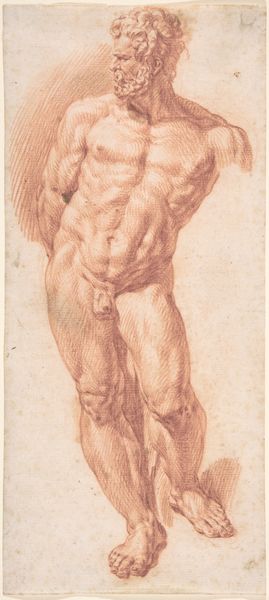
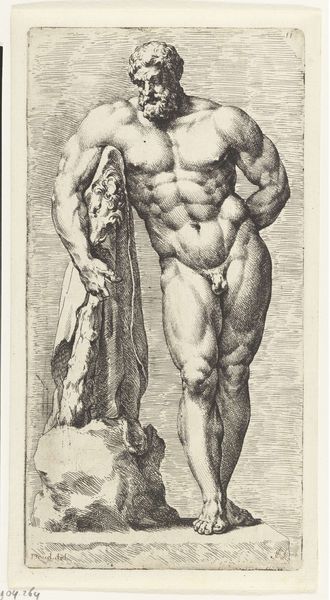
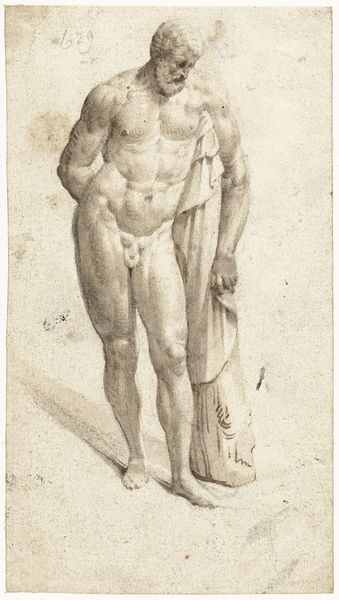
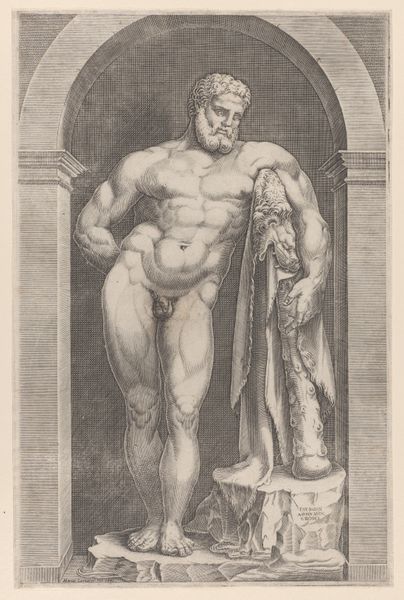
Curator: Richard Dalton, an artist who lived between 1715 and 1791, created this work entitled, "The Farnese Hercules." It currently resides in the Tate Collections. Editor: The sheer musculature is astonishing. He seems weighed down, not just by his club but by the burdens he carries. Curator: The Farnese Hercules, of course, is a Roman copy of a Greek sculpture. The figure of Hercules became a symbol of strength, virtue, and civilization, especially during periods of revolution and societal upheaval. Editor: Absolutely, Hercules embodies triumph over adversity. The lion skin he carries signifies his victory over the Nemean lion, and by extension, over primal, untamed forces. It is a symbol of power. Curator: Indeed, yet this representation, particularly Dalton's study, reveals a more vulnerable figure, burdened by the weight of expectations. Editor: It prompts contemplation on the complex, often contradictory, nature of heroism. Curator: Precisely, a timeless symbol, yet a human one.
Comments

tate 11 months ago
⋮
http://www.tate.org.uk/art/artworks/dalton-the-farnese-hercules-t08241


Join the conversation
Join millions of artists and users on Artera today and experience the ultimate creative platform.
tate 11 months ago
⋮
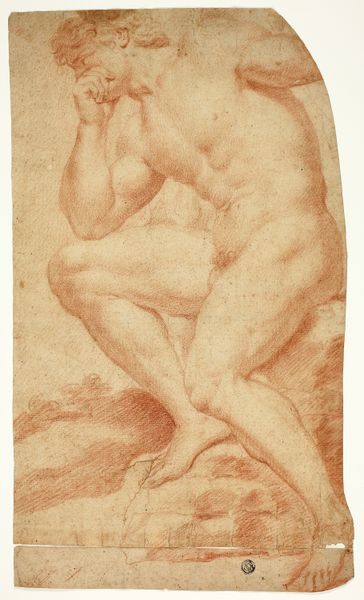
This drawing demonstrates the extremely fine line-work which can be achieved with red chalk. The thinness of the lines suggests that Dalton used a natural red chalk, since these tended to be harder than fabricated or synthetic red chalks. Dalton would probably have fastened a stick of red chalk into a holder and kept the point sharp with a knife. The darkest areas within the figure have been made by cross-hatching and drawing closely spaced narrow lines one on top of the other. Gallery label, August 2004
 Collect
More like this