

1895
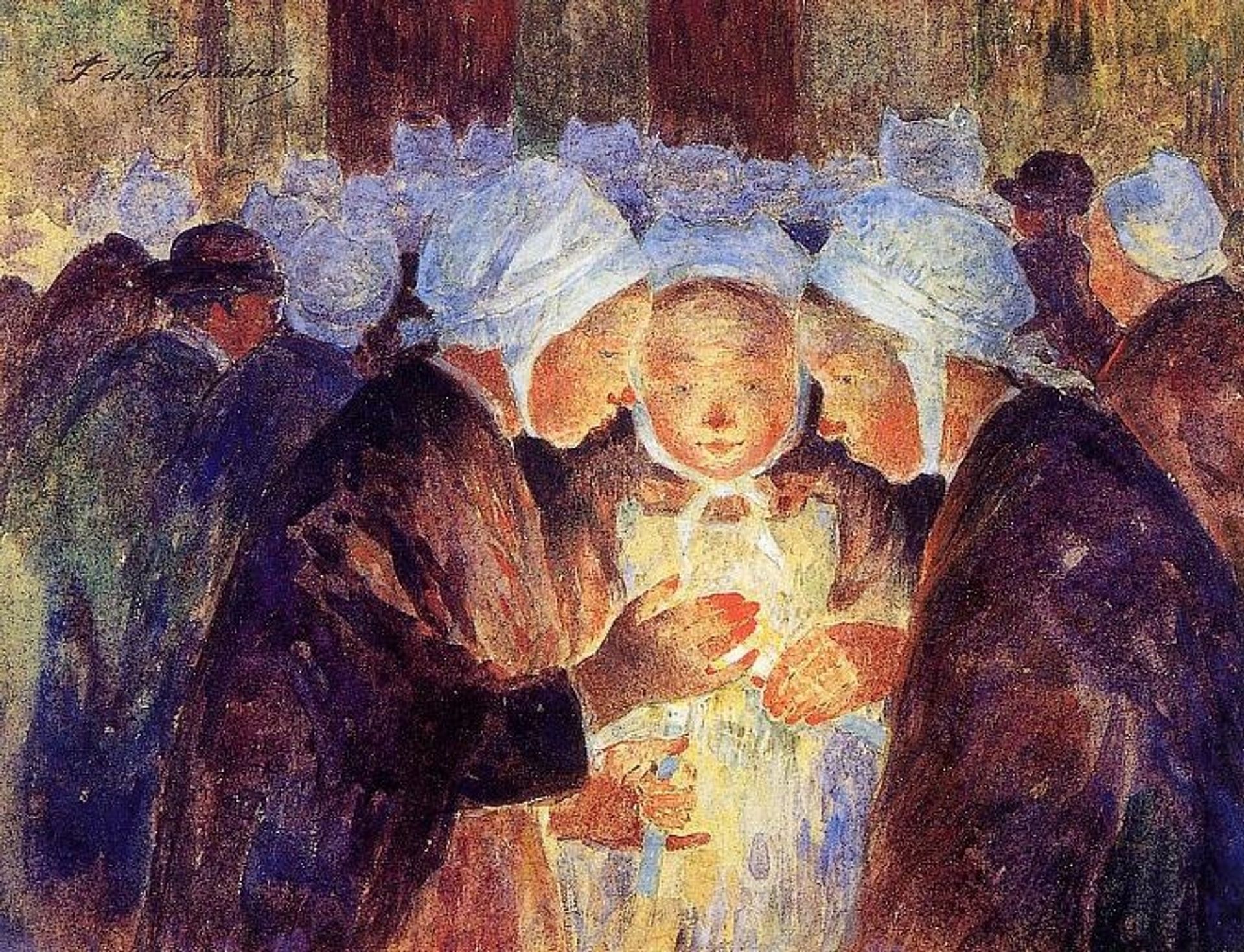
Three Breton Girls Lighting Their Candles Before the Process

Listen to curator's interpretation
Curatorial notes
Editor: This is Ferdinand du Puigaudeau’s “Three Breton Girls Lighting Their Candles Before the Process,” painted in 1895 using oil paint. It's remarkable how he captures the candlelight – it feels almost like you're there with them. How do you interpret this work? Curator: This painting speaks to me about the intersection of faith, community, and the representation of women. These Breton women, seemingly caught in a moment of quiet ritual, raise questions about agency within tradition. Do you notice how the light almost seems to emanate from the central figure? Editor: Yes, the girl holding the candle definitely stands out! What's the significance of their traditional clothing? Curator: The traditional Breton dress is critical here. Clothing often acts as a marker of identity and cultural resistance. Here, it could be seen as asserting a specific cultural identity in a rapidly modernizing world. How does it make you feel, seeing them positioned so centrally? Editor: I see it as emphasizing their importance – like their traditions and rituals matter. But were these representations always respectful? Curator: That's an important question. Paintings of rural women could romanticize and even exoticize them. We must consider the gaze of the artist and the potential for objectification, even if unintentional. This leads to interesting questions about the artist's positionality and its impact on representation. Do you think the artist had an agenda? Editor: That's complex. It's hard to know the artist's true intentions, but understanding the historical context definitely enriches how we view it. I didn't know to consider these representations could contribute to the ongoing complexities about tradition, gender, and identity. Curator: Precisely! It showcases how art history can provide invaluable perspective through intersectional readings.