About this artwork
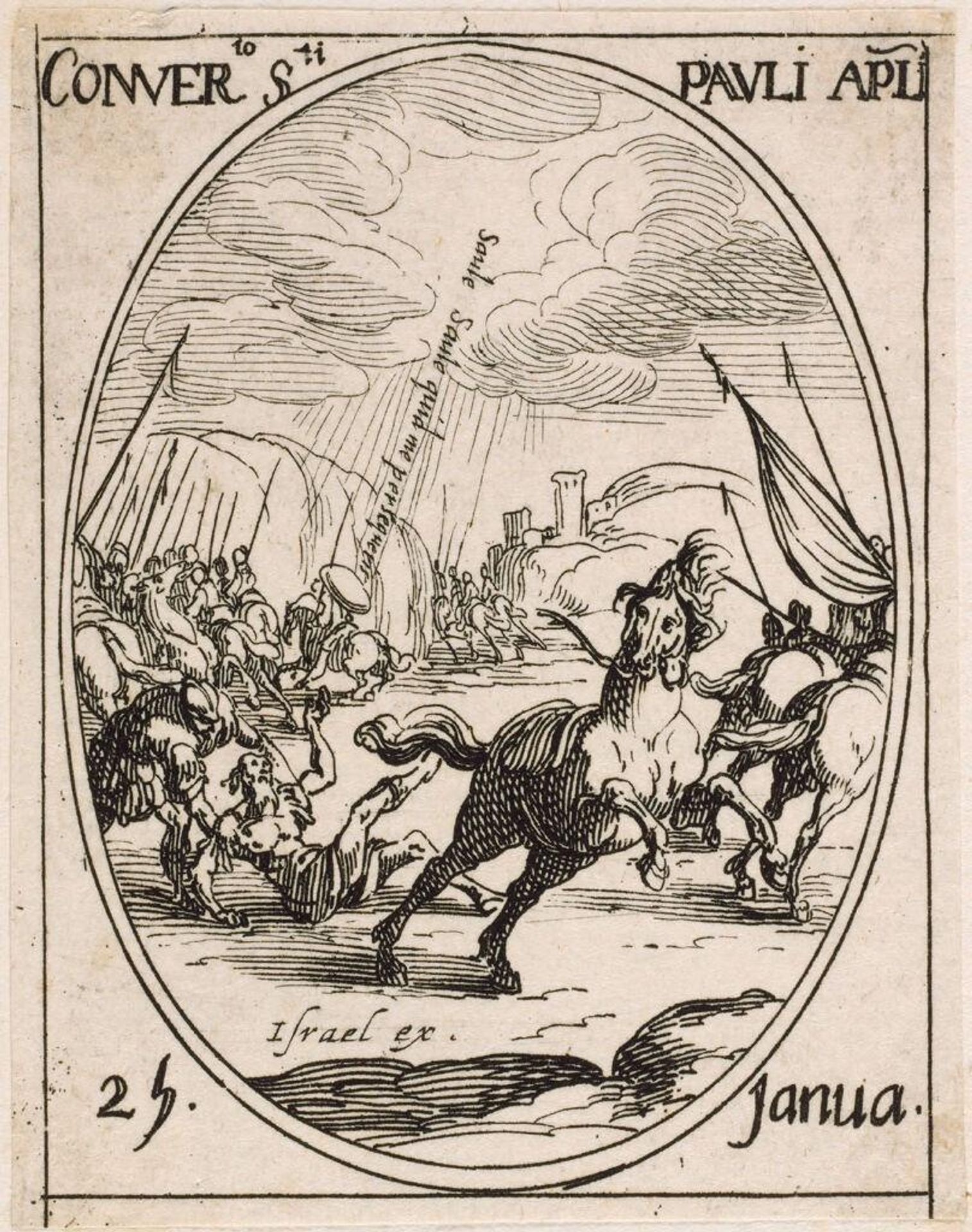
Curator: This is Jacques Callot's "Conversion of Saint Paul," held at the Harvard Art Museums. It's a very small engraving, only about 3 by 1 and 15/16 inches. Editor: It feels so dramatic, despite the size! The dynamism of the figures, especially that rearing horse, is quite compelling. Curator: Callot really captures the pivotal moment. Note the figure of Paul, fallen from his horse, illuminated by divine light. It's a symbol of his spiritual awakening. Editor: Yes, the light as a visual motif is very striking, and the soldiers in the background, seemingly unaffected, highlight Paul's singular experience, perhaps underscoring the exclusivity of divine revelation. Curator: And think of the cultural context. Religious imagery like this was central to life; these images reinforced faith and moral narratives. Editor: Indeed, Callot’s skill brought these narratives to life, and considering the historical impact of Paul's conversion, this resonates even today.
Conversion of Saint Paul c. 17th century


Artwork details
- Dimensions
- 7.6 x 4.9 cm (3 x 1 15/16 in.)
- Location
- Harvard Art Museums
- Copyright
- CC0 1.0
Comments
No comments
About this artwork
Curator: This is Jacques Callot's "Conversion of Saint Paul," held at the Harvard Art Museums. It's a very small engraving, only about 3 by 1 and 15/16 inches. Editor: It feels so dramatic, despite the size! The dynamism of the figures, especially that rearing horse, is quite compelling. Curator: Callot really captures the pivotal moment. Note the figure of Paul, fallen from his horse, illuminated by divine light. It's a symbol of his spiritual awakening. Editor: Yes, the light as a visual motif is very striking, and the soldiers in the background, seemingly unaffected, highlight Paul's singular experience, perhaps underscoring the exclusivity of divine revelation. Curator: And think of the cultural context. Religious imagery like this was central to life; these images reinforced faith and moral narratives. Editor: Indeed, Callot’s skill brought these narratives to life, and considering the historical impact of Paul's conversion, this resonates even today.
Comments
No comments