About this artwork
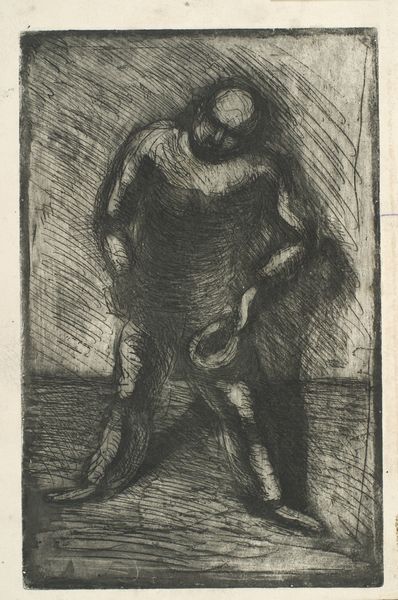
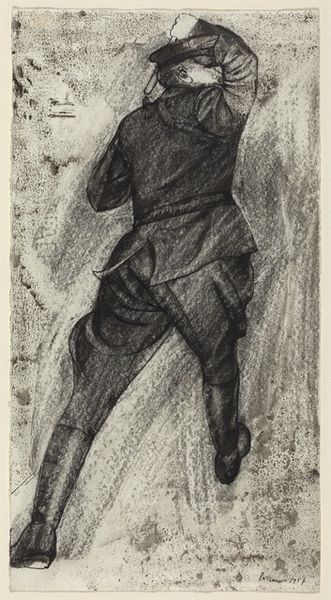
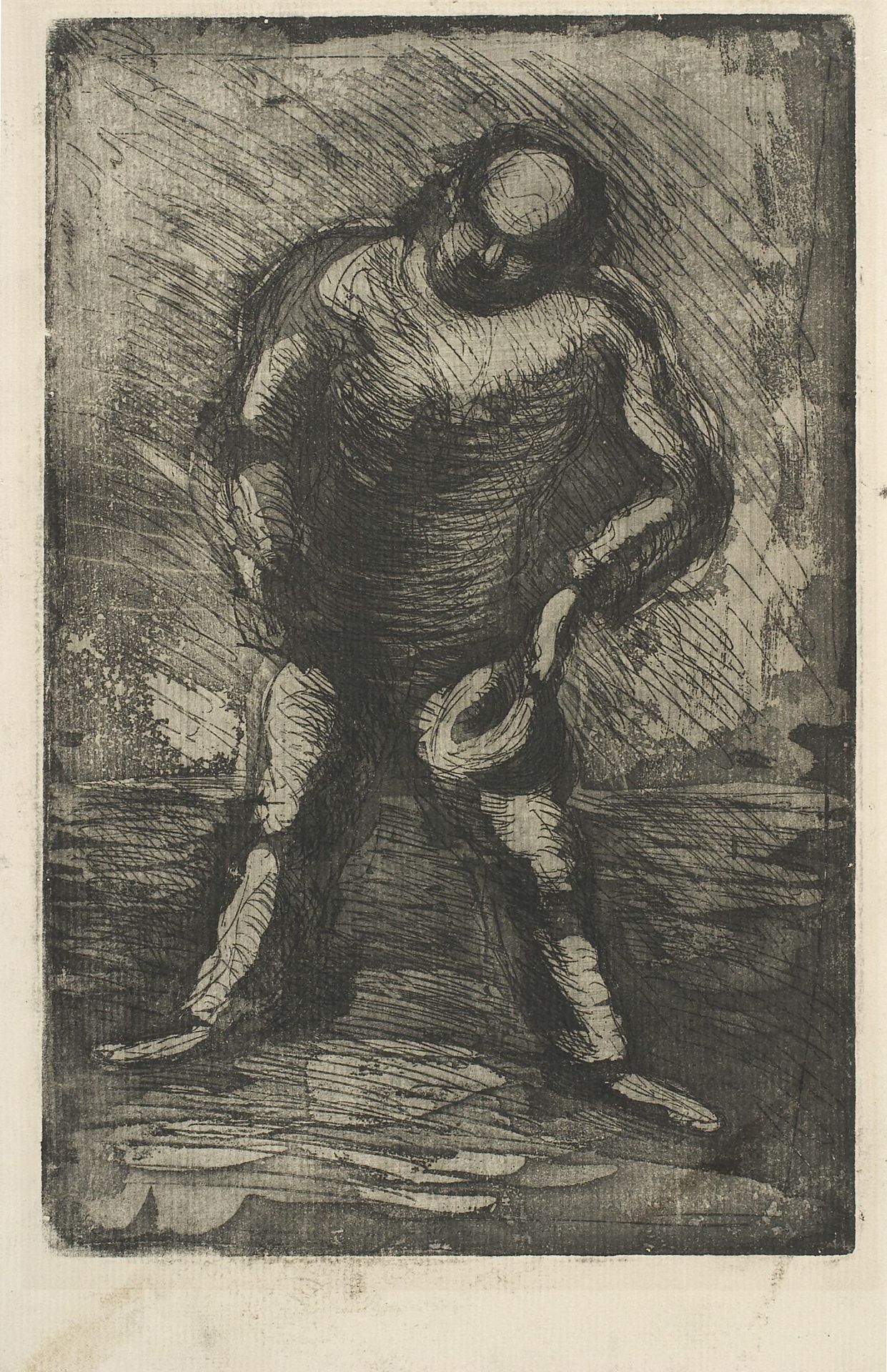
Curator: Vilhelm Lundstrom's "Striding Man with Hat in Hand," created between 1920 and 1923, an etching now residing at the SMK. It’s a stark image rendered with visible intensity, wouldn’t you agree? Editor: It feels… vulnerable, almost painful. The hunched posture, the hat clutched like a lifeline. There's an undeniable weight pressing down on him, physically and perhaps emotionally. Curator: The social context is important. Consider the aftermath of World War I. This was a period of profound disillusionment, and Lundstrom, though often associated with more vibrant, cubist-influenced styles, captures that weary spirit so effectively here. Editor: Cubist influences, really? I see hints of it, the reduction of form to near-geometric abstraction, especially in the treatment of his torso. But the emotional weight overpowers any formal concerns, I think. It’s a figure stripped bare, humbled. And the rough lines, they add to the urgency of it all. Curator: Exactly! The etching medium, with its potential for fine detail but also raw immediacy, serves him perfectly. Think about the distribution and the limited exposure that art faced in the Post-War society: what purpose did art had? Editor: Makes you wonder who this man is. Is he defeated, begging, contemplative? And the setting—so undefined. Is it urban blight or emotional desolation he is immersed into? There's a beautiful tension between the subject and what remains deliberately unsaid. A sense of open questions on how the population handled defeat. Curator: Lundstrom frequently reduced figures to archetypes or generalized states of being. It’s not necessarily about a specific narrative, but more a commentary on the universal human experience under duress in 1920's Europe. Editor: He makes that universal human experience palpable. I won’t soon forget this etching. Such simple lines evoking such depth. The hat becomes the key. Curator: I hope our listeners were captivated. We need art like this to constantly push dialogues on art history. It forces us to look inwards and outwards.
Skrævende mand med hatten i hånden
1920 - 1923


Artwork details
- Medium
- print, etching
- Dimensions
- 258 mm (height) x 169 mm (width) (plademaal)
- Location
- SMK - Statens Museum for Kunst
Tags
Comments
Share your thoughts
About this artwork
Curator: Vilhelm Lundstrom's "Striding Man with Hat in Hand," created between 1920 and 1923, an etching now residing at the SMK. It’s a stark image rendered with visible intensity, wouldn’t you agree? Editor: It feels… vulnerable, almost painful. The hunched posture, the hat clutched like a lifeline. There's an undeniable weight pressing down on him, physically and perhaps emotionally. Curator: The social context is important. Consider the aftermath of World War I. This was a period of profound disillusionment, and Lundstrom, though often associated with more vibrant, cubist-influenced styles, captures that weary spirit so effectively here. Editor: Cubist influences, really? I see hints of it, the reduction of form to near-geometric abstraction, especially in the treatment of his torso. But the emotional weight overpowers any formal concerns, I think. It’s a figure stripped bare, humbled. And the rough lines, they add to the urgency of it all. Curator: Exactly! The etching medium, with its potential for fine detail but also raw immediacy, serves him perfectly. Think about the distribution and the limited exposure that art faced in the Post-War society: what purpose did art had? Editor: Makes you wonder who this man is. Is he defeated, begging, contemplative? And the setting—so undefined. Is it urban blight or emotional desolation he is immersed into? There's a beautiful tension between the subject and what remains deliberately unsaid. A sense of open questions on how the population handled defeat. Curator: Lundstrom frequently reduced figures to archetypes or generalized states of being. It’s not necessarily about a specific narrative, but more a commentary on the universal human experience under duress in 1920's Europe. Editor: He makes that universal human experience palpable. I won’t soon forget this etching. Such simple lines evoking such depth. The hat becomes the key. Curator: I hope our listeners were captivated. We need art like this to constantly push dialogues on art history. It forces us to look inwards and outwards.
Comments
Share your thoughts