About this artwork
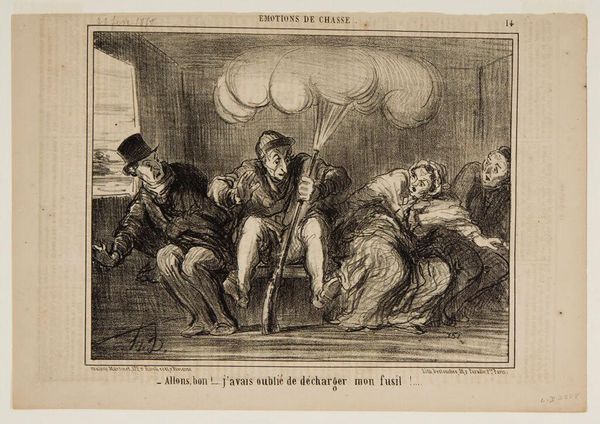
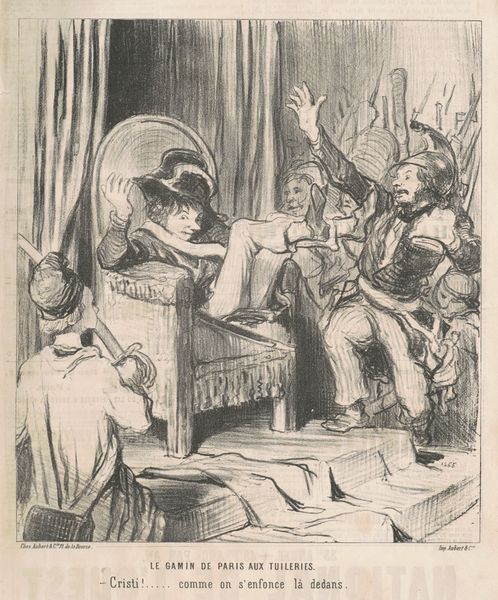
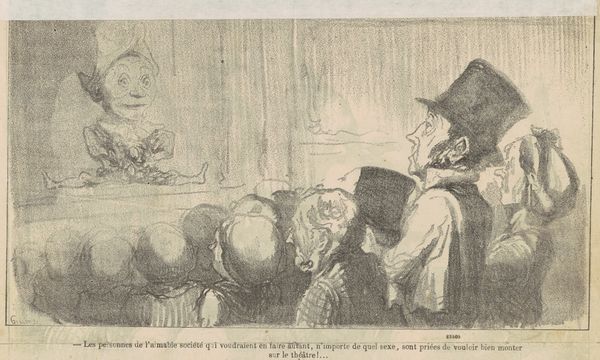
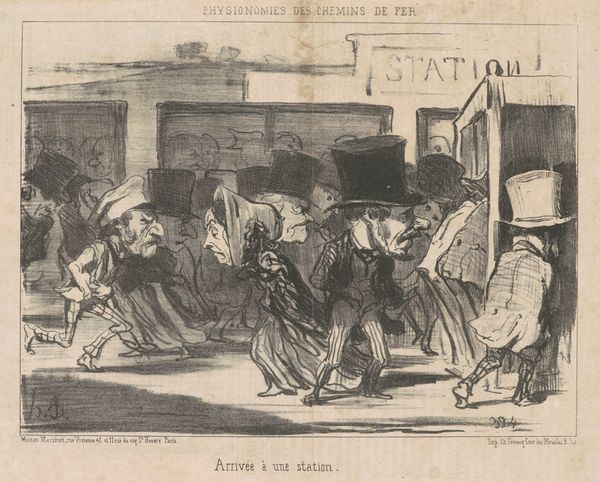
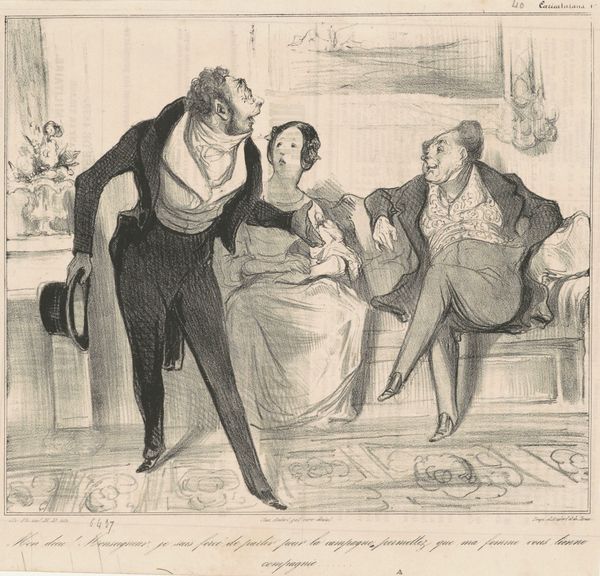
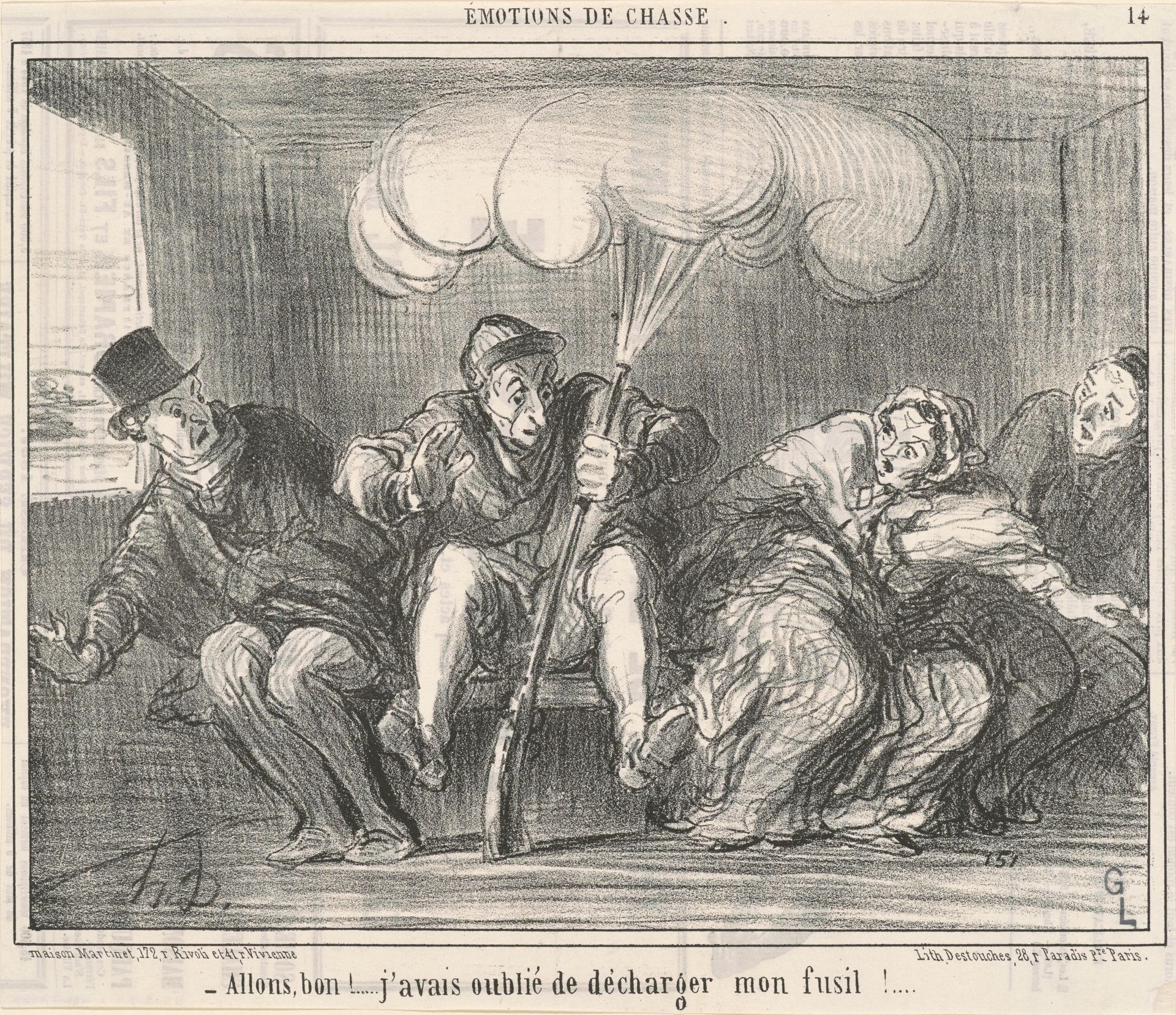
Honoré Daumier created this lithograph titled, "Allons Bon! J'avais oublié de décharger mon fusil!" in France, during a period of significant social change. Daumier, a master of social commentary, uses caricature to critique the bourgeoisie. Here, we see a hunting party traveling, presumably back to Paris. The central figure, a hunter, has accidentally discharged his rifle inside the train carriage. The reaction of his fellow passengers is one of comical horror. Daumier plays with the fear and anxiety of a rising middle class, gently mocking their pretensions and anxieties. His work appeared regularly in journals such as "Le Charivari," which were key sites for the development of a visual public sphere in nineteenth-century France. These journals were responding to the liberalization of the press and the growth of a mass reading public. To fully appreciate Daumier's work, one needs to consider the social and political context of his time. A dive into the archives of "Le Charivari" and other journals, alongside studies of French social history, are crucial for understanding the nuances of his satire.
Allons Bon! J'avais oublié de décharger mon fusil!
c. 19th century


Artwork details
- Medium
- lithograph, print
- Copyright
- National Gallery of Art: CC0 1.0
Tags
lithograph
caricature
romanticism
genre-painting
realism
Comments
Be the first to share your thoughts about this work.
About this artwork
Honoré Daumier created this lithograph titled, "Allons Bon! J'avais oublié de décharger mon fusil!" in France, during a period of significant social change. Daumier, a master of social commentary, uses caricature to critique the bourgeoisie. Here, we see a hunting party traveling, presumably back to Paris. The central figure, a hunter, has accidentally discharged his rifle inside the train carriage. The reaction of his fellow passengers is one of comical horror. Daumier plays with the fear and anxiety of a rising middle class, gently mocking their pretensions and anxieties. His work appeared regularly in journals such as "Le Charivari," which were key sites for the development of a visual public sphere in nineteenth-century France. These journals were responding to the liberalization of the press and the growth of a mass reading public. To fully appreciate Daumier's work, one needs to consider the social and political context of his time. A dive into the archives of "Le Charivari" and other journals, alongside studies of French social history, are crucial for understanding the nuances of his satire.
Comments
Be the first to share your thoughts about this work.