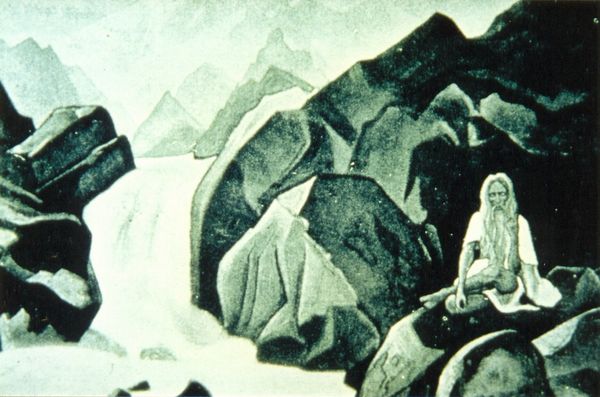
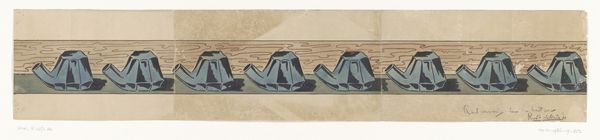
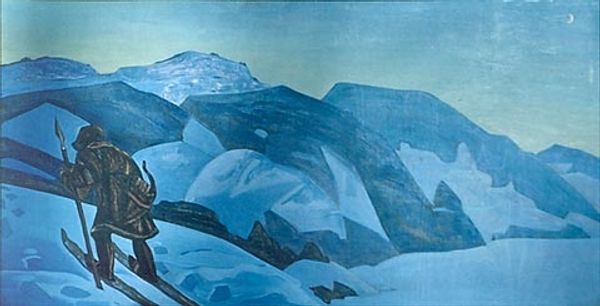
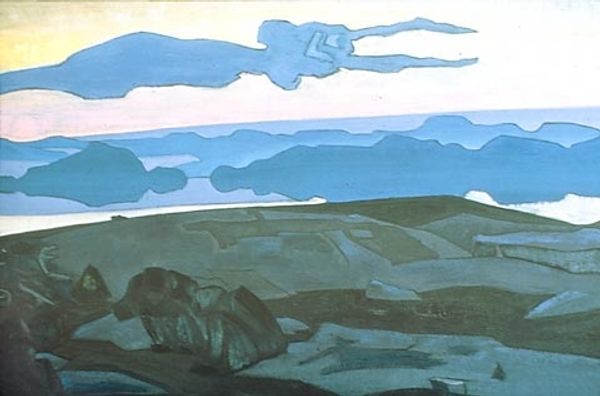
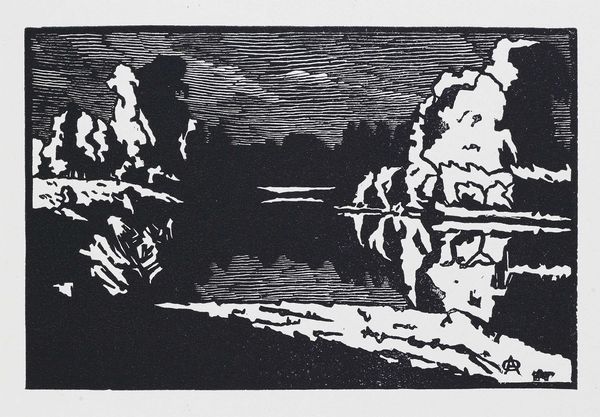
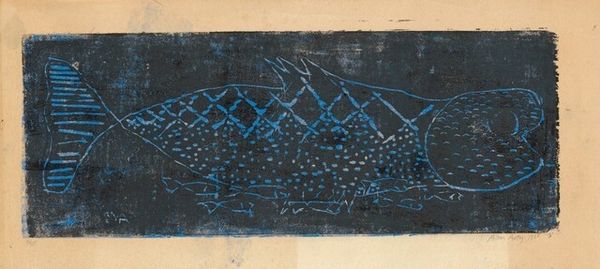
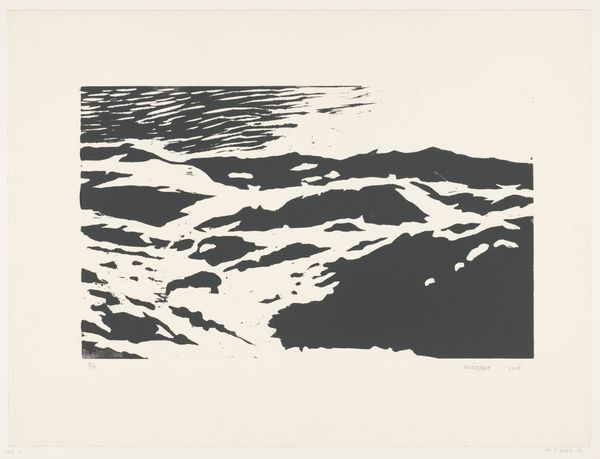
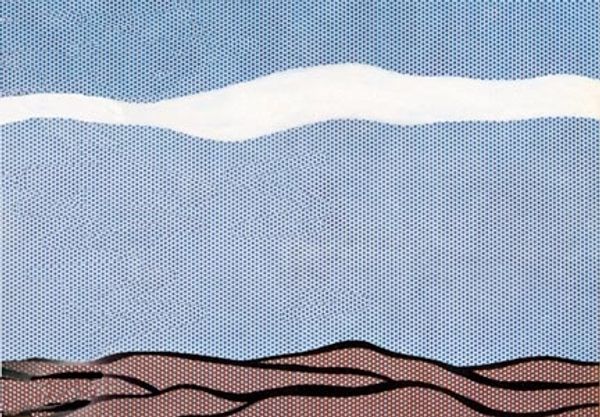
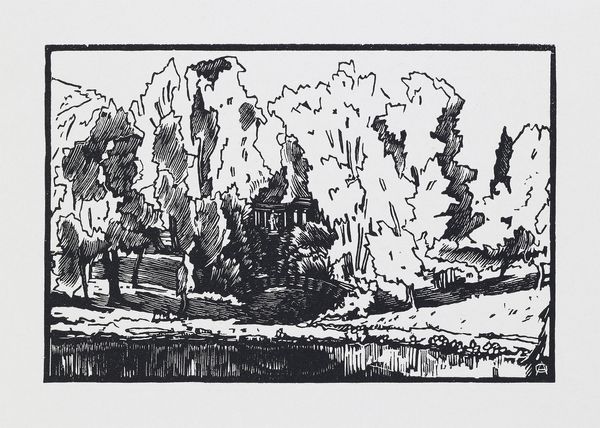
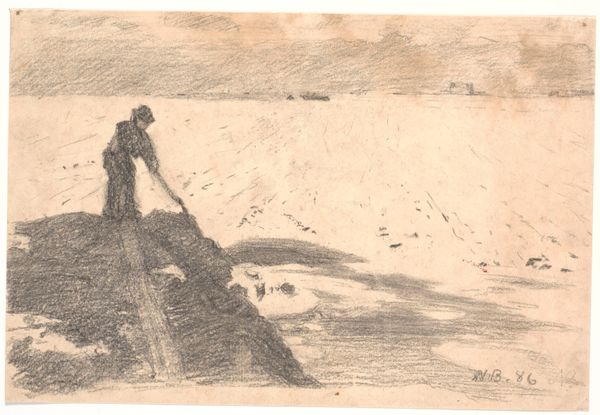
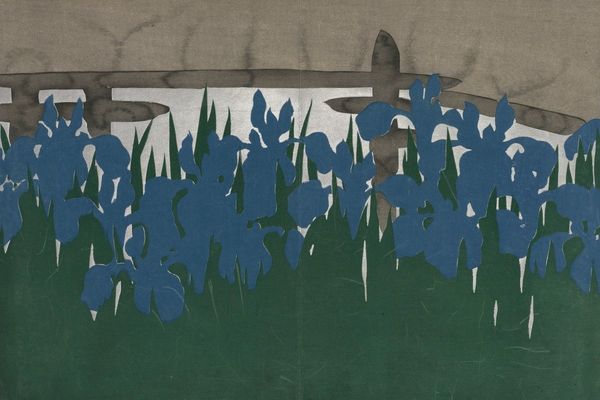
Illustration to the collection of poems by M. Bazhan 'Legacy' 1978

hryhoriihavrylenko
Private Collection
graphic-art, print
graphic-art
landscape
figuration
watercolour illustration
monochrome
Copyright: Hryhorii Havrylenko,Fair Use
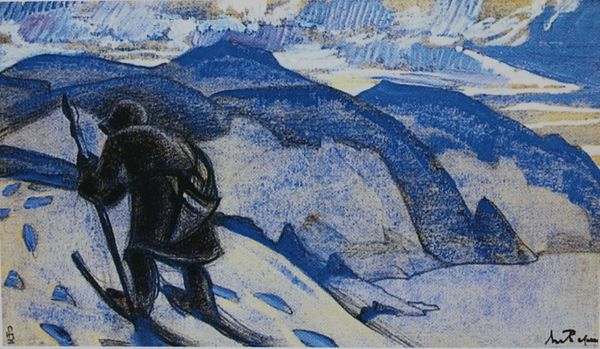
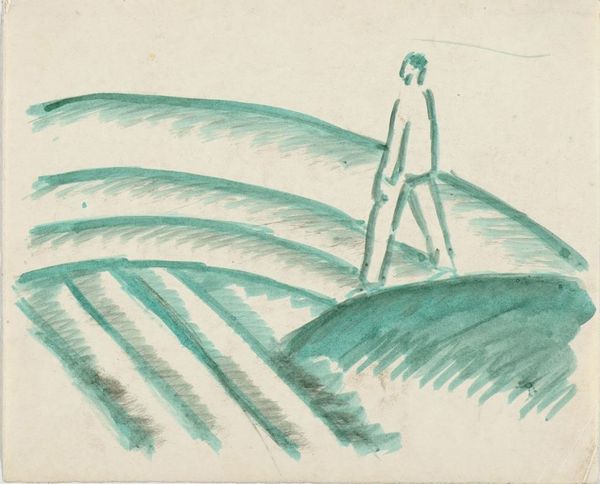
Curator: This striking print, dating from 1978, is entitled "Illustration to the collection of poems by M. Bazhan 'Legacy'" by Hryhorii Havrylenko. Editor: The limited palette of whites, blues, and grays really sets a somber, contemplative mood, wouldn't you agree? There’s almost a folk-art simplicity to the graphic style, and a real tension in how flat shapes construct form. Curator: Indeed, the simplicity is deceptive. The relationship between positive and negative space creates the dimensionality. Consider how the monochrome medium elevates the material texture of the graphic-art—especially if this piece involved any innovative, time-saving or accessible modes of production for the artist. Editor: I am struck by the central figure – perhaps a traveler or pilgrim—with his staff. There is a loneliness here, emphasized by the landscape—or what we can discern of it through these flat fields of tone. It's intriguing, isn't it, how this rendering makes such deliberate use of stark reduction? It could point towards artistic constraints but is ultimately effective! Curator: It evokes a certain historical gravitas. I would suggest the staff symbolizes guidance. Note that his walking stick intersects his silhouette at almost a perfect right angle. If that form is the intention it adds structural solidity, wouldn't you say? Editor: Very true! Now, it prompts one to think: what manual processes were employed to produce the various tonal densities that compose that monochromatic ground? Also, what would insight into the publication details of this poem reveal to us about readership at that particular point? Curator: A pertinent point. The material conditions of production would inevitably constrain the aesthetic outcome, but I feel like there's also something deliberately pared-down about the forms; it transcends its apparent technical limitations. Editor: Well, for me, that's what keeps drawing me back: the connection to the materiality of the print-making itself, the artist’s studio, and perhaps broader access afforded to print-making—the labour involved in these various graphic-art practices. It also underscores the thematic element within the selected poem for which it provides and insight. Curator: A vital reminder of art's rootedness in specific conditions, then. It shifts us from merely observing form and symbol to accounting for how such things materialize from, and in turn shape, our world. Editor: And on that note, perhaps the illustration speaks to us not just of individual legacy but about the tangible legacy of the making of art.
Comments
No comments
Be the first to comment and join the conversation on the ultimate creative platform.
 React
React Comment