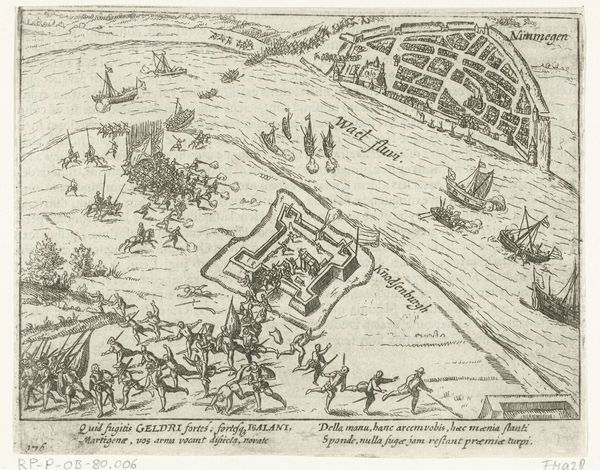
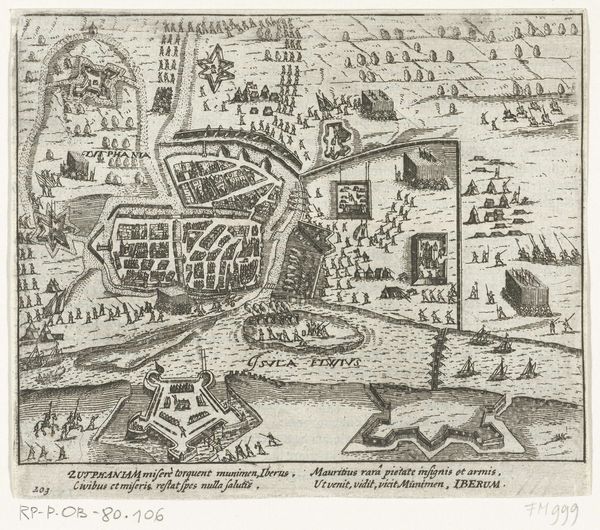
print, etching, engraving
baroque
etching
landscape
river
geometric
engraving
Dimensions: height 157 mm, width 245 mm
Copyright: Rijks Museum: Open Domain
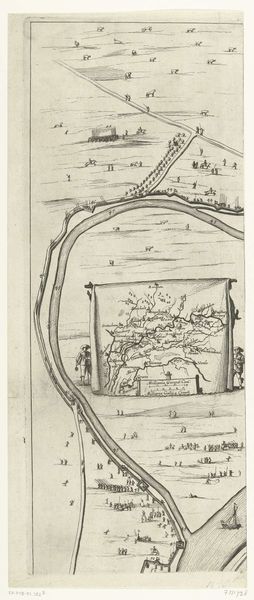
Curator: Well, isn't this something? At first glance, it gives me the impression of a meticulously planned excavation site. Like a futuristic city rendered with the rudimentary tools of the past. Editor: Indeed. What strikes me most is its calculated linearity, the austere geometry of the river's imposed bend. Here, we are looking at "Omleggen van een bocht van een rivier," which translates to something like "Realigning a bend of a river," likely etched sometime between 1677 and 1696, created by an anonymous artist. The etching captures a fascinating attempt to alter nature itself. Curator: Oh, that rings true. It's a dance, isn't it? Humanity wrestling with the landscape. A statement of intent almost declaring "Nature, I shall bend you to my will!" in a kind of dramatic flair. Does it look as permanent as it's meant to be? Not at all... Maybe I should visit and see if it remained? Editor: Possibly. It certainly raises complex questions about our relationship with the environment. From a formalist perspective, notice the intricate cross-hatching. It establishes depth and mass, almost arguing about our perceived mastery of our own reality. Curator: Yes, a statement carved onto a copper plate for centuries later, the Baroque boldness is certainly undeniable in how the land and water intertwine as though molded by human hands rather than a natural occurrence! Editor: Perhaps it represents an attempt to rationalize, to control the inherently chaotic force of nature through the tools of artistic representation and engineering prowess, but now as an etching it may remind you more about human desires. The inscription reinforces this, noting how the altered path has solved a pre existing state of ruin. Curator: I do enjoy how the landscape almost looks defeated—or simply yielding, which is so, so dramatic in a silent, humble image. But after dissecting all its little dark lines and seeing beyond the print, its story suddenly makes perfect, simple sense. Editor: Indeed. I suspect you are already imagining new exciting possibilities when viewing something beyond any traditional or expected aesthetic response, allowing for deep reflections.
Comments
No comments
Be the first to comment and join the conversation on the ultimate creative platform.
 React
React Comment