

1925 - 1926
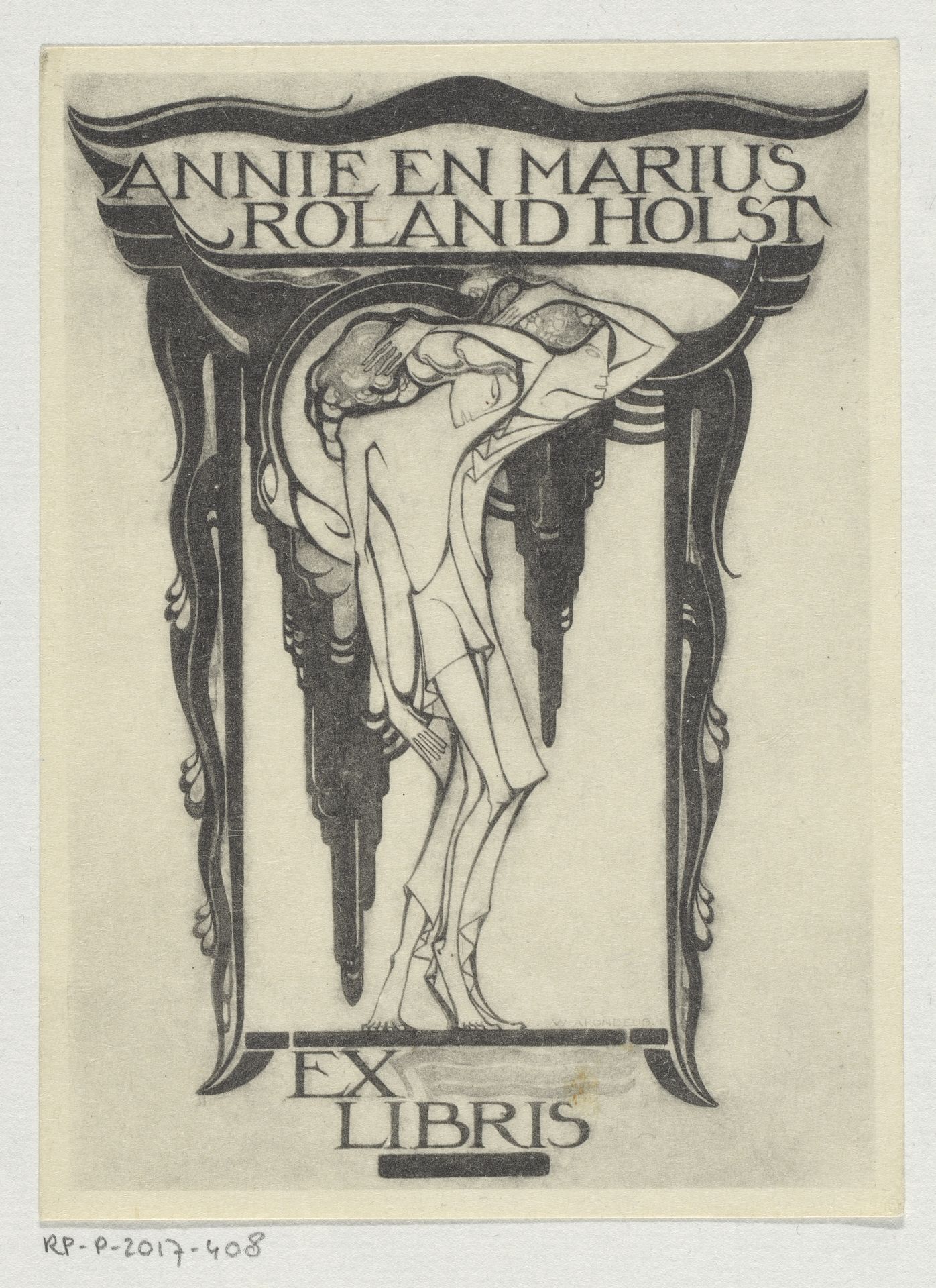
Ex libris van Annie en Marius Roland Holst

Willem Arondéus
1894 - 1943Location
RijksmuseumListen to curator's interpretation
Curatorial notes
Editor: This is a bookplate designed by Willem Arondéus around 1925 or 1926 for Annie and Marius Roland Holst. It’s an ink drawing, very much in the Art Nouveau style. The figures look trapped within the frame... What do you see in this piece? Curator: What immediately strikes me is the overt symbolism in this seemingly simple bookplate. Beyond its aesthetic Art Nouveau appeal, the work offers a fascinating look into the intellectual and political climate of the early 20th century. It’s difficult to ignore the strong socialist convictions of Annie and Marius Roland Holst and how that could be embedded here. Editor: So the Roland Holsts' politics influenced the design? Curator: Precisely. Consider the burdened figures. They could be interpreted as representations of the working class, crushed under the weight of societal expectations or perhaps even capitalism itself. Arondéus, openly homosexual, often embedded coded messages related to identity and societal constraints into his works. Can we then consider how his personal experiences could be reflected in the figures? How the Holsts' identities informed their patronage? Editor: That's a compelling point. I hadn't considered that Arondéus’s personal identity might be woven into the piece alongside the Holsts' political leanings. Curator: It encourages us to look beyond face value, doesn’t it? We see how art can function as a subtle form of activism, reflecting and commenting on social and political realities. Editor: I definitely have a richer understanding now, seeing it less as a simple bookplate and more as a statement about the struggles of the human condition and the socio-political context it comes from. Curator: Indeed. This "Ex Libris" offers an invitation to continually question what is seen and unseen and whose stories are reflected, framed, and, importantly, excluded.